

Note on terminology: Throughout this article, “compression socks” refers to the product category as a whole. If you’re looking for the difference between socks and stockings as length terms, see our Socks vs Stockings Guide. If you’re comparing compression socks and compression stockings as different product grades for sourcing, see our Buyer’s Guide to Compression Socks vs Compression Stockings.
Introduction
Most people assume compression socks are just “tighter regular socks.” That assumption costs brands real money — wrong material specs, wrong machines, wrong certifications, and at the end, a product that fails its mmHg test.
The truth: regular socks and compression socks share almost nothing beyond the basic shape. They use different yarns at different ratios, run on different knitting machines, and are tested against entirely different standards. The visible difference is small. The structural difference is everything.
This article walks through the five measurable differences — function, material, length, design, and production — that separate the two categories. We’ve manufactured both for over 10 years, supplying brands across Europe and North America, and the questions our clients ask in their first inquiry are almost always the same. This is the answer we wish every new buyer had read first.
Who this is for: wearers deciding whether they need compression socks, brand owners scoping a new product line, and procurement teams preparing an RFQ.
The 5 Differences at a Glance
| Aspect | Regular Socks | Compression Socks |
| Primary function | Comfort, warmth, moisture-wicking | Graduated pressure for blood circulation |
| Elastic content | 5–10% spandex | 30–50% Lycra/spandex |
| Length | Ankle to thigh-high (mostly low-cut to crew) | Mostly knee-high or thigh-high |
| Pressure rating | None | 8–15 / 15–20 / 20–30 / 30–40 mmHg |
| Knitting machine | Standard circular | Standard circular or medical-grade (e.g., Merz) |
| Design freedom | Unlimited | Unlimited for daily-grade; plain colors for medical-grade |
Function — What Compression Socks Actually Do
The single defining feature of a compression sock is graduated pressure. The fabric applies the highest pressure at the ankle and gradually loosens up the calf, pushing venous blood back toward the heart. Regular socks apply uniform — and usually low — pressure, which keeps them on your foot but does nothing for circulation.
Pressure is measured in mmHg (millimeters of mercury), the same unit used for blood pressure. The four standard grades:
- 8–15 mmHg — Mild. For everyday comfort, mild leg fatigue, light travel.
- 15–20 mmHg — Moderate. For people who stand or sit for long periods: nurses, teachers, pregnant women, frequent flyers.
- 20–30 mmHg — Firm. For athletic recovery, mild varicose veins, post-surgical edema. The crossover between consumer and medical use.
- 30–40 mmHg — Medical-grade. Prescription only. For chronic venous insufficiency, post-DVT management, severe edema.
A common misunderstanding we see in the market: many “sports compression socks” sold online claim a compression function but have never been tested on a pressure measurement device. They are simply tight. Without a verified mmHg curve, “compression” is a marketing word, not a product specification. According to the Cleveland Clinic, the therapeutic effect of compression depends on the pressure being graduated — uniform tightness can actually impede circulation rather than help it.
If you’re sourcing for a specific end-user group, we’ve published dedicated solution pages for maternity, nurses and healthcare workers, sports and recovery, and travel and flight — each with the recommended mmHg level, knit structure, and materials for that use case.
Material — Why Compression Socks Need 20–50% Lycra
Every sock is built from three yarn components: the main yarn (the body of the sock), the jacquard yarn (the pattern threads), and the elastic fiber (spandex or Lycra®). The ratio between these three is what fundamentally separates a regular sock from a compression sock.
Regular socks use cotton, bamboo, wool, polyester, or silk as the main yarn, depending on what the product is for. Cotton and bamboo for breathability and skin comfort. Wool for insulation. Silk for lightweight summer hosiery. Spandex content typically sits between 5% and 10% — enough to keep the sock on your foot, not enough to apply meaningful pressure.
Compression socks are different. The main yarn is almost always nylon or polyester, because these fibers can be knitted under high tension without breaking and they pair cleanly with high-percentage elastic. The elastic content is the critical number: 20% to 50% of the sock’s composition is Lycra or spandex. That ratio is what physically creates the graduated pressure. Without it, the sock cannot hold a measured mmHg curve.
We’ve tested our own compression stockings on our in-house equipment — the test result below shows 47% nylon, with elastic content close to that figure. The exact composition shifts slightly with each design (full patterns require different ratios than plain knits), but the order of magnitude is consistent. This is the structural difference between the two product categories, and it’s why a regular sock — no matter how tight — cannot be relabeled as a compression sock.
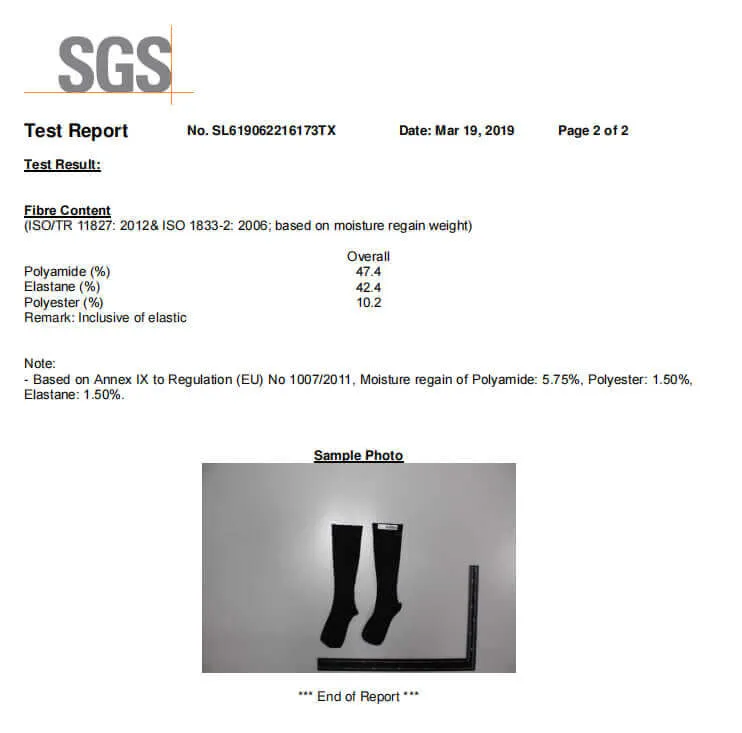
The elastic we use is DuPont Lycra®, which has roughly 10× the recovery of standard spandex and lets brands carry the Lycra® mark on their packaging — a recognized quality cue in retail. Different elastic grades create meaningful differences in price, durability, and how long the sock holds its compression curve over wear cycles.
For a deeper breakdown of yarn types, recycled-fiber options, and how to write material specs into your RFQ, see our guide to compression sock composition.
For brands: the high Lycra ratio is the primary reason compression socks cannot be quoted using regular sock pricing logic. The elastic alone often costs more per kilogram than the structural yarn.
Length — Why Compression Socks Are Mostly Knee-High
Sock length runs across a spectrum: invisible (no-show), ankle, crew, mid-calf, knee-high, and thigh-high. Regular socks are produced across the full range, with low-cut and crew styles dominating the market.
Compression socks cluster at the upper end of the spectrum — almost always knee-high, sometimes thigh-high. The reason is anatomical: the calf muscle is the primary pump for venous return in the lower leg. A compression sock has to cover the calf to do its job. An ankle-length compression sock would compress the wrong area and provide no circulatory benefit.
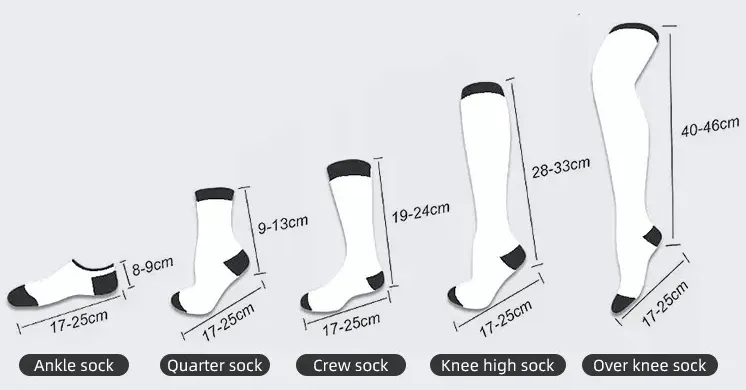
The split between knee-high and thigh-high is mostly clinical:
- Knee-high is the standard for daily wear, sports, travel, and most workplace use cases. Roughly 90% of compression socks sold globally are knee-high.
- Thigh-high is used for post-surgical recovery, severe venous insufficiency, or specific medical protocols where the femoral vein needs support. These are typically prescribed.
Both lengths can prevent DVT and reduce swelling. The choice is driven by the location of symptoms and patient comfort, not by effectiveness alone.
If the words socks and stockings feel interchangeable when you’re reading product listings, that’s because in compression specifically, they often are — but the broader terminology has a separate logic. We’ve broken that down in our Socks vs Stockings Guide.
Design — What You Can and Can’t Customize
This is the question we get most often during product development calls: can my compression sock have a full pattern? The answer depends entirely on the mmHg level.
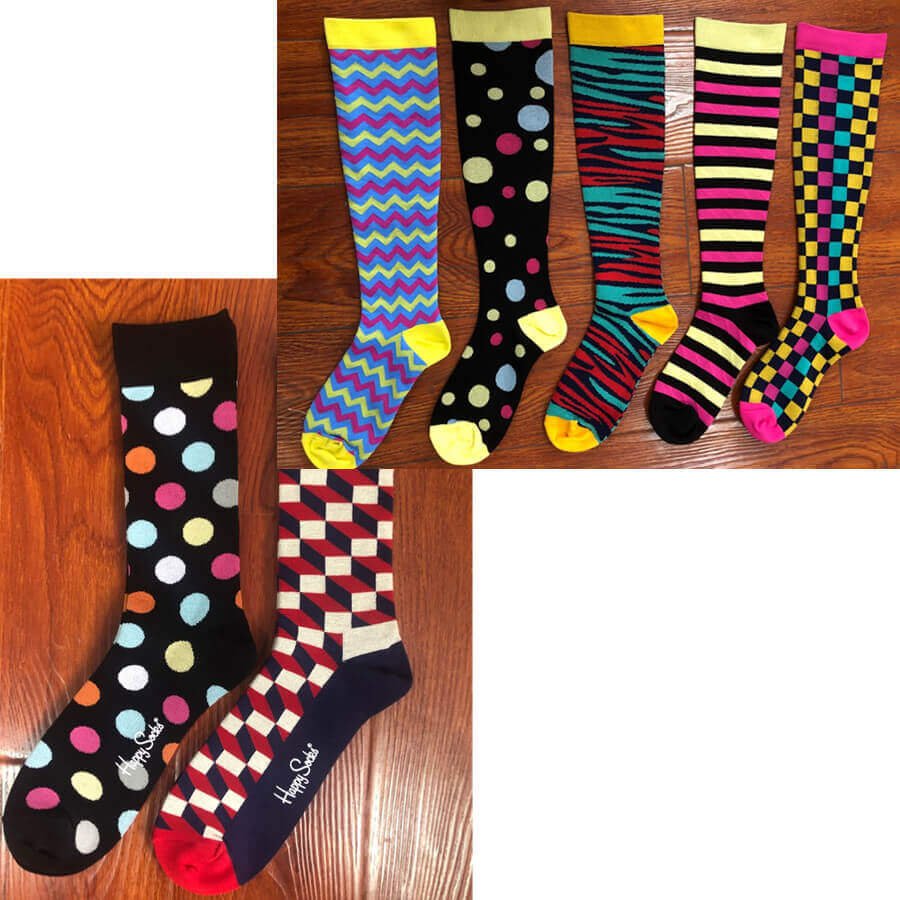
Daily-grade compression socks (8–15 and 15–20 mmHg) can be designed with the same freedom as regular socks: jacquard patterns, all-over prints, tie-dye, embroidered logos. The structural elastic is high enough to absorb the small inconsistencies that patterns introduce without losing pressure.
Medical-grade compression socks (20–30 mmHg and above) are different. Around 99% of medical-grade products on the market are produced in plain colors — beige, black, nude, navy. The reason is the machinery itself: medical compression socks are knitted on specialized imported circular machines such as MERZ and LONATI, which are built for pressure accuracy and yarn tension control, not pattern complexity. These machines cannot run complex jacquard designs — the maximum is a basic 2-color pattern like dots or simple stripes.
For brands: the design constraint maps directly onto your brand positioning.
- Building a fashion or lifestyle compression brand → daily-grade only, full design freedom, mmHg cap at 15–20.
- Building a wellness or sports recovery brand → 15–20 or 20–30 mmHg, partial design freedom, simpler patterns recommended.
- Building a medical brand → expect plain colors and accept that as part of the category’s visual language.
This trade-off needs to be locked down before product development starts, not after sampling.
Production Machines & Certification
The machine that makes a sock is invisible to the wearer but critical to the buyer’s due diligence. Two factories quoting the same product from different machine bases will deliver very different products.
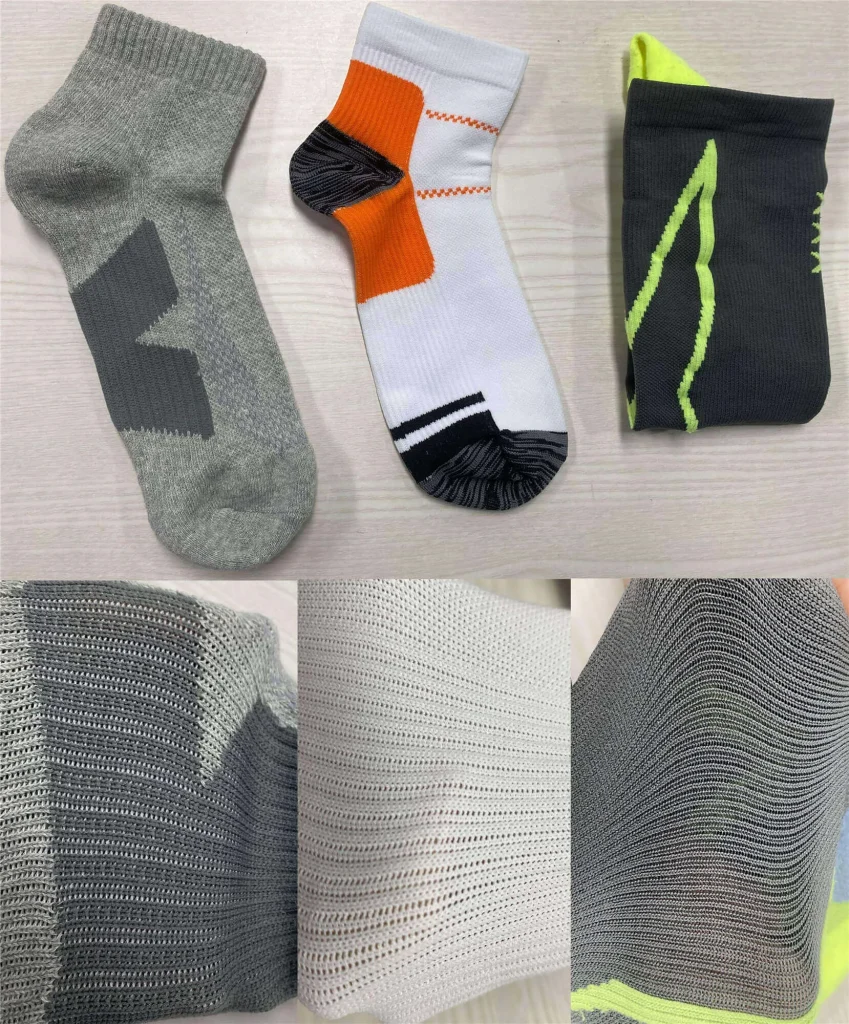
Daily-grade compression socks are produced on standard circular knitting machines that produce sports socks and dress socks, configured for higher elastic tension. Production speed is fast, MOQ is reasonable, design freedom is high.
Medical-grade compression socks require specialized medical knitting machines that allow precise control over the graduated pressure curve, automated tension adjustment, and digital quality monitoring. We use Merz or Lonati machines imported from Germany for our medical-grade production. These machines cost roughly 10–20× as much as standard circular machines, run slower, and require trained operators — which is why medical compression has a higher unit price and longer lead times across the industry.
Needle count is the other variable that affects the final product. Standard counts are 144, 168, 200, and 220 needles. Higher needle counts produce a finer, smoother, more elastic fabric — at higher cost. We run 30 high-needle-count machines specifically for extra-wide-calf compression socks, a category where US demand has grown sharply over the last two years.
Pressure testing. Every batch of our medical-grade product is tested on a Swisslastic MSTMK V compression measurement system, imported from Switzerland — currently one of the most precise mmHg verification instruments available. Below is a sample test report and the testing setup.
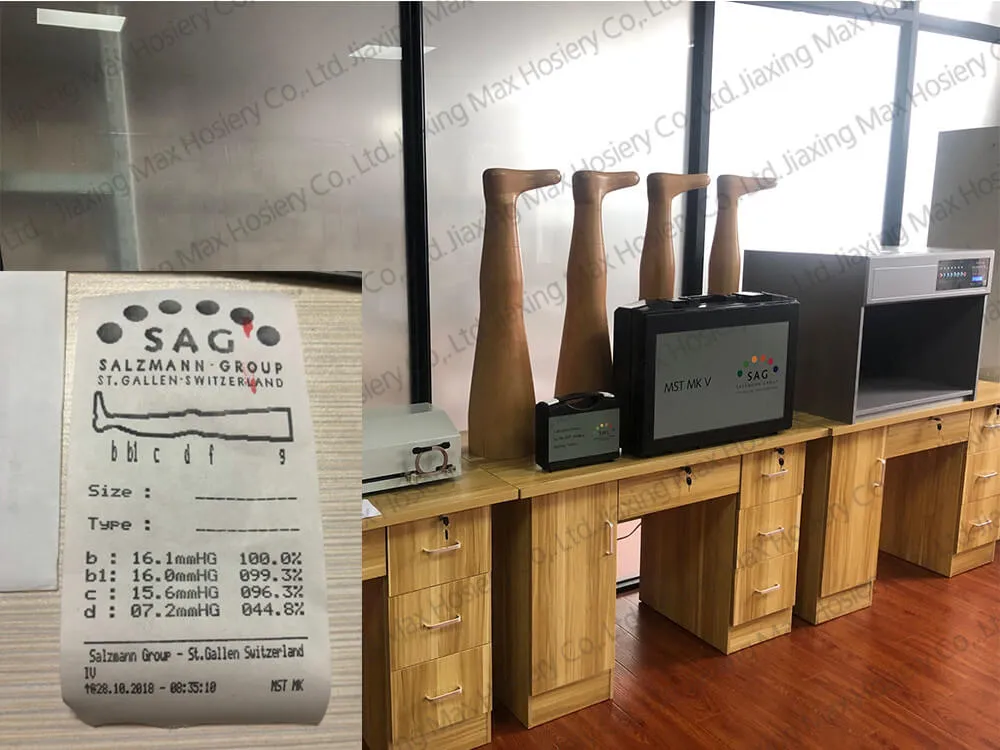
A note on reading test results: the mmHg figure on the report is the pressure at the ankle (B point) — that is the 100% reference. Pressure decreases progressively up the leg, typically to 50–80% at the calf and 20–50% at the upper portion. A test that reads “7–16 mmHg at multiple points” is not a 7–16 mmHg sock — the ankle reading is the rated value, and you’d verify it as a 15–20 mmHg product.
Certifications. Our factory holds US Class I FDA registration and ISO 13485 certification for medical device quality management. This is the standard pairing required for selling medical compression socks into US clinics, pharmacies, and DTC medical channels. We do not currently hold EU MDR certification — buyers selling into the EU medical channel should confirm that requirement separately.
Free service for buyers: we provide in-house mmHg testing for all sample orders at no charge. The equivalent third-party test from SGS, Intertek, or TÜV typically runs USD 200–300 per design.
When to Choose Which — Decision Framework
For wearers:
- Mostly seated or standing, mild discomfort → 8–15 mmHg
- Pregnant, long-haul flights, long shifts on your feet → 15–20 mmHg
- Athletic recovery, mild varicose veins → 20–30 mmHg
- Diagnosed venous condition or post-surgical → follow your physician’s prescription, usually 20–30 or 30–40 mmHg
For brands:
- Fashion or lifestyle compression line → daily-grade, 15–20 mmHg cap, full design freedom, standard circular machines
- Wellness or sports recovery line → 15–20 or 20–30 mmHg, partial design freedom, ISO 13485 not strictly required but recommended
- Medical brand or clinic supply → 20–30 mmHg and above, plain colors, medical-grade machines required, ISO 13485 + FDA registration mandatory for US market
For help mapping your end-customer profile to the right mmHg level, see our compression level selection guide. If you’re specifically weighing compression socks vs medical compression stockings as separate SKUs in your catalog, see our Buyer’s Guide.
For Brands & Buyers — What to Spec When Sourcing
The questions below should be on every RFQ for compression socks. If a supplier cannot answer them clearly, that is itself an answer.
- mmHg level + the full graduated pressure curve — not just one number, but the curve from ankle to upper leg
- Lycra/spandex percentage and whether DuPont Lycra® is used (affects packaging claims)
- Knitting machine type — standard circular, Lonati, Merz, or other medical-grade
- Needle count — 144 / 168 / 200 / 220, and matched to your design complexity
- Certifications held — ISO 13485, FDA registration, EU MDR (if applicable)
- In-house mmHg testing capability and which equipment is used
- Design constraints at your target mmHg level — what patterns are achievable
- MOQ, lead time, and sample policy
Want a free mmHg test report for your reference design? Send us a sample of the product you’re benchmarking, and we’ll include a Swisslastic MST MK V test report with your sample shipment. Request a sample →
FAQ
What’s the main difference between compression socks and regular socks?
Compression socks apply graduated pressure — measured in mmHg — from the ankle upward to support blood circulation. Regular socks provide comfort, warmth, and moisture management without targeted pressure. The structural difference is in the elastic content: compression socks contain 30–50% Lycra/spandex, compared to 5–10% in regular socks.
How is compression measured?
Compression is measured in millimeters of mercury (mmHg). The four standard grades are 8–15 mmHg (mild daily wear), 15–20 mmHg (moderate, for long standing or sitting), 20–30 mmHg (firm, for athletes and mild medical use), and 30–40 mmHg (medical-grade, prescription only).
Are tight regular socks the same as compression socks?
No. Tight regular socks apply uniform pressure that can actually restrict circulation. True compression socks apply graduated pressure — tightest at the ankle and decreasing up the leg — verified through professional testing equipment such as the Swisslastic MST MK V.
Can compression socks be made with full patterns or designs?
Daily-grade compression socks (8–15 and 15–20 mmHg) can have full patterns, jacquard designs, or printing without significant compression loss. Medical-grade socks (20–30 mmHg and above) are typically produced in plain colors because patterns affect pressure consistency.
Why do compression socks cost more than regular socks?
Three main reasons: (1) high Lycra/spandex content (20–50% vs 5–10%), (2) specialized knitting machines for medical grades — Merz machines cost 10–20× more than standard circular machines, and (3) compulsory pressure testing and medical certifications.
What’s the difference between compression socks and compression running socks?
Both apply graduated pressure, but compression running socks are typically engineered with additional moisture-wicking yarns, targeted padding at the heel and arch, and a denser knit at high-impact zones. The mmHg level is usually 15–20 or 20–30, optimized for athletic recovery rather than medical treatment.
Can I wear compression socks every day?
Yes — 8–15 and 15–20 mmHg compression socks are designed for daily wear. They are commonly used by nurses, teachers, pregnant women, frequent travelers, and people with sedentary jobs. Higher levels (20–30 mmHg and above) should be used under medical guidance.