

If you are a brand owner, retailer, or procurement manager researching compression socks for your product line, the question “which compression level should we use?” is harder than it looks. Most articles answer from the consumer’s perspective: which mmHg should I wear? That logic does not transfer cleanly to sourcing decisions.
For brands and distributors, compression level is not a single-purchase choice — it is a SKU mix decision that affects inventory turnover, channel strategy, retail price positioning, and product differentiation. Picking wrong here can lock 6-12 months of working capital into stock that does not move.
This guide is built for that decision. We will walk through what each compression level actually means in retail terms, which end-markets each level serves, how to build a SKU mix matched to your channel, and what to verify before placing your OEM order.
Scope of this guide
This article covers regular round-knit compression socks sold through retail, e-commerce, sports, and wellness channels — the mainstream OEM compression market.
Medical compression stockings (flat-knit, prescription-channel, or RAL-certified products) and anti-embolism (TED) stockings have substantially different sourcing logic, regulatory requirements, and distribution channels. If your project falls into those categories, see our custom medical compression stockings page instead.
Compression Sock Levels at a Glance
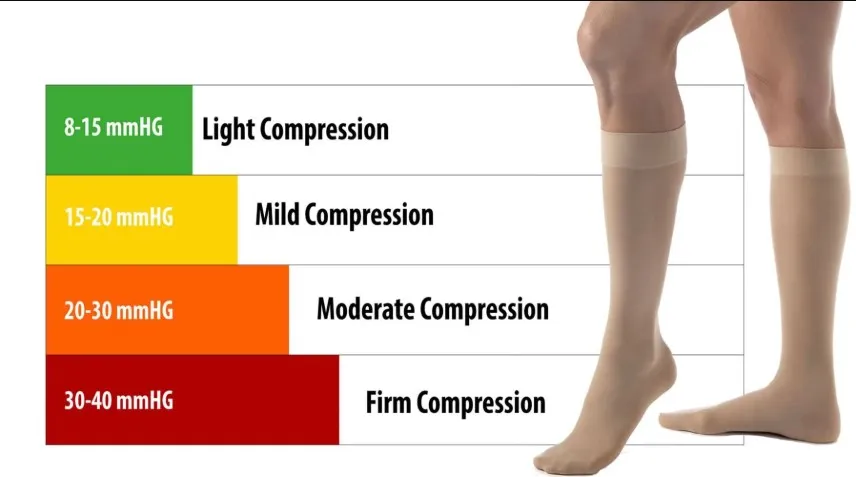
The four standard compression ranges, with the retail-relevant context for each:
| Level | mmHg Range | Primary End-Use | Prescription | In Scope of This Guide |
| — | 8-15 | Travel, mild swelling, gifting, light wellness | No | ✓ Covered below |
| Class II | 15-20 | Daily wear, healthcare workers, pregnancy, light recovery | No | ✓ Covered below |
| Class III | 20-30 | Varicose vein OTC, sports recovery, advanced retail | No (varies by region) | ✓ Covered below |
| Class IV | 30-40 | Severe medical conditions, post-surgical, lymphedema | Yes (most markets) | → See section below |
Quick orientation for consumers: If you are an individual trying to choose a level for personal use, this guide is not the right starting point. Try our consumer-facing articles instead: 15-20 vs 20–30 mmHg comparison or what 15–20 mmHg actually means.
Why Compression Levels Matter More to Retailers Than to Wearers

For a consumer, picking the wrong compression level means one uncomfortable pair of socks. Annoying, but recoverable.
For a brand or retailer, picking the wrong level means inventory that doesn’t sell, returns that erode margin, marketing claims that don’t substantiate, and channels that won’t accept your product. The cost is structural, not personal.
Three things make this decision particularly consequential when you are sourcing:
SKU concentration risk. A single-level lineup is faster to launch but exposes the brand entirely to one demand pattern. If consumer preference shifts (e.g., a 15–20 mmHg category becomes saturated on a marketplace), the brand has nothing to fall back on.
Channel-level fit. Each retail channel has an implicit compression-level expectation. Pharmacies expect medical-adjacent levels with stronger documentation. Sports retailers expect 20–30 mmHg with athletic positioning. General wellness e-commerce expects 15–20 mmHg with comfort claims. A mismatch shows up as low sell-through, not as an obvious failure.
Regulatory and labeling consequences. What you can claim on packaging depends on the compression level you sell. The higher the level, the tighter the rules on therapeutic language. Brands sometimes discover this only after their first shipment is held at customs or flagged by a marketplace.
The rest of this guide is organized to help you make this decision deliberately, not by default.
Compression Levels and Their End-Markets
This section covers what each level is, who it is for, and which kinds of brands typically build product lines around it. We will reference our own factory order distribution where useful, with appropriate context.
A note on the data referenced in this section
We will share our factory’s order distribution by compression level. These percentages reflect orders from our customer base — predominantly mid-to-premium retail brands serving Western markets. They are not industry-wide statistics.
A factory primarily serving low-cost marketplace sellers would likely show a different distribution, with 8-15 and 15–20 mmHg taking a larger share. We share these numbers as one reference point, not as a market forecast. Your sourcing decision should reflect your end-customer’s market, not our customer mix.
Which levels move fastest depends on your end market and where you sell — a travel accessory range and a clinic-adjacent range look nothing alike. We can talk through the mix for your specific channel.
| mmHg Level | Share of Our OEM Orders |
| 8–15 mmHg | 12% |
| 15–20 mmHg | 40% |
| 20–30 mmHg | 43% |
| 30–40 mmHg (medical, see separate guide) | 5% |
8–15 mmHg (Class I): Light Compression for Comfort and Travel
Who wears it. Long-haul flight passengers, road-trippers, first-trimester pregnancy comfort, mild end-of-day swelling, all-day standers wanting gentle support without therapeutic intent. The functional benefit is real but mild — these are wellness products, not problem-solvers.
Retail channels. Travel accessory sections, airport retail, hospitality and corporate gifting, general wellness e-commerce, gift-set inclusions. Less common as a standalone “hero SKU” — more often a complementary product within a broader line.
Pricing context. Lowest retail price band among compression levels. The category is volume-driven, not margin-driven, which is part of why it represents a smaller share of OEM orders — many cost-driven 8–15 mmHg buyers source ready-stock from trading companies rather than going through OEM development.
Product design considerations. Lighter compression means more flexibility in fashion design — pattern-heavy products, fashion colorways, novelty packaging all work well at this level. The functional claim is gentle enough that aesthetic differentiation often drives purchase as much as the compression itself.
Best fit for these brands:
- Travel accessory brands extending into wellness
- Gift and corporate-amenity suppliers
- Wellness brands using 8-15 as a “starter” SKU before introducing higher-level products
- Hospitality and airline retail
🔗 For brands focused specifically on the travel and flight market — including consumer pain points and packaging strategies — see our travel compression socks solution page.
15–20 mmHg (Class II): The Mainstream Daily-Wear Level
Who wears it. This is the most demographically diverse compression level. Three end-market segments dominate:
Healthcare professionals — nurses, doctors, dental hygienists, surgical techs, pharmacists, lab workers. Long-shift, on-feet professionals are one of the most reliable repeat-purchase segments in compression. Brands serving this group typically build their identity around shift-friendly designs, durability, and pattern variety.
🔗 For healthcare-focused sourcing, see our nurses compression socks market guide.
Pregnancy and postpartum — second and third trimester wear, postpartum recovery. Strong gift-set attach rate (baby shower products), stable year-round demand. Maternity compression at 15–20 mmHg often pairs with specialized fit features such as extended top bands or belly-accommodating cuts.
🔗 For maternity-specific market dynamics and product specifications, see our maternity compression socks solution page.
General wellness and light athletic recovery — desk professionals, occasional runners, post-flight recovery, fitness enthusiasts. The largest segment in raw consumer count, but the most fragmented across brands and the most price-competitive.
Retail channels. Broad presence across e-commerce marketplaces, DTC websites, pharmacies, healthcare uniform retailers, sports stores, and general wellness retail. Probably the easiest level to find shelf space for — and the hardest to differentiate within.
Pricing context. Wide retail price band, accommodating both entry-level brands and premium positioning. The breadth of the range is also why competition is fierce — there are price points and consumer segments to fit nearly any business model.
Product design considerations. This is where the broadest range of base materials becomes commercially viable: cotton-blend for skin comfort, bamboo for sustainability positioning, nylon-blend for durability, merino for premium outdoor-adjacent positioning. The choice should match your target consumer, not the compression level itself.
Best fit for these brands:
- First-time OEM projects looking for the broadest market acceptance
- Healthcare-uniform-adjacent brands
- Maternity and family wellness brands
- Comfort-led wellness brands using natural-fiber positioning
Caveat for new brands. Because 15–20 mmHg is the easiest entry point, it is also the most saturated. Launching here without a clear differentiation angle — specific end-user, specific functional claim, specific design language — usually leads to slow sell-through. Brands that succeed in this range tend to win on a clearly defined niche, not on being “another 15–20 mmHg sock.”
20–30 mmHg (Class III): Firm Compression for Functional Buyers
Who wears it. This level serves consumers with a more specific need:
- Varicose vein management and prevention (over-the-counter category in most markets)
- Athletic recovery and sports performance — runners, cyclists, CrossFit, weekend athletes
- Long-shift standing professionals with progressive symptoms (waitstaff, retail workers, nurses upgrading from 15-20)
- Post-flight and post-surgery (consumer-purchased, non-prescription) recovery scenarios
🔗 For sports-focused brands and athletic recovery positioning, see our sports compression socks solution page.
Retail channels. Sports retail (specialty running, cycling, CrossFit), pharmacy OTC compression sections, dedicated compression e-commerce brands, healthcare retail with consumer-direct lines. Marketplaces like Amazon also carry significant 20-30 volume, often positioned around varicose vein support or sports recovery.
Pricing context. This level supports a wider range of retail prices than people often assume — from value-oriented OTC products to premium sports recovery positioning. Margin within the regular (non-medical) compression range is not categorically higher at 20-30 than at 15-20. What changes is the positioning logic: 20–30 mmHg gives brands stronger functional claim language to support content marketing, athletic endorsement, and clinical-adjacent marketing — which can in turn justify higher customer acquisition cost in some channels.
Product design considerations. All standard base materials remain viable at this level — cotton, bamboo, nylon, polyester, merino blends are all production-feasible at 20–30 mmHg in regular compression construction. Material choice should match retail positioning and target consumer, not be constrained by the compression value. (More on this misconception in §5.)
Best fit for these brands:
- Sports and athletic recovery brands
- Varicose vein OTC retail brands
- Specialty compression brands targeting functional consumers
- Brands extending upward from a 15–20 mmHg base to add a “performance” or “advanced” SKU
30–40 mmHg (Class IV): Outside the Scope of This Guide
This level falls into the medical compression category. Manufacturing specifications, regulatory pathways, distribution channels, and consumer purchasing behavior all differ substantially from regular compression.
In our order book, 30–40 mmHg represents about 5% of compression production, and these orders come from established medical-supply customers — not from new retail brands.
If you are sourcing at this level, see our custom medical compression stockings page.
For everything else — 8-15, 15-20, and 20–30 mmHg — the rest of this article applies.
SKU Mix Recommendations by Channel
The right SKU mix depends on which channel you are selling into. The patterns below reflect common retail structures across the regular compression market — they are starting points for your own analysis, not rigid prescriptions.
| Channel | 8–15 mmHg | 15–20 mmHg | 20–30 mmHg | Strategic Rationale |
| DTC E-commerce (new brand launch) | 0% | 70% | 30% | Single-level launches risk saturation; pair an entry SKU with a “performance upgrade” path |
| Amazon FBA / Marketplace | 15% | 60% | 25% | 8-15 captures travel-season search volume; mainstream demand sits at 15-20 |
| Pharmacy / Healthcare Retail | 5% | 50% | 45% | Pharmacy customers expect functional claim language; 20-30 supports varicose vein positioning |
| Sports & Athletic Retail | 0% | 30% | 70% | Athletic buyers self-select into firmer compression for recovery claims |
| Travel & Wellness Gifting | 60% | 35% | 5% | Travel and gift markets favor lighter compression and aesthetic-led design |
| Maternity & Family Wellness | 10% | 80% | 10% | 15-20 dominates pregnancy demand; lighter SKUs serve early trimester and gift-set inclusion |
| Specialty Compression Brand | 0% | 40% | 60% | Specialist brands command premium positioning at firmer compression levels |
How to use this table. Identify the channel(s) closest to your launch plan, treat the percentages as a starting hypothesis, then adjust based on your specific positioning. A premium-only sports brand might push 20-30 to 90%; a value-focused marketplace seller might compress entirely into 15-20 to keep SKU complexity low.
The most common SKU-mix mistake we see in first-time OEM projects: launching with a single compression level and a single colorway. This minimizes upfront cost but eliminates the cross-sell paths that drive AOV (average order value) and repeat purchase rates over time. A two-level, three-colorway minimum is usually a healthier starting point even for cost-sensitive launches.
Compression Level vs Material Choice: A Common Misunderstanding
A question we often hear from first-time OEM buyers:
“If we want 20–30 mmHg compression, do we have to use nylon? Can we still position the brand around natural fibers like cotton or bamboo?”
Within the regular compression range covered in this guide (8-15 to 20–30 mmHg), the answer is yes, you can.
Cotton blends, bamboo blends, nylon blends, polyester blends, and merino blends are all production-feasible across these compression levels. The pressure value is achieved primarily through spandex content and knitting structure, not through restricting the base yarn. This is different from medical compression (30–40 mmHg and above), where higher elastic recovery requirements and longer wear cycles do start to narrow the material options.
What material choice actually decides is something else entirely:
- Hand-feel and skin contact experience
- Breathability and moisture handling
- Retail price band (cotton and bamboo cost more than polyester; merino significantly more)
- Sustainability and natural-fiber marketing claims
- Which end-consumer demographic identifies with your brand
A cotton-blend 20–30 mmHg sock and a nylon-blend 20–30 mmHg sock can deliver identical compression performance — but they appeal to different buyers, support different price points, and tell different brand stories.
🔗 For how each base yarn affects product positioning, durability, and retail price band, see our compression sock material sourcing guide.
🔗 For the underlying composition ratios — including how spandex percentage is calculated, why a “100% cotton” compression sock is mathematically impossible, and how jacquard yarn affects the final blend — see our compression sock composition breakdown.
Compliance Considerations for Regular Compression
Regulatory requirements scale with the compression level and the marketing claims attached to the product. For regular compression sold through retail and e-commerce in the US market — the most common scenario for our OEM customers — the relevant points are:
Classification follows your claims, not the factory. How a regular compression sock is classified in the US depends on the claims you make in your own listing, not on the factory. We hold FDA establishment registration and device listing (Reg. 3012251300); talk to your own regulatory advisor before writing marketing copy.
Marketing claim discipline. The line between “wellness” and “medical” claims is what determines regulatory exposure. Phrases like “treats varicose veins,” “prevents deep vein thrombosis,” or “for medical use” cross into medical-device territory regardless of the compression level. Brands can sell 20–30 mmHg socks as wellness or sports recovery products without medical regulatory burden — but only if their packaging, marketing, and product copy stay within wellness claim language.
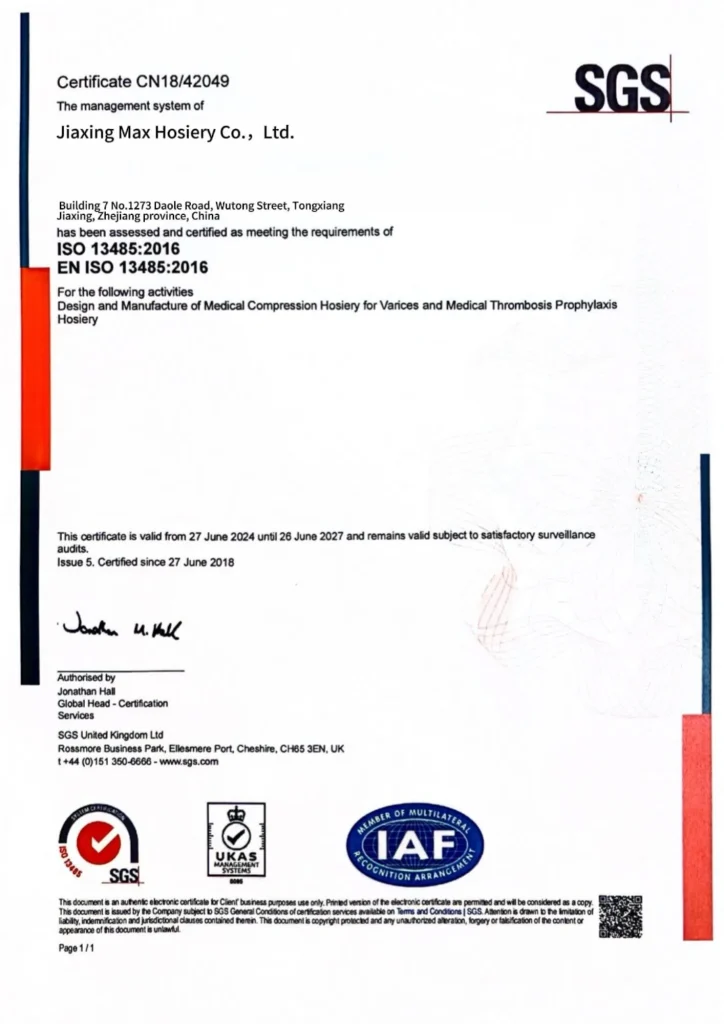
ISO 13485-certified manufacturing capability. Our facility is certified to ISO 13485:2016, the international quality management standard for medical device manufacturing. Most regular compression products do not legally require ISO 13485:2016 manufacturing — but for brand owners who want documentation rigor, traceability, and the option to extend their product line into medical compression later, sourcing from an ISO 13485:2016 certified facility is a meaningful advantage.
Other markets. Compliance requirements for the EU, UK, Canada, Australia, Japan, and other markets each have their own structures. Brand owners are responsible for verifying market-specific labeling and conformity assessment requirements for their target geographies. We provide manufacturing documentation to support our customers’ compliance work — but the regulatory submissions and market-entry filings are typically handled by the brand or its local distribution partner.
What to Verify Before Placing Your OEM Order
Compression accuracy is what separates a real compression sock from one that just “feels tight.” Before placing a production order, these are the verification points worth confirming with any manufacturer:
Pressure measurement methodology
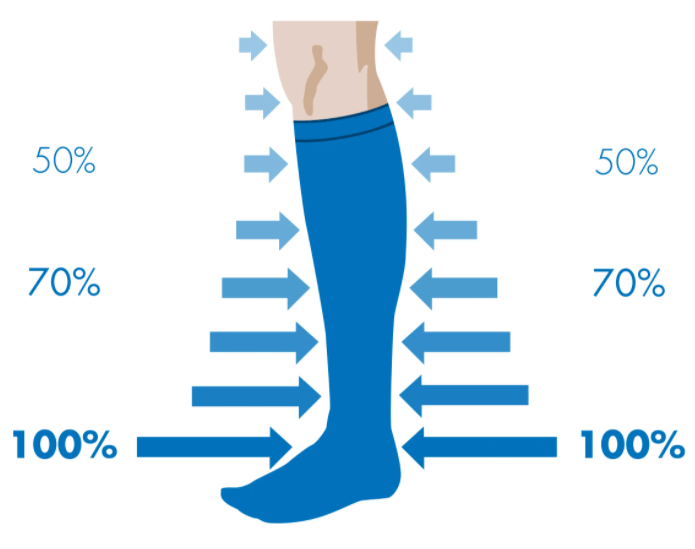
Compression in a finished sock is not a single value — it is a gradient distributed across the leg. Standard measurement protocols define multiple anatomical points (typically 14 zones from ankle to top band), with the highest pressure at the ankle gradually decreasing up the leg. A sock labeled “20–30 mmHg” should deliver approximately 20–30 mmHg at the ankle, with a smooth gradient transition above.
Ask your supplier to specify where on the sock the labeled pressure is measured, and how the gradient is verified. Manufacturers without dedicated pressure-testing capability often cannot answer this question precisely.
Per-batch testing on calibrated equipment
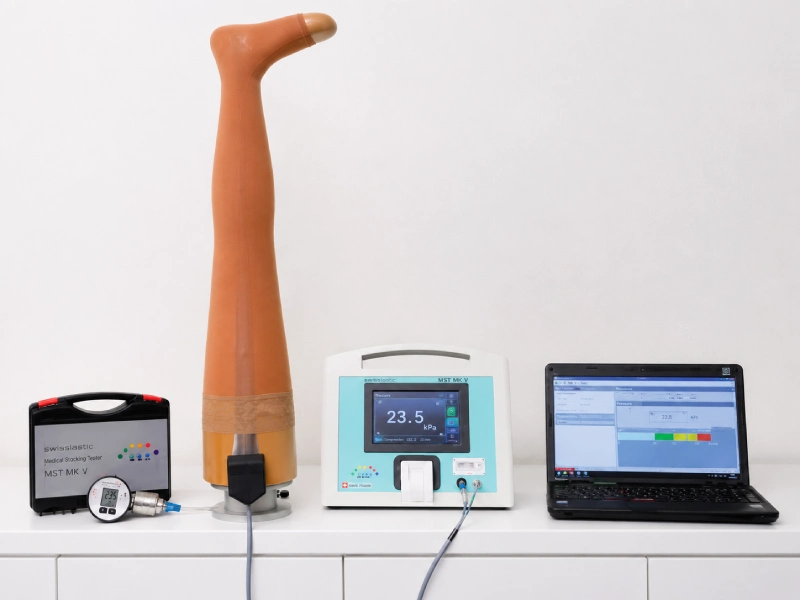
We test every production batch on Swisslastic MST MK V — Swiss-made medical stocking testing equipment that has become the de facto industry standard for compression hosiery quality control. Major medical compression brands worldwide use the same equipment for production testing.
We apply the same Swisslastic testing protocol to all compression levels in our production — 8-15, 15-20, and 20–30 mmHg are tested with equivalent rigor. Pressure verification is not something we reserve for “premium” orders.
Documentation and traceability
For brand owners who need it, we can provide:
- Per-batch pressure testing reports (gradient distribution at standard measurement zones)
- ISO 13485:2016 certificate (manufacturing quality system)
- FDA establishment registration (US market)
- Material composition declarations (for regulatory and labeling submissions)
- OEKO-TEX® Standard 100 or other applicable material certifications upon request
MOQ and lead time (uniform across compression levels)
A point worth clarifying: our minimum order quantity and production lead time are the same regardless of compression level. There is no MOQ premium or lead-time penalty for choosing 20-30 over 15-20, or for adding 8-15 as a secondary SKU. The cost and complexity differences between compression levels in regular construction are smaller than buyers often expect.
This matters for SKU mix planning: you can structure a multi-level launch without paying disproportionate setup costs on the lower-volume SKUs.
Sample-stage compression verification
For first-time OEM projects, we strongly recommend requesting a physical sample with its actual pressure test report before approving production. Photos and spec sheets are useful, but the sample-plus-data combination is the only way to verify both the product feel and the manufacturing precision before committing to a full production run.
Compression Sock Brands: Compression Level Comparison
| Brand | Primary mmHg Level(s) | Market Positioning | Retail Price Range |
|---|---|---|---|
| SIGVARIS | 15-20, 20-30, 30-40 | Medical / Premium | $45-130+ |
| JOBST | 15-20, 20-30, 30-40 | Medical / Clinical | $48-164 |
| medi / mediven | 8-15, 15-20, 20-30, 30-40 | Medical / Therapeutic | $20-122 |
| Juzo | 15-20, 20-30, 30-40 | Medical / Daily wear | $65-128 |
| VIM & VIGR | 15-20, 20-30, 30-40 | Lifestyle / Fashion DTC | $38-54 |
| Sockwell | 15-20, 20-30 | Lifestyle / Natural fiber | $32-35 |
| Comrad | 15-20, 20-30 | DTC / Everyday wear | $34-48 |
| Bombas | 15-20, 20-30 | DTC / Comfort & performance | $30-40 |
| CEP | 20-30, 30-40 | Sports performance / Recovery | $30-70 |
| PRO Compression | 10-20, 15-25, 20-30, 25-35 | Sports / Running | $20-35 |
| 2XU | 15-20, 20-30 | Sports performance / Training | $30-45 |
| CHARMKING | 15-20 | Budget / Multipack | $14-27 |
This table gives you an at-a-glance view of how established compression brands position themselves across the mmHg range. Use it as a competitive landscape reference when planning your own SKU mix.
Frequently Asked Questions
What does 20–30 mmHg compression socks mean?
20–30 mmHg compression socks are firm support socks that provide strong pressure to improve circulation and reduce swelling. They are commonly used for varicose veins, moderate edema, or sports recovery.
Which compression level is best for everyday wear?
The best compression level for everyday wear is usually 15–20 mmHg. This range offers gentle support for sitting, standing, or travel without feeling too tight.
Are there different levels of compression socks?
Yes, compression socks come in different levels such as 8-15, 15-20, 20-30, and 30–40 mmHg. Each level serves a purpose, from preventive care to medical treatment.
What mmHg is good for travel compression socks?
Most travelers choose 15–20 mmHg compression socks. This level helps prevent swelling and discomfort on long flights or car trips while staying comfortable for hours.
How are compression sock levels measured?
Compression sock levels are measured in mmHg using calibrated testing equipment that captures the gradient pressure across the leg. The sock delivers the highest pressure at the ankle and gradually less pressure toward the calf and knee.
What is the minimum order quantity (MOQ) for compression socks?
Our MOQ is 500 pairs per design, single color and single size, and it is the same across all compression levels (8-15, 15-20, and 20–30 mmHg). Adding a second compression level to your order does not increase the MOQ disproportionately.
Can I produce multiple compression levels in a single OEM order?
Yes. Many of our customers structure their first orders with two or three compression levels across a shared design family — for example, a single colorway produced in 15-20 and 20–30 mmHg for an “everyday + performance” SKU pair. Lead times remain consistent regardless of how many levels are included.
Do you provide pressure test reports for each production batch?
Yes. Every production batch is tested on Swisslastic MST MK V equipment, and per-batch pressure distribution reports are available on request. This applies to all compression levels we produce, not only premium orders.
What is the lead time for compression sock production?
Standard lead time is 25–30 days for orders under 10,000 pairs. Lead time does not vary by compression level. For tighter timelines, contact us during the quote stage to discuss expedited production options.
Ready to Plan Your Compression SKU Mix?
If you are evaluating compression socks as a new product line — or expanding an existing line into new compression levels — we can help you structure the SKU mix, material specification, and production plan that fits your target market.
Our team will review your channel, target consumer, and retail price plan, then recommend a starting compression-level mix and material specification grounded in production reality. No generic templates — every recommendation is built around your specific brand and market.
→ Get a Custom Compression Sock Quote
We respond to all sourcing inquiries within 24 hours.