
Medical Compression Stockings & Socks Manufacturer
Medical compression stockings and socks for pharmacy, DME, hospital and vein-clinic channels — knee-high, thigh-high, zipper and anti-embolism styles in 8–40 mmHg, knitted on 12 dedicated Lonati and Merz medical machines (320N–452N). FDA establishment registration & device listing; ISO 13485:2016 quality management system.
MOQ per Color & Size
Registration & Listing
13485
What Separates Medical Compression Stockings from Standard Compression Socks
From a procurement perspective, four criteria separate a medical compression stocking from a compression sock that merely carries the label.
Certified Pressure Accuracy
A medical compression product needs verifiable pressure, not just a label. We measure pressure at multiple points on a standard leg form with a Swisslastic MST MK V tester — typically within ±2–3 mmHg of the specified value — and supply a pressure test report with every bulk order.
Regulatory Compliance
Pharmacy and hospital channels ask for paperwork before they list a product. We hold FDA establishment registration and device listing, an ISO 13485:2016 quality management system and OEKO-TEX® Standard 100 certified yarns — documents you can share with your procurement and QA teams.
Graduated Compression Engineering
Medical compression is graduated, not uniform: pressure is highest at the ankle and decreases toward the calf and thigh. The profile is set in the knitting program and checked at multiple measuring points on a standard leg form.
Dedicated Medical Knitting Machines
Medical styles are knitted on 12 dedicated medical machines — Lonati (Italy) at 320N–452N and Merz (Germany) at 360N and 420N — separate from our standard sock machines. A higher needle count gives a finer, denser knit for more precise pressure distribution.
Illustrative profile: pressure is highest at the ankle and decreases up the leg.
FDA
Registration & Listing
ISO 13485:2016
Quality System
OEKO-TEX® Standard 100
Certified Yarns
Swisslastic
MST MK V Tested
Medical Needle Counts
12 Lonati & Merz medical knitting machines
Medical Compression Stockings by Style
From knee-high everyday styles to thigh-high post-surgical stockings — find the right category for your product line, then let’s talk specs.

Best for: pharmacy brands, DME distributors, varicose vein & edema product lines
Your most versatile option — knee-high medical compression stockings built for everyday wear, occupational standing, pregnancy, and post-operative product lines. Open-toe or closed-toe depending on whether end users need skin monitoring. This is where most brands start.
- 15–20 / 20–30 / 30–40 mmHg
- Open or Closed Toe
- Custom Color & Logo

Best for: post-surgery recovery, vein clinic channels, higher-value medical stocking lines
When your product needs full-leg coverage, thigh-high medical compression stockings are the standard. Silicone stay-up band options help keep them in place. Available in open-toe and closed-toe.
- 20–30 / 30–40 mmHg
- Silicone Grip Band
- Open or Closed Toe

Best for: senior care, rehab, arthritis-friendly product lines
Zipper styles make compression stockings easier to put on. A side zip helps older users, people with limited hand strength and post-surgical patients dress on their own — worth considering if your brand serves senior care or rehab channels.
- 15–20 / 20–30 mmHg
- Easy On/Off Design
- Knee or Thigh High

Best for: hospital suppliers, surgical centers, post-operative care programs
Anti-embolism stockings are low-pressure (8–18 mmHg), open-toe knee- or thigh-high styles made for patients who are mostly in bed, supplied through hospital and surgical-center channels.
- 8–18 mmHg
- Knee or Thigh High
- Hospital-Ready Packaging
Sourcing for wide-calf or plus-size patients?
Standard size runs don't fit every leg. Our extended sizes go up to 71cm / 28″ calf — each size band re-calibrated and pressure-verified, so the graduated curve holds at every circumference. See our wide calf & plus size compression socks →
Medical Compression Levels: Which mmHg Is Right for Your Product Line?
Compression level determines your distribution channel, your buyer, and your regulatory requirements. Understand the levels first — then map your channel to a starting spec below.
Mild 15–20 mmHg
Preventive / Wellness- Everyday leg support
- Tired, heavy-feeling legs
- Long periods of sitting or standing
- Travel & long flights
- General pregnancy comfort
Firm 20–30 mmHg
Medical · Most Common Prescription Range- Moderate leg-vein support needs
- Post-surgical & post-partum recovery wear
- Occupational swelling from long shifts
- Everyday firm support under medical guidance
Extra Firm 30–40 mmHg
Medical · Specialist / Clinic Range- Higher-level leg-vein support needs
- Significant swelling management
- Specialist- and clinic-directed wear
- Prescription & physician-recommended programs
Know Your Channel? Here’s Your Starting Spec.
Levels explained — now map your distribution channel to a complete starting specification, including the documentation that channel expects.
| Buyer / Channel | Recommended Product | Compression | Length | Toe | Key Documentation |
|---|---|---|---|---|---|
| Pharmacy / DME brand | Knee-high medical stockings | 20–30 mmHg | Knee-high | Open / closed | FDA registration & listing, ISO 13485:2016, pressure test report |
| Hospital supplier | Anti-embolism stockings | 8–18 mmHg | Knee / thigh-high | Open toe | Batch pressure report, hospital-ready packaging |
| Senior / rehab channel | Zipper compression socks | 15–20 / 20–30 mmHg | Knee-high | Open toe | Donning guide, size guide |
| Vein clinic / specialist | Firm medical stockings | 30–40 mmHg | Knee / thigh-high | Open toe | Compression verification, labeling file |
Specifying in EU Compression Classes (CCL)?
US buyers specify in mmHg; most European pharmacy and medical-supply channels specify in compression classes under the German RAL-GZ 387 standard. The ranges do not line up exactly — use this table to translate your spec, then confirm the target range with us before sampling.
| US mmHg range | Closest EU class (RAL-GZ 387) | Class pressure at the ankle | Typical channel |
|---|---|---|---|
| 8–18 mmHg | Anti-embolism (not classified) | — | Hospital, surgical centers |
| 15–20 mmHg | Below / lower CCL 1 | CCL 1: 18–21 mmHg | Pharmacy OTC, preventive lines |
| 20–30 mmHg | CCL 1 – CCL 2 | CCL 2: 23–32 mmHg | Pharmacy, DME, vein support |
| 30–40 mmHg | CCL 2 – CCL 3 | CCL 3: 34–46 mmHg | Vein clinics, specialist channels |
Whichever system your market uses, we knit to the agreed target range and verify it on the Swisslastic MST MK V at the ankle and calf measuring points before bulk production.
Our product specialists help you map compression levels to your target distribution channels and end-user profiles.
Medical Compression Product Lines by End-User Need
Each line below is a product-development direction for your brand — pick the end-user need your channel serves.
Varicose vein support line
Knee-high and thigh-high graduated lines for everyday leg-vein support — length is chosen by where on the leg support is needed, and pressure by the product's intended use.
Edema & swelling support line
For end users managing fluid buildup in the lower legs and ankles.
Post-surgery & immobility recovery line
Recovery wear for post-procedure and reduced-mobility periods.
Lymphedema / firm-compression line
Higher-level firm compression for specialist and clinic channels.
Pregnancy swelling support line
Comfort-focused support for expectant end users.
Building a wellness, sports, travel or occupational line that does not need medical-device documentation? That is our custom compression socks program — same factory, no regulatory file.
Specifying a Medical Compression Stocking
Medical stockings use nylon/polyamide and spandex; the pressure profile follows the product’s intended use and the documentation your channel expects. Here is what you specify.
Needle Count & Knit Density
Choose from 320N, 352N, 360N, 420N and 452N needle counts on our Lonati and Merz medical machines — each gives a different knit density, hand feel and price point. We help you pick the right one for your positioning and target retail price.
Sizing System
Built for fit. Uneven pressure, marks and roll-down usually come down to fit. Our sizing uses foot length, calf circumference and calf height (plus thigh circumference for thigh-high), so you can spec wide-calf and plus-size medical ranges up to 71 cm / 28″ calf.
Design & Branding
Pantone color matching, woven or printed patterns, and logo placement by knitting, printing or embroidery. Medical function and a modern look can go together — useful for pharmacy and medical-supply retail.
Packaging & Documentation
Custom boxes, hang tags, inserts and product documentation. A pressure test report is supplied with every bulk order and can be placed inside each retail package on request.
Medical Compression QA & Traceability
Medical styles run on 12 dedicated Lonati and Merz knitting machines. Pressure is measured with a Swisslastic MST MK V tester on a standard leg form, stretch is checked on a WLY-3 sock tensile tester, and bulk production is inspected at AQL 2.5. Test reports are supplied with your order.
Medical Knitting & Pressure-Testing Equipment
Equipment used on our medical compression lines.
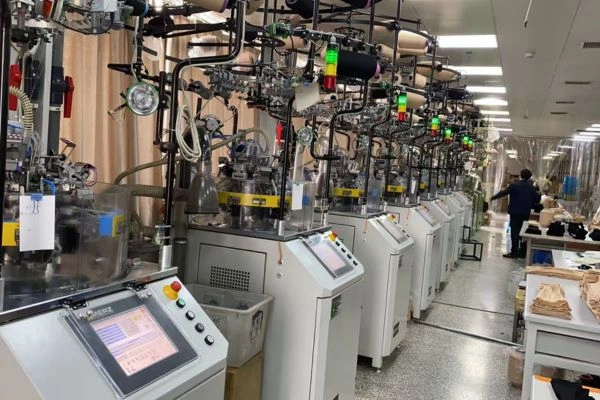
Lonati & Merz Medical Knitting Machines

Swisslastic MST MK V — multi-point pressure testing
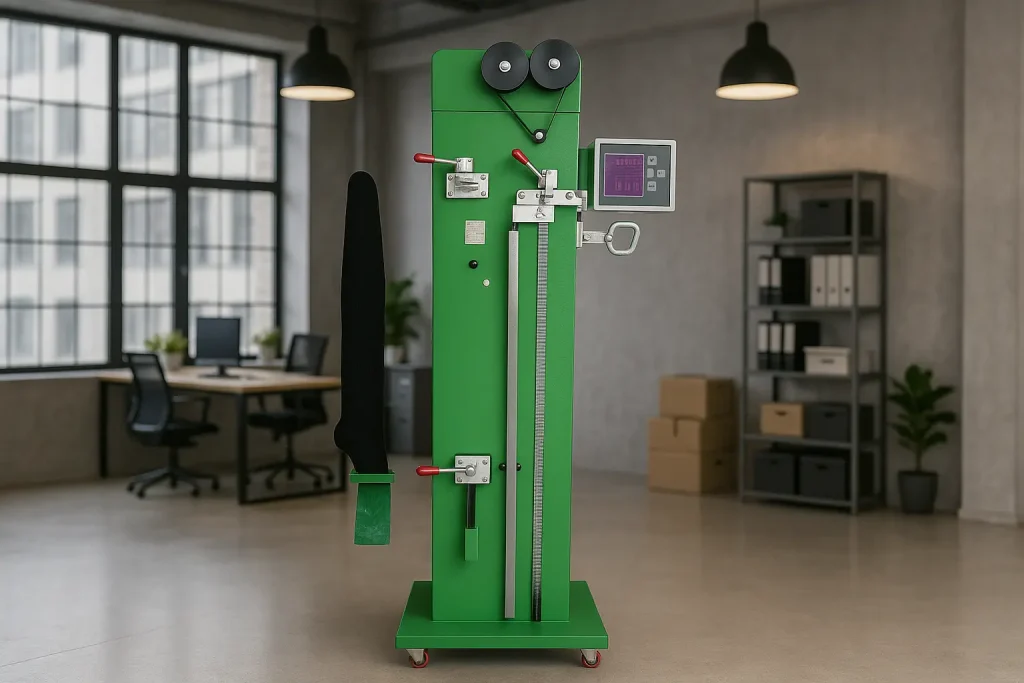
WLY-3 Sock Tensile Tester
Frequently Asked Questions
Common questions from pharmacy, DME and hospital buyers about sourcing medical compression stockings.
Do I need FDA registration to sell medical compression stockings in the US?
In the US, medical support stockings are regulated by the FDA as medical devices (21 CFR 880.5780), and what applies depends on your product’s intended use and claims. Our facility holds FDA establishment registration and device listing and an ISO 13485:2016 quality management system; we share these documents and help you check what your product and market require before production.
How long does sampling take for medical compression stockings?
Free stock samples (up to 3 styles) ship in 3–5 days. Custom sample timing depends on your specification. Pressure testing on our Swisslastic MST MK V tester is free, so you can check compression before approving bulk production.
Can you match the specs of an existing product we're already sourcing?
Yes. Send us a sample or spec sheet and we’ll reverse-engineer the construction — gauge, pressure profile, materials, sizing. We run Swisslastic MST MK V testing to verify the match before bulk production begins.
Which documents can you supply for a pharmacy or DME listing?
For medical compression stockings we supply our FDA establishment registration and device listing, the ISO 13485:2016 certificate, OEKO-TEX® Standard 100 certificates for the yarns used, and a Swisslastic MST MK V pressure test report for each bulk order. Product-specific labeling files and other documentation are available upon request once the specification is fixed.
Do you make both anti-embolism stockings and graduated compression stockings?
Yes. Anti-embolism stockings (low pressure, for patients who are mostly in bed) and graduated compression stockings (15–40 mmHg, for people who are up and walking) use different pressure profiles, so each runs its own knitting program and pressure specification.
What's the difference between 320N, 360N and 452N needle counts?
A higher needle count gives a finer, denser knit. 320N suits standard medical compression stockings; 452N gives a finer hand feel for brands targeting higher retail price points. We recommend the needle count based on your positioning and target cost.
Medical Compression Stockings: Guides & Resources
Practical guides on medical compression stockings, pressure levels and documentation for brands and distributors building a healthcare line.
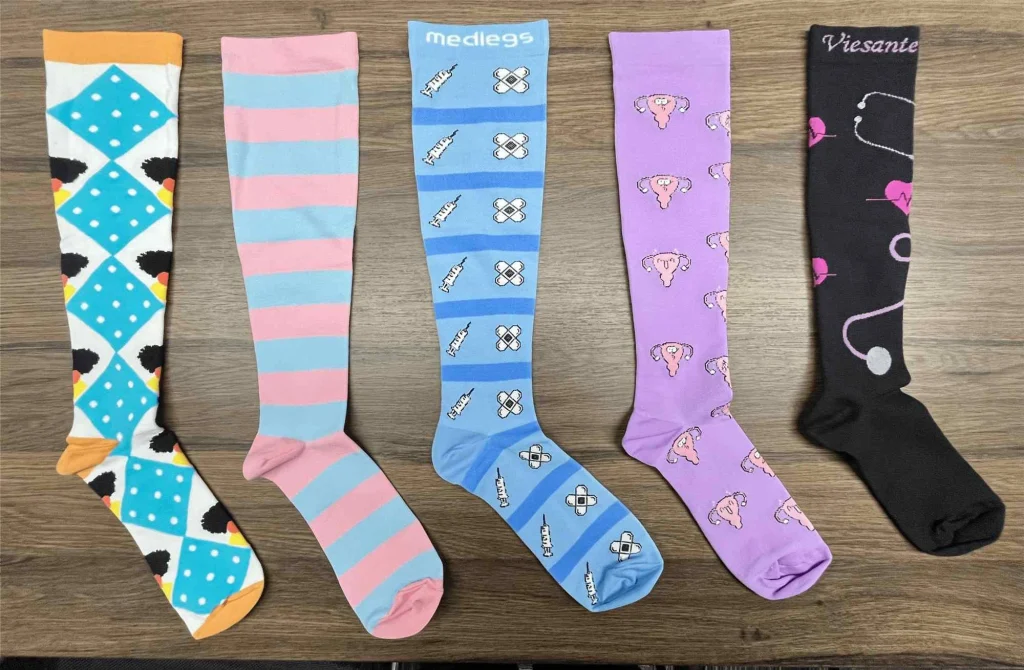
Compare compression socks and medical stockings in pressure level, production method, certification, and buyer use case to help brands choose the right product line.

See why thigh-high compression socks are chosen for fuller leg coverage, circulation support, and product lines focused on recovery, travel, and medical-related needs.
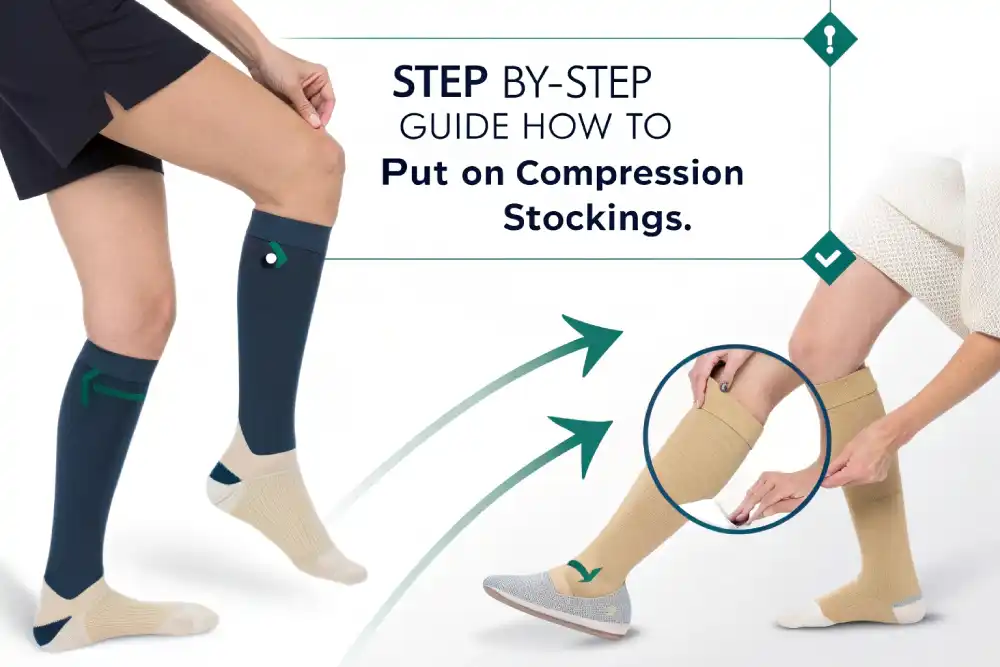
Donning steps for knee-high and thigh-high stockings — useful for writing insert cards and choosing zipper or open-toe styles for users who struggle to put them on.
Ready to Build Your Medical Compression Stocking Line?
Tell us your channel, target compression range (mmHg or CCL) and style — we’ll come back with a production plan, pricing, documentation list and a sample timeline. No commitment for the first conversation.
Inquiry & Spec Review
Share your channel, target pressure range and style. We reply within 24 hours with pricing, a proposed spec and the documentation your market requires.
Sample Development
We knit the sample to your specification and pressure-test it on the Swisslastic MST MK V before it ships, with approval photos and the test result. Free stock samples ship in 3–5 days.
Sample & Order Confirmation
Review your samples and request any refinements. Once approved, we confirm order details and start production after the deposit.
Bulk Production
Bulk production takes 25–30 days after sample approval, depending on quantity.
Inspection, Documentation & Shipping
Bulk orders ship after pre-shipment inspection at AQL 2.5, with the batch pressure test report and certificates included. Express, air or sea freight, including DDP; transit time is confirmed with your quotation and may extend for remote destinations, customs inspection or peak season.
🔒Your information is secure. We’ll respond within 24 hours with a customized proposal.