

Introduction
When you are sourcing or designing your own socks, ever had customers ask why their compression socks sag or their grip socks slip? It all comes down to sock structure. Do you have an understanding of the basic construction of socks? Different constructions can enhance the functionality and comfort of your socks and better fit your brand concept. As a socks manufacturer, I, the project manager will introduce 5 basic sock constructions to help you get a better idea.
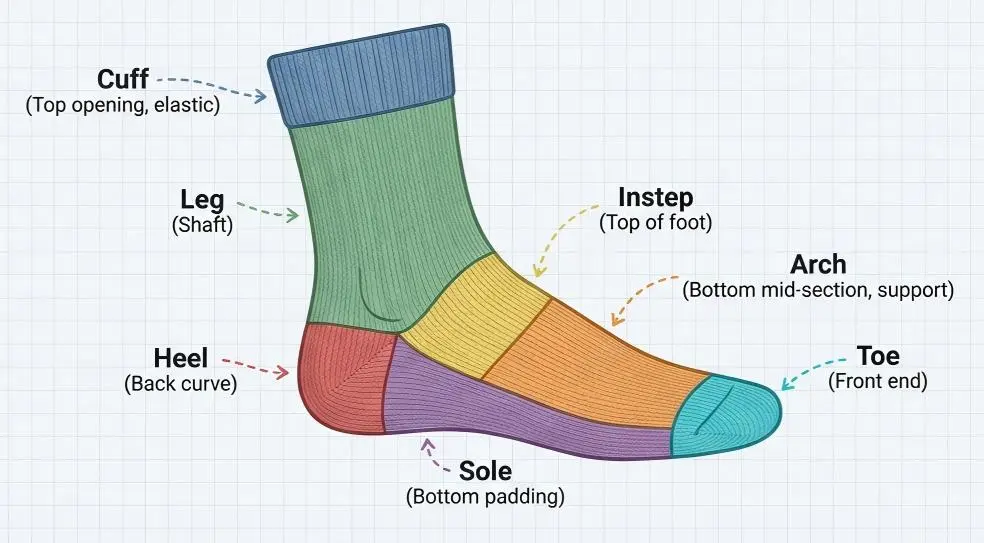
Before we go into specific knit structures, here’s a quick overview of the main zones on a sock: the cuff, leg, instep, arch, heel, sole, and toe. Each zone can use different structures depending on the sock’s purpose.
For example, elastic ribs are usually found in the cuff or arch area. Mesh panels often go on the instep for ventilation. Terry loops are commonly added to the sole or heel for cushioning. Knowing where these structures sit will make it much easier to understand how they work together in the sections below.
Jacquard Pattern
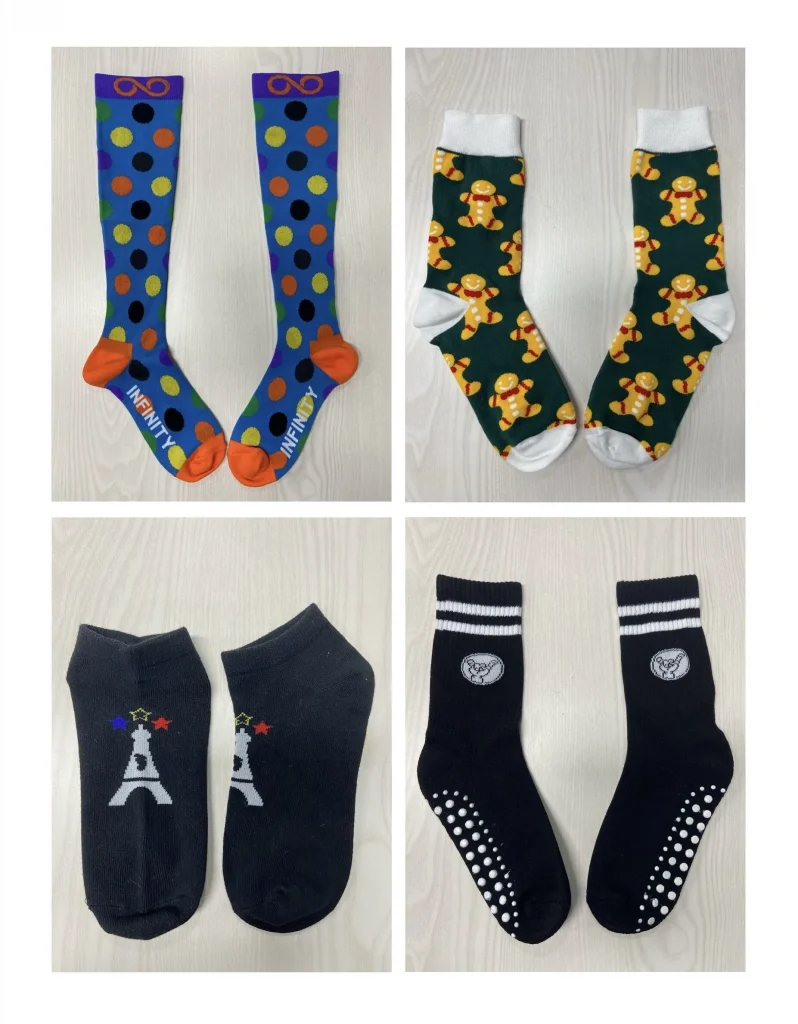
The jacquard section is a common construction on socks, and most of the patterns on socks are knitted, which means it’s knitted by the machine directly. Below are photos for reference. So when you send an inquiry to the factory, pay attention to the pattern technique. If you write a printing pattern, then this is a completely different technique from jacquard (refer to this previous article for the printing process), and the price of printing is more expensive than jacquard. So be careful to distinguish between the pattern process.
One thing worth noting: the number of colors a jacquard pattern can achieve depends on the knitting machine. Most standard sock knitting machines can handle 4 to 6 colors per row. If your design has more colors than that, the factory may need to simplify or split the pattern. This is something we often discuss with our clients at the sampling stage — sometimes a small adjustment to the design can save a lot of trouble in production.
Also, jacquard works best for patterns with clear shapes and defined edges, such as logos, geometric shapes, or lettering. If your design has fine gradients or photographic detail, jacquard is not the right technique — you’d need to consider printing or sublimation instead. So before you finalize your artwork, it helps to check with your manufacturer whether the pattern is suitable for jacquard knitting. You can refer to our earlier article on how to tell if a sock is knitted or printed for more detail.
Tip for buyers: When you receive a jacquard sample, turn the sock inside out. You’ll see “floating yarns” — the threads that are not showing on the front side. If the floats are long and loose, it means the pattern has wide color jumps, which can cause snagging during wear. A well-controlled jacquard should have short, tight floats on the inside.
Elastic ribs
In our compression sock ribs, elastic ribs are used to improve the elasticity of the socks, as they are the main component of our factory compression socks. They are basically used in sports socks, mainly on the cuff, ankle and arch support areas. According to the American Orthopaedic Foot & Ankle Society, proper support and stability in sock construction—such as elastic ribs—can reduce foot fatigue and injury risk during physical activities. By adding elastic ribs, the stretch is enhanced, helping the wearer to bounce better during exercise. In addition, the stronger stretching makes them feel more compression during exercise and improves blood circulation. The thickness of the rib varies as well, as shown in the picture below. 2*1 and 3*1 are common, with the latter being more common.
Elastic Rib vs. Graduated Compression: They Are Not the Same
I want to clarify something here because I often see buyers mix these two up. Elastic ribs and graduated compression are related, but they serve different purposes.
Elastic ribs improve the local stretch and recovery of specific areas — for example, making the cuff grip better or giving the arch a snugger feel. They make the sock more elastic and supportive in those zones.
Graduated compression, on the other hand, is a whole-leg pressure system. It is designed so that the pressure is highest at the ankle and gradually decreases as it goes up the leg. This is how medical-grade compression socks work, and achieving the correct pressure gradient requires careful engineering — specific yarn tension, stitch density, and machine programming at each section of the sock.
In other words, adding elastic ribs to your socks will make them feel more supportive, but that alone does not make them compression socks. If you’re developing a compression sock product, you’ll need to work with a manufacturer that can control and test the actual pressure values at different points. At our factory, we use the Swisslastic MST MK V for pressure testing to make sure the gradient meets the required standards.
Cuff structure
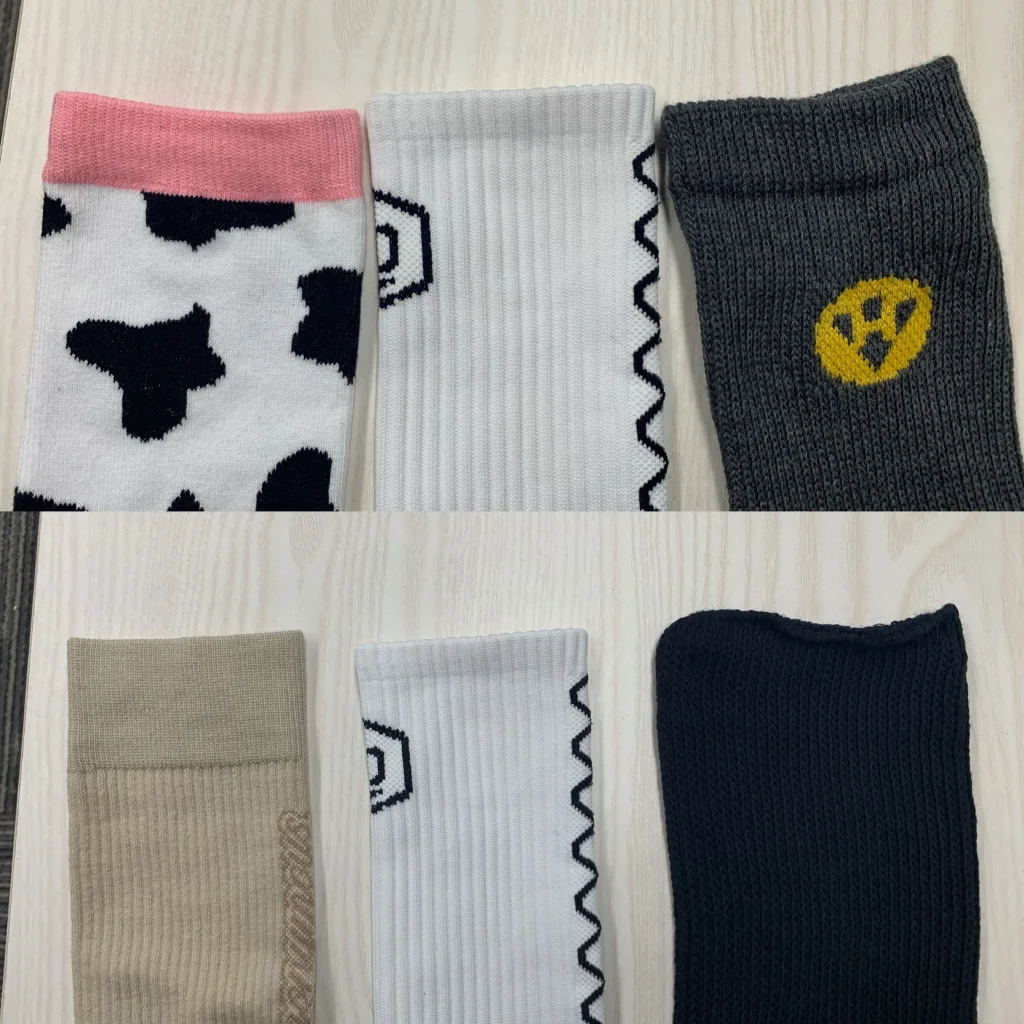
The cuff part is known as top of socks, and the different cuff structures will affect the comfort of the sock. The below pictures show a few different types of cuff construction. For everyday casual socks, the cuff is relatively loose to achieve a comfortable fit, but loose doesn’t mean that they will fall off over time, but rather that they are less tight compared to sports socks. The right picture shows the cuff of a sports sock, which is made of elastic ribs in 3*1 or 2*1 thickness. A moderately tight cuff prevents the sock from falling off during exercise and provides support for the ankle. There is a special type of sock called a diabetic sock, which is usually made with a loose-cuff construction, as diabetics are affected by high blood sugar levels over a long period of time, which can cause poor circulation and require a loose-cuff design to prevent the foot from being squeezed.
Flat and Terry
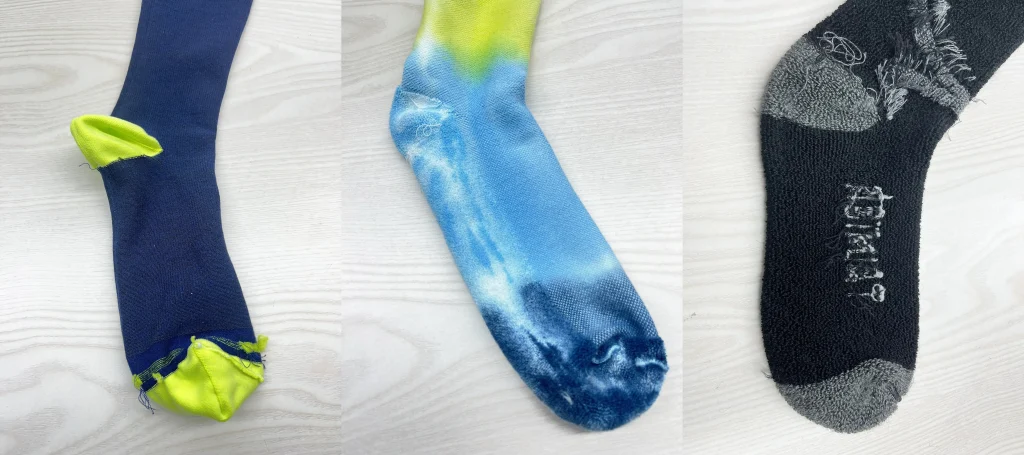
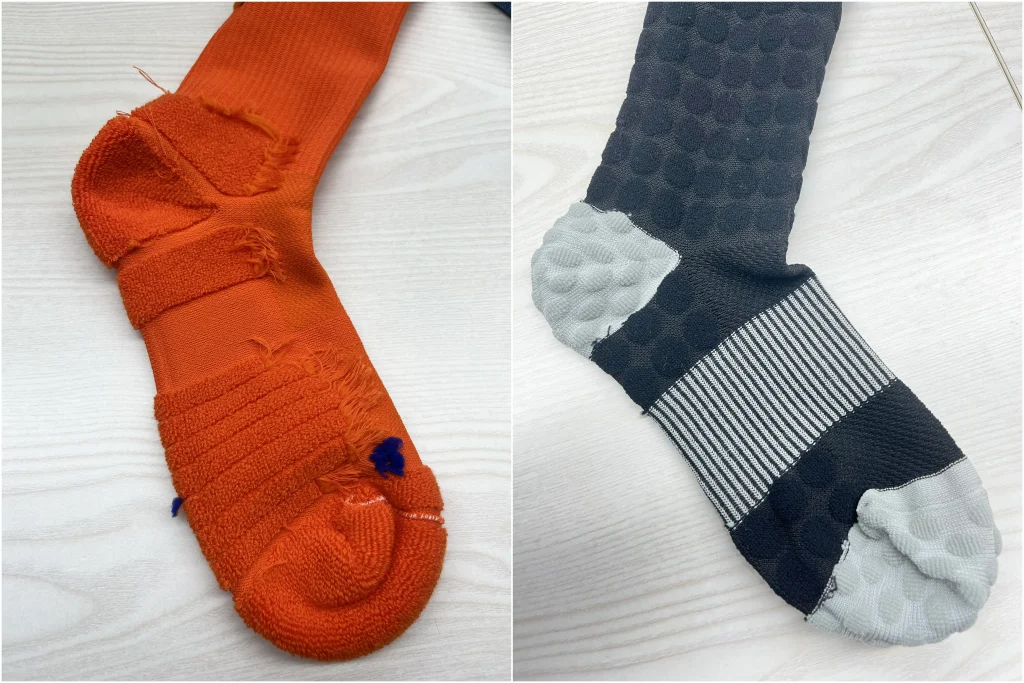
In terms of thickness, socks are differentiated by flat and terry, as shown in the chart below. The majority of daily regular socks are mainly flat, while sports socks or socks with a thermal function have an additional terry section. Terry loops can be made on the soles of the feet or the whole sock body, in addition to increasing warmth, there is also the function of moisture absorption and perspiration, so sports socks generally add terry loops on the soles of the feet.
Moreover, the terry can also make a variety of shapes in different parts, such as the dots in the image below, the protective layer on the ankles, and irregular stripes on the soles of the feet.
This irregularly shaped loop is called arbitrary terry, and its production is much lower than that of ordinary socks and is, therefore, more expensive.
Mesh structure
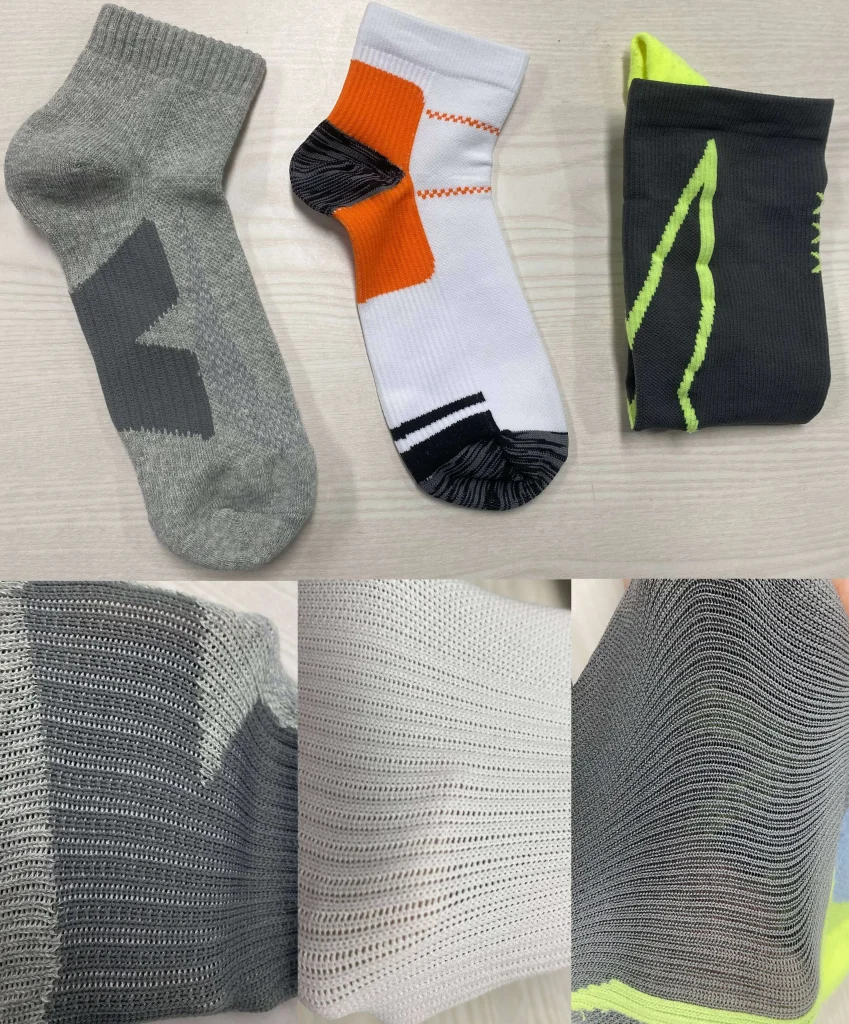
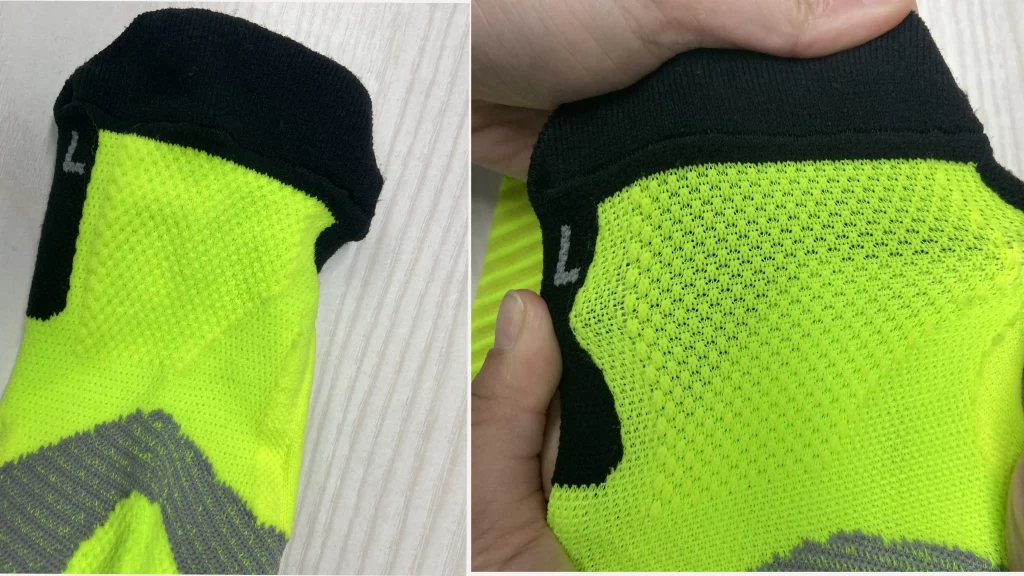
The mesh construction is easy to recognize, as shown in the following picture. Usually, the mesh is used on sports socks to achieve the effect of ventilation, but there are also patterns made from the mesh. In addition, the mesh can be made anywhere on the sock, usually at the instep and ankle.
Toe Construction: Why the Toe Seam Matters More Than You Think
The toe is one of the areas that wearers feel the most, especially during long walks, running, or standing for hours. How the toe is closed during production directly affects comfort.
In standard sock production, the toe is closed by a rosso machine, which folds the opening and stitches it shut. This creates a seam across the top of the toes. For everyday socks, this is fine — it’s fast and cost-effective. But for performance socks, hiking socks, or medical socks like diabetic socks, this seam can be a problem. It creates a ridge that rubs against the toes, especially inside tighter shoes.
The alternative is a hand-linked toe (sometimes called a “seamless toe”). In this process, the toe is closed by a separate linking machine that joins the stitches one by one, creating a much smoother, nearly flat finish. On the production side, hand-linking is significantly slower — it requires an extra step and a dedicated operator, so the cost per pair is higher. But for brands that position their socks as premium or performance-level, it’s a noticeable quality difference that end users can immediately feel.
A practical check: When you’re evaluating a sample, turn the sock inside out and run your finger across the toe area. If you feel a thick, raised ridge, that’s a rosso seam. If the transition is smooth and nearly flat, it’s likely hand-linked. This is one of the easiest ways to judge sock quality without any tools.
Heel Construction: What Makes a Sock Stay in Place
Ever had the experience of wearing socks that keep twisting around your foot? That usually comes down to heel construction.
A well-made sock has a Y-shaped heel pocket — this is created through a process called reciprocated knitting, where the machine knits back and forth (rather than in a continuous circle) to form a three-dimensional pocket that follows the natural curve of the heel. This is what makes the sock “sit” properly on the foot without rotating.
Cheaper socks sometimes skip or simplify this step, resulting in a flatter heel that doesn’t cup the foot well. From our production perspective, reciprocated heel knitting does slow down the machine slightly, but it’s a fundamental part of making a sock that fits properly. We consider it non-negotiable for any performance or branded sock.
In addition to the shaping, the heel is also a high-wear zone. It’s one of the first areas to develop holes over time. That’s why many sports and work socks use reinforced knitting in the heel — either a denser stitch, a stronger nylon blend in that section, or a combination of both. If your product needs to handle heavy daily use, like work safety socks or hiking socks, pay extra attention to the heel construction in your sample review.
Arch Support Band
Your sock’s arch area is easy to overlook in the design stage, but it plays a big role in how the sock feels during wear.
An arch support band is created by using elastic yarn or targeted rib knitting across the mid-foot zone. Its main job is to keep the sock snug against the foot so it doesn’t slide or bunch up inside the shoe. For sports socks, this is especially important during repeated movements — the arch band prevents the sock from shifting, which reduces friction and the risk of blisters.
In our production, the arch band is usually programmed into the knitting pattern as a zone of tighter stitches. It doesn’t add significant cost, but it does require the design to account for it from the start. If you’re developing running socks or cycling socks, I’d recommend including an arch support band as a standard feature — it’s one of those details that makes the difference between a “basic sock” and a properly engineered one.
How to Combine Sock Structures for Different Applications
In real product development, you rarely use just one structure. The best socks combine several structures based on the intended use. Here’s how we typically recommend structure combinations for different applications:
Running socks usually combine mesh panels on the instep for airflow, an arch support band for stability, a hand-linked or smooth toe to reduce friction, and reinforced heel and toe areas. Light terry on the sole is optional depending on whether the brand wants a thin racing feel or more cushioning. (→ See our custom running socks)
Hiking socks prioritize durability and cushioning. You’ll typically see full or targeted terry loops on the sole and heel, reinforced heel and toe construction, a supportive cuff with elastic ribs, and often a merino-blend yarn for temperature regulation. The arch band is also standard. (→ See our wool hiking socks)
Compression socks need a graduated pressure design along the entire leg, controlled through specific yarn tension and stitch density at each zone. The cuff is usually engineered for a firm but comfortable grip. Mesh or ventilation panels can be added, but must be carefully integrated so they don’t disrupt the pressure gradient. (→ See our custom compression socks)
Diabetic socks take a different approach. The focus is on reducing pressure and friction: a non-binding, loose cuff to avoid restricting circulation; a smooth or hand-linked toe to eliminate seam irritation; soft cushioning on the sole; and often moisture-wicking yarns to keep the foot dry. (→ See our custom diabetic socks)
| Application | Key Structures | Main Goal |
|---|---|---|
| Running | Mesh + arch band + smooth toe + reinforced heel/toe | Breathability + fit + blister prevention |
| Hiking | Terry cushion + reinforced zones + arch band + supportive cuff | Durability + comfort + warmth |
| Compression | Graduated pressure + engineered cuff + controlled elasticity | Circulation support + recovery |
| Diabetic | Loose cuff + smooth toe + soft sole + moisture management | Reduced pressure + gentle fit |
| Work / Safety | Dense terry + reinforced heel/toe + arch support + firm cuff | Durability + all-day support |
If you’re not sure which combination is right for your product, feel free to send us your concept and we can suggest the most suitable structure plan based on your target market.
How to Check Sock Construction Quality Before Placing a Bulk Order
Before you commit to a large production run, it’s worth taking time to carefully evaluate the construction in your pre-production samples. Here are the areas I always recommend buyers check:
Cuff: Put the sock on or stretch the cuff with your hand. Does it grip well without feeling too tight? Does it spring back to its original shape after stretching? A good cuff should recover quickly — if it stays stretched out, the elastic quality is not sufficient.
Toe: Turn the sock inside out and feel the toe seam. Is it smooth or bulky? For everyday socks, a slight ridge is normal. For performance or medical socks, the seam should be as flat as possible.
Heel: Wear the sock or place it on a foot form. Does the heel pocket sit where it should, or does the sock feel like it wants to rotate? A properly shaped heel stays centered during movement.
Terry: If the sock has terry loops, check that they are even and consistent. Uneven loops can create uncomfortable pressure points and suggest quality control issues in production.
Mesh: Look at the mesh zones closely. The holes should be uniform in size and spacing. Inconsistent mesh can indicate machine tension problems that may also affect durability.
Jacquard: For patterned socks, check the inside for floating yarns. Long, loose floats can cause snagging. Also check whether the pattern edges are clean and well-defined — blurry edges usually mean the pattern needs to be optimized for the machine’s needle count.
These details might seem small, but they directly affect how comfortable the sock feels, how long it lasts, and how your customers perceive the quality of your brand.
So the above is about the 5 basic structures of socks, which we hope will help you with sock design.
Here’s a summary video for your reference:
Conclusion
We also recommend paying attention to yarn safety when developing socks, especially for products that are worn close to the skin for extended periods. Our production uses yarns certified under OEKO-TEX® Standard 100, which tests for harmful substances in textiles — a standard that is particularly relevant for sports, everyday, and medical-use socks.
FAQs
Q: Is elastic rib the same as compression? No. Elastic ribs add local stretch and support to specific zones of the sock, such as the cuff or arch. Graduated compression is a different concept — it involves a pressure gradient that is highest at the ankle and decreases upward. A sock with elastic ribs is not automatically a compression sock.
Q: What is a hand-linked toe, and why does it cost more? A hand-linked toe is closed stitch-by-stitch on a separate machine, creating a nearly flat seam. It’s slower than the standard rosso method, which is why it adds cost. But for sports, medical, or premium socks, the comfort difference is worth it.
Q: How many colors can a jacquard sock have? Most sock knitting machines handle 4 to 6 colors per row. If your design requires more colors, your manufacturer may suggest simplifying the pattern. Always confirm color capacity with the factory during the sampling stage.
Q: What sock structure is best for diabetic socks? Diabetic socks typically use a non-binding loose cuff, smooth or seamless toe, soft cushioning, and moisture-wicking materials — all designed to reduce pressure and friction on sensitive feet.
Q: How do I communicate sock structures on my tech pack or spec sheet? Use clear, industry-standard terms for each zone: specify cuff type (e.g. “3×1 rib”), cushioning placement (e.g. “full sole terry”), toe closure method (e.g. “hand-linked”), and any special zones (e.g. “instep mesh panel”). If you can provide a simple diagram marking these zones alongside your tech pack, it helps the factory understand your requirements faster and reduces sampling revisions.
Follow us: