

Executive Summary
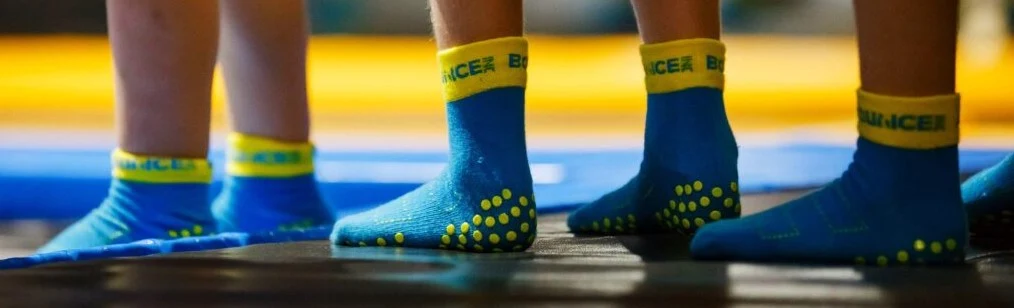
In trampoline parks and group jump programs, grip socks are not a nice-to-have; they’re the foundation of your risk, hygiene, and experience stack. Leading chains require branded or approved socks and allow launder-and-reuse policies to keep costs down while standardizing safety. Industry frameworks (e.g., ASTM F2970) and association guidance (IATP) reinforce the need to formalize footwear within your operating model.
Safety First: Stable Feet Create Predictable Jumps
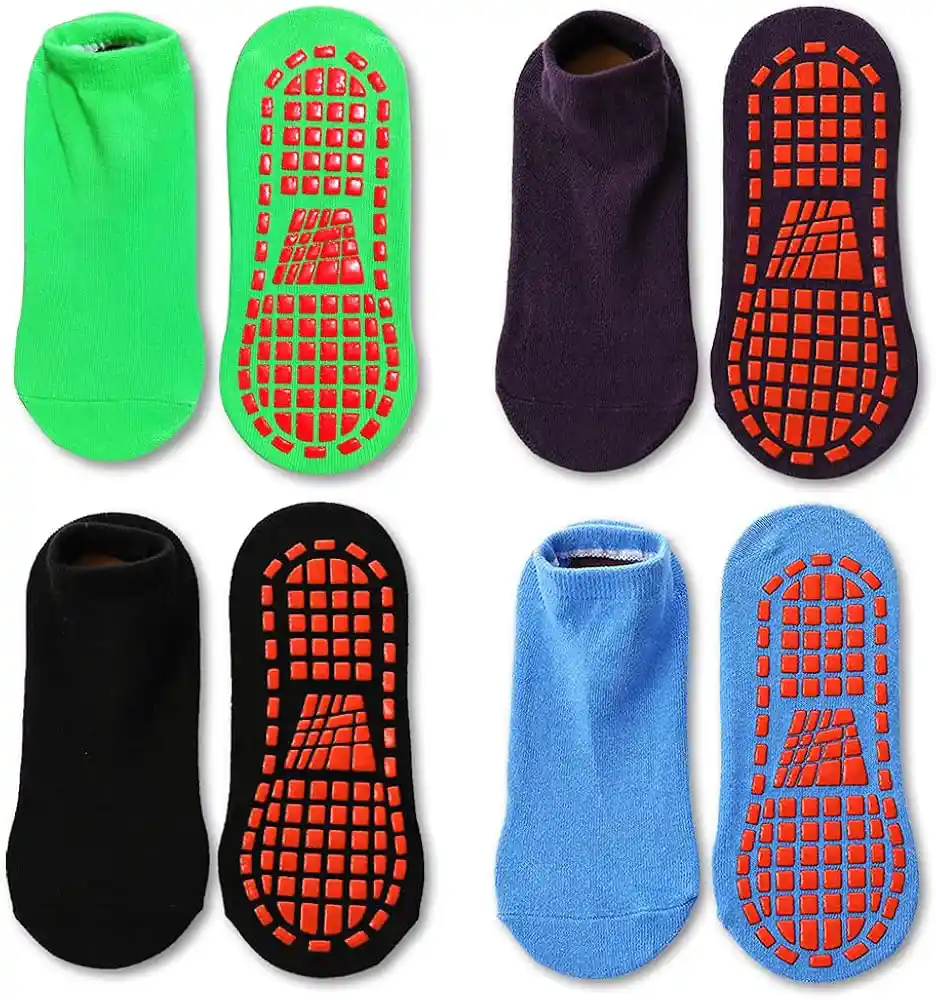
High-energy takeoffs and landings on smooth, often perspiration-damp surfaces raise slip risk. Full-foot or targeted silicone/rubber patterns on grip socks materially increase foot–surface friction, reducing micro-slides at the two most critical moments: the explosive push-off and the absorption phase on landing. This stabilizes vectors, lowers avoidable falls, and cuts sprain/bruise incidence.
From a governance standpoint, ASTM F2970 (Standard Practice for Trampoline Courts) embeds safety and operations considerations into design, maintenance, inspection, and operation—a practical basis for codifying sock use inside your SOPs.
Hygiene You Can Prove: A Personal Barrier in Shared Spaces
Public, moist surfaces are classic exposure points for tinea pedis (athlete’s foot). Dermatology guidance notes people ‘most often get it from walking barefoot in moist public places’ and recommends keeping feet clean, dry, and protected; CDC echoes the same preventive behaviors for fungal and other skin infections in shared facilities. In trampoline parks, a park-approved grip sock acts as a personal barrier and supports better hygiene between sanitization cycles. This is not just a guest convenience—it’s a measurable control that complements cleaning SOPs and reduces barefoot exposure time on shared mats.
What chains do:
- Sky Zone requires patented SkySocks with trademark grip; socks are reusable if in good condition and are the only socks permitted on attractions.
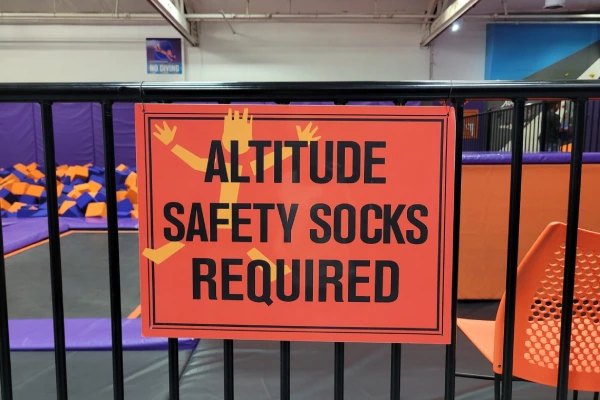
- Altitude Trampoline Park requires safety socks, explicitly noting they can be washed and re-worn; the rule exists “to help keep our jumpers safe and our park clean.”
- Get Air requires jump socks at all locations and states they are reusable for future visits.
Performance Gains: Higher, Cleaner Energy Transfer

Consistent friction underfoot improves energy transfer and movement repeatability. When push-off isn’t compromised by micro-slips, more of the vertical impulse becomes usable height; landings track closer to the center with less compensatory rotation. For coaching blocks—seat drops, turn sequences, controlled twists—uniform grip across a class reduces the variance coaches must correct, speeding skill acquisition and lowering fatigue. Standardizing an ‘approved grip’ also reduces outliers (over-grippy/under-grippy) that can disrupt a session’s tempo and raise the signal-to-noise for technique feedback.
Comfort and Fit (What Keeps Guests Wearing Them)

Choose blends that balance handfeel (cotton) with wicking and resilience (poly/nylon + elastane). Bonded silicone or rubber patterns should cover full-foot or high-pressure zones (heel strike, lateral forefoot). Reinforce heel/toe for abrasion; specify colorfast dyes for repeat laundering; and define recovery targets so socks keep their shape. Operator-friendly touches—size color-coding, barcode labels, tamper-evident party packs—tighten inventory control and cut front-desk handling time.
- Materials: a balanced blend (cotton handfeel + moisture-wicking synthetics + elastane recovery)
- Ergonomics: snug wrap to prevent bunching; arch-support bands to reduce midfoot fatigue; seamless toe to cut irritation; optional light cushioning for repetitive impacts
These attributes translate into longer, happier on-deck time without compromising control.
Your Product Strategy: Customizable, Two-Tier Offer
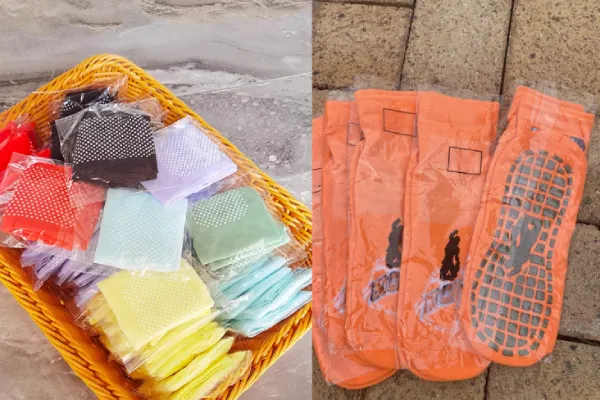
Move from a one-size policy to a portfolio that meets distinct needs while holding the safety line.
Tier A — Single-Use “Entry Socks” (cost-controlled, compliance-first)
- Use case: one-off visitors, birthday parties, price-sensitive segments
- Spec: compliant grip coverage with a lighter fabric spec to keep unit cost down
- Operational upsides: zero laundering expectations, straightforward loss accounting, reduces guest friction at the gate
- Positioning: “Included with admission” or sold at a nominal add-on—clearly labeled as single-use to set expectations
Tier B — Durable, Reusable “Member Socks” (value-added, eco-aware)
- Use case: members, season pass holders, camps, league participants
- Spec: reinforced heel/toe, higher-grade bonded silicone/rubber grip, colorfast blends designed for repeated washing
- Operational upsides: improved guest satisfaction and hygiene habits; supports a “bring-back & reuse” message already recognized by major brands
- Positioning: loyalty perk or bundled with memberships/party packages
Customization Levers (for both tiers)
- Branding: logo, colorways, seasonal campaigns
- Grip geometry: full-foot vs. zonal patterns by program (freestyle, dodgeball, toddler time)
- Fabric weights & heights: ankle/crew; climate-appropriate options
- Size runs: clear color-coding by size, kid-to-adult
- Packaging & ops: barcode/size labels for fast POS, tamper-evident packs for party inventory
Financially, socks behave like a small, durable safety asset when paired with a reuse policy. Unit cost is recaptured over multiple visits (memberships, leagues, camps) while incident reduction protects far larger downside risks. Major chains bake this into their consumer journey—required at entry, available on-site, reusable when in good condition. Your Tier A entry socks remove friction for one-off guests and parties; Tier B durable socks increase satisfaction, lower replacement churn, and encourage guests to return with ‘their pair,’ reducing queue time and POS load.
Care & Longevity (for the Durable Tier)
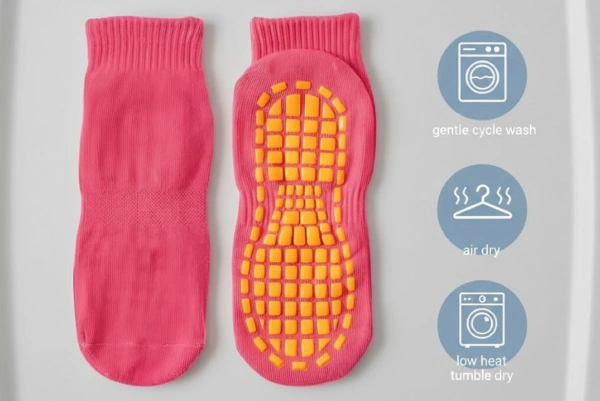
- Wash: inside-out, gentle cycle, mild detergent
- Dry: air-dry or low/no-heat to preserve grip integrity
- Replace: on visible wear, peeling grip, holes, or lost elasticity
These steps echo public-health guidance to keep feet clean, dry, and protected.
Objections → Recommended Talking Points
| Objection | Recommended response |
|---|---|
| “It adds cost.” | Offer Tier A single-use socks (lowest unit cost) and Tier B durable socks for members; both satisfy compliance while giving guests a choice. Major chains already require socks—your policy simply adds choice. |
| “Guests don’t want to manage laundry.” | That’s what Tier A is for. For frequent jumpers, Tier B offers superior comfort, durability, and reuse value. |
| “Do we really need a standard?” | ASTM F2970 and IATP resources provide the operational backbone for court safety and footwear policy integration. |
| “Is hygiene risk overstated?” | Dermatology/public-health guidance warns against bare feet on communal moist surfaces; protective footwear and dry, clean feet reduce infection risk. |
FAQs
Why do parks restrict which socks are allowed?
To standardize traction, hygiene, and liability control. For example, Sky Zone requires its own SkySocks and permits reuse only when they’re in good condition—ensuring consistent grip and cleanliness across guests.
Can guests wear regular socks or socks from another park?
Often no. Policies typically require park-approved grip socks to guarantee traction and sanitation; many venues sell compliant pairs on site and specify reuse rules. Check your park’s FAQ (e.g., Sky Zone, Altitude).
Do grip socks materially improve hygiene vs. barefoot?
Yes. Dermatology and public-health guidance warn that going barefoot on moist shared surfaces increases infection risk; protective footwear and keeping feet clean/dry reduce transmission.
Can parks allow reuse without compromising safety?
Yes—if condition-based and communicated. Sky Zone and Get Air both require approved socks and allow reuse when clean and intact, reinforcing safety and hygiene standards.
What standards should management cite in SOPs?
Reference ASTM F2970 for design/operation/inspection of trampoline courts and pair it with IATP’s standards resources for training and audits.
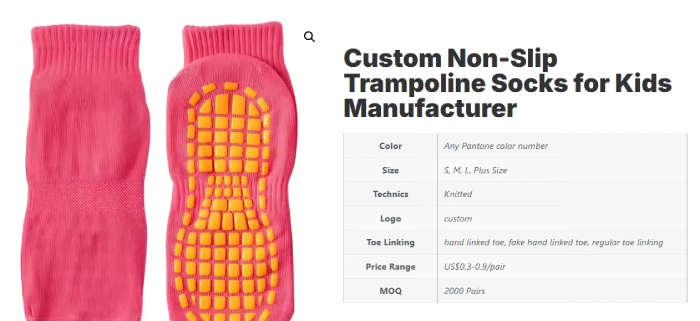
Looking for grip socks built around your program—not a one-size-fits-all? Max Hosiery designs and manufactures custom trampoline/park grip socks aligned to your safety, hygiene, and guest-experience goals. Tell us your requirements (grip geometry, materials, sizing, branding, packaging), and we’ll propose specs, samples, and timelines.
Let’s talk: Max Hosiery—custom socks, built for your park.