

Introduction
Socks are knitted in the barrel of a sock machine in a loop. A point on each loop is a stitch, so the number of stitches in a loop is the number of stitches in that sock. Usually, we use Needle (N) to tell the number of stitches, in short, the needle count of a sock is the total number of stitches around the circumference of the sock tube.
But needle count is more than just a technical spec on a factory sheet. It directly affects how your custom logo turns out, what yarn you can use, how the sock feels, and ultimately what you’ll pay. This guide walks through everything a buyer needs to know — from the basics to the decisions that matter for your order.
Common needles of socks
The standard needle for socks is 48N, 56N, 72N, 84N, 96N, 108N, 120N, 132N, 144N, 168N, 170N, 176N, and 200N. Some of these are single needles, and some are double needles. Single-needle socks are more common because of the ability to make complex patterns.
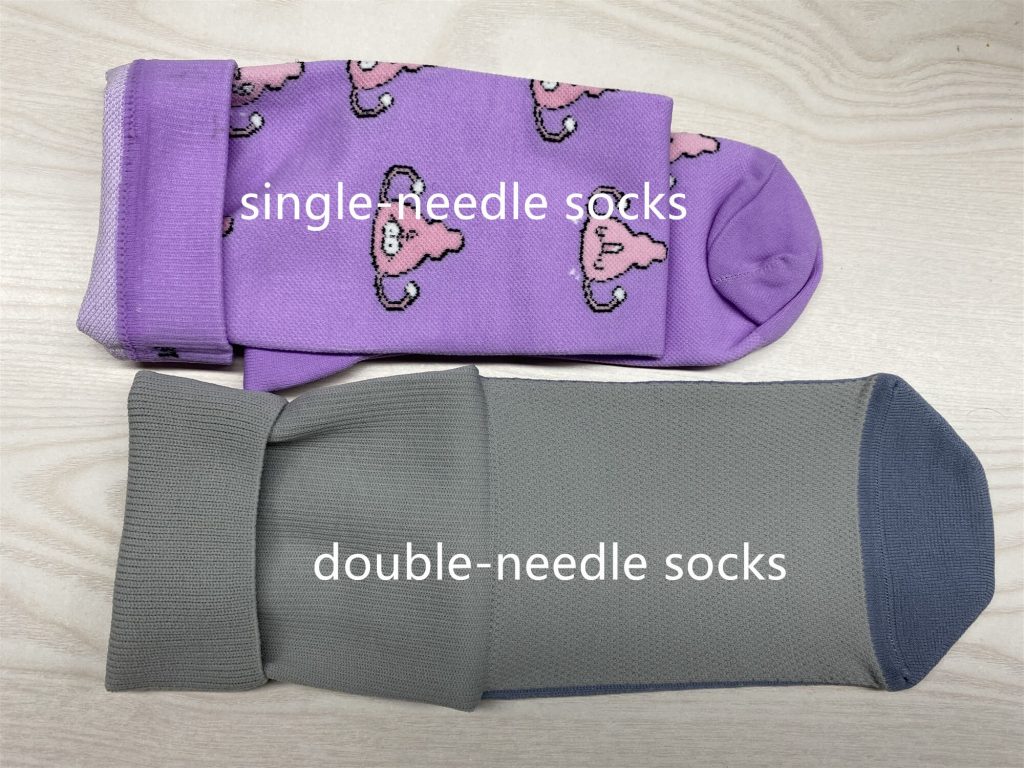
There are two easy ways to distinguish between single and double-needle socks. One is to turn the sock over and look at the cuff part, if it is the same as the front of the sock, it is double-needle, if it is not and a stitching line appears, it is single-needle. The second way: a double-needle sock has a single-layer cuff, while a single-needle sock has a double-layer cuff.
For single-needle socks and compression socks specifically, the most commonly used needle counts are 144N, 168N, and 200N. Our factory also runs 220N, 260N, and 320N and 400 N+ medical machines for extended size ranges and certain medical-grade products.
How to Identify the Needle Count of a Sock
To figure out the needle count of a sock, you need to understand what a single stitch looks like. Using a single-needle sock as an example — each vertical “strip” you see on the sock surface represents one stitch, which corresponds to one needle on the machine. Count how many of these strips appear around a full loop of the sock, and that gives you the needle count.
We have also made a video showing how to count needles on a real sock if you’d like to see it done step by step.
Needle Count Comparison: Which One Is Right for Your Product?
This is where most buyers get confused — not because the concept is hard, but because nobody breaks it down by actual product type. Here’s how the most common needle counts map to real applications:
| Needle Count | Typical Applications | Key Characteristics |
|---|---|---|
| 96N / 108N | Winter socks, home slipper socks, thick work socks | Thick, warm, designed for heavier yarns |
| 144N | Athletic socks, casual everyday socks | The market standard — balances thickness with decent pattern clarity |
| 168N | Premium dress socks, quality men’s fashion socks | Noticeably finer than 144N, better for branded details |
| 200N | High-end dress socks, custom cycling socks, logo-heavy designs | Maximum pattern resolution, smooth hand feel, finer appearance |
The takeaway here is not that higher is always better. It’s that different needle counts serve different end products. A 200N sock is not automatically superior to a 144N sock — it depends entirely on what you’re making and who’s buying it.
How Needle Count Affects Your Custom Logo
If you’re placing a branded order, this section matters more than any other.
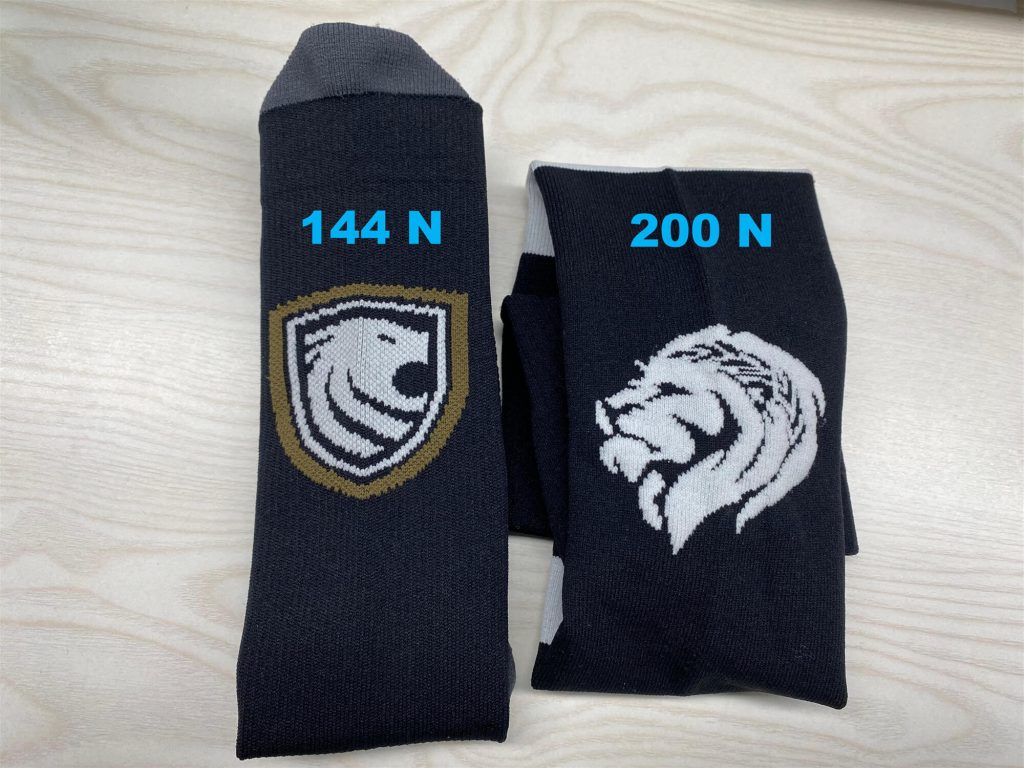
Think of needle count like screen resolution on a monitor. A 144N sock can reproduce most brand colors, basic geometric shapes, and bold text cleanly. But if your logo includes thin serif fonts, fine lines, small text under 5mm, or detailed gradients, the lower the needle count, the more that detail gets lost — edges become jagged, small text turns into a blur.
As a general rule from our production experience:
- Simple logos, block colors, bold text → 144N is sufficient
- Medium-complexity logos with moderate detail → 168N recommended
- Fine text, intricate geometric patterns, high-detail artwork → 200N is the minimum
Before finalizing your needle count, send us your logo file. Our team can tell you whether your design will reproduce cleanly at 144N or whether you need to move up — no charge for the assessment.
The Relationship Between Needle Count and Yarn
Here’s something that doesn’t come up often enough: needle count and yarn thickness have to be compatible. You can’t simply choose the highest needle count and expect the best result.
On a high-needle machine like 200N, the gap between each needle is very small. This means only fine-denier yarns can feed through properly. If you try to run a thick wool yarn on a 200N machine, the yarn won’t pass through the needle bed cleanly — production issues follow.
- This creates a practical constraint that matters for your product decisions:
- Want a thick, cushioned athletic sock with terry sole? Don’t chase 200N. A 144N or even 108N machine with the right yarn will give you the warmth and cushioning you need.
- Want ultra-fine dress socks or cycling socks with minimal bulk? 200N with a fine nylon-lycra blend is the right combination.
- Want compression socks? Compression is primarily a function of yarn tension and spandex content — not needle count. Most compression socks run well on 144N or 168N.
The point: needle count and yarn selection should be decided together, not separately.
What Does Needle Count Affect?
To summarize the practical impact across the main variables:
1. Pattern Clarity
The higher the needle count, the finer and more detailed the pattern. This is non-negotiable for logos with fine elements. (See the comparison photos above.)
2. Fabric Density
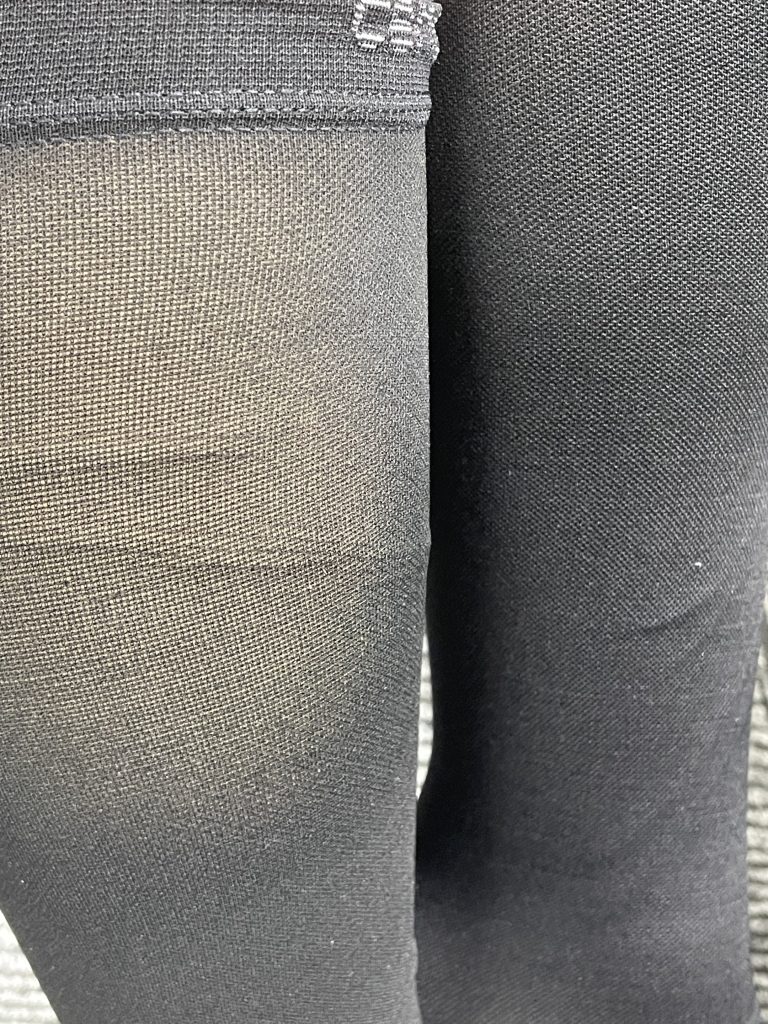
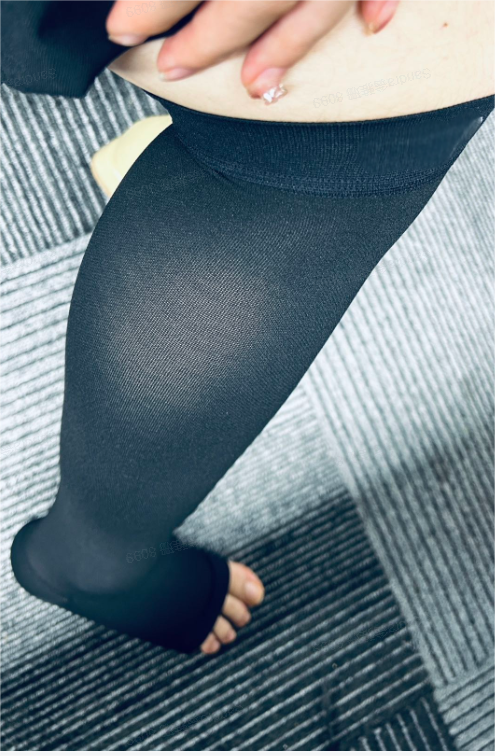
Under the same yarn conditions, higher needle count produces a denser fabric. This is also why some socks look slightly see-through — they may be using a higher needle count with a fine yarn, which creates a sheer appearance rather than opacity.
3. Price
Higher needle count generally means finer yarn (more expensive), longer knitting time, and higher machine maintenance cost. For 200N vs 144N in the same style, expect a meaningful unit price difference — typically more noticeable at lower order quantities.
4. Suitable End Market
This is the practical output of everything above:
- Mass-market athletic / promotional → 144N is the sweet spot for cost-efficiency
- Premium branded / fashion / corporate gifting → 168N or 200N positions the product at a higher tier
- Medical or compression → Needle count is secondary; yarn and compression specification take priority
Procurement Checklist: Choosing the Right Needle Count
Before confirming your spec, run through these questions:
- Does your logo have fine details or small text? If yes, go 168N or above.
- Is warmth or cushioning a priority? Higher needle count = finer, thinner terry. Match needle count to the cushioning thickness your end market expects.
- What’s your target retail price point? Higher needle count raises unit cost; make sure the market supports it.
- Is this for compression? Needle count is less critical here — focus on compression level and material instead.
Conclusion
Needle count is one of the first specs you’ll encounter when ordering custom socks — and one of the most misunderstood. The short version: match your needle count to your yarn type, your logo complexity, and your end market. Don’t default to the highest number; default to the right number.
If you’re not sure which needle count fits your project, send us your logo and target product description. We’ll tell you exactly which spec to use — and why.
👉 Contact us or request a quote directly below.
Next Steps for Sourcing:
- 6 Factors That Make a Huge Difference in the Price of Compression Socks
- Guide to Logo Techniques for Custom Socks
FAQ
1. Does higher needle count always mean better quality? Not necessarily. Higher needle count means finer fabric and better pattern detail — but whether that’s “better” depends on the product. A 96N thick winter sock is exactly right for its purpose. Choosing 200N for a heavy-cushioned athletic sock would actually be the wrong call, since the machine can’t run the thick yarn required.
2. What needle count is best for compression socks? Most compression socks are produced on 144N,168N or 200N machines. The compression level itself comes from spandex content and yarn tension, not needle count. For medical-grade compression socks requiring higher accuracy, we use imported-Merz or Lonati machines.
3. What needle count do I need if my logo has fine text or complex details? For logos with thin lines, small text , or detailed geometric artwork, we recommend a minimum of 168N. For the highest possible reproduction accuracy — especially for cycling socks or premium branded dress socks — 200N is the right choice.
4. Can I use a 200-needle machine for thick athletic socks? Yes, it’s possible — but the result will be different from what a lower-needle machine produces. Higher needle counts can knit terry-sole socks, but the loops will be finer and the cushioning layer thinner. If your customer prioritizes a thick, plush feel underfoot, a 144N machine will give you that heavier terry. If they prefer a lighter cushioning with a more refined finish, 200N terry is a valid option. The right choice depends on the thickness and hand-feel your end market expects.
5. What is the difference between single-needle and double-needle socks in terms of use? Single-needle socks are more versatile for complex patterns and are the standard for most custom branded socks. Double-needle construction creates a more durable, even finish at the cuff but limits pattern complexity.