

Introduction
Gradient and ombre effects on socks have become one of the most consistent requests we receive from fashion brands, activewear labels, and lifestyle sock buyers. The look is distinctive, the market for it is real — and most buyers who ask for it don’t know which production method actually delivers it.
The short answer: for most gradient sock projects, tie-dye or dip-dye is the right process. Not sublimation printing. This guide explains why, how each method works, what your product needs to qualify, and what to expect when placing a custom order.
Tie-Dye vs. Dip-Dye: What’s the Difference?
The two terms are often used interchangeably, but they produce different effects and suit different design briefs.
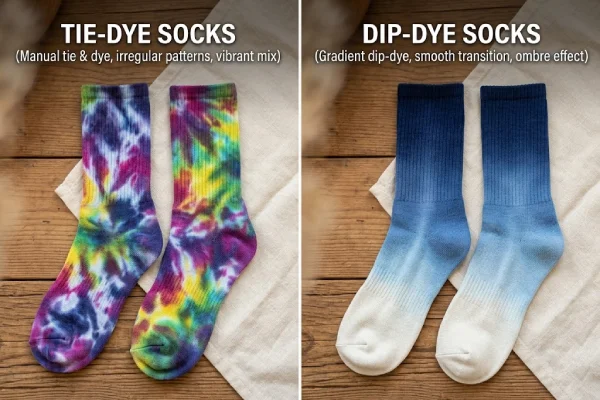
Tie-dye involves binding, twisting, or folding the sock before it goes into the dye bath. The bound areas resist the dye, creating irregular patches, rings, or abstract patterns where the base fabric color shows through. The result is organic and unpredictable in a way that’s part of the aesthetic — no two pairs are exactly identical, which is often a selling point for lifestyle and fashion products.
Dip-dye (ombre) involves submerging the sock progressively into the dye bath in stages, with each section spending a different amount of time in the dye. The longer a section is immersed, the deeper the color. The result is a smooth gradient that transitions from dark at one end to light at the other — or from one color to another. The effect is more controlled and graphic than tie-dye, and works well for brands that want a clean, modern look rather than a handcrafted one.
Both methods are done on finished socks after knitting and boarding. The entire sock goes into the dye bath — there’s no masking or partial application.
Why Tie-Dye and Dip-Dye, Not Sublimation Printing?
This is the question we get most often. If sublimation printing can produce gradients digitally, why use a manual dyeing process?
Three reasons:
Material compatibility. Tie-dye and dip-dye use fiber-reactive dyes that work with natural fibers — primarily cotton and cotton-blend yarns. Most fashion and lifestyle socks are cotton-dominant. Sublimation printing, by contrast, requires ≥50% polyester to bond correctly. On high-cotton fabric, sublimation dye spreads and diffuses during heat pressing, producing a blurry, washed-out result rather than a clean gradient. The fabrics that work best for tie-dye don’t work for sublimation, and vice versa.
Elasticity. Sublimation printing uses high-temperature pressing at around 200°C, which damages spandex and lycra fibers — reducing the sock’s stretch and recovery. Tie-dye and dip-dye are low-temperature processes. Elasticity is fully preserved. For compression socks and athletic socks where stretch performance matters, this is a meaningful difference.
Visual quality. A digitally produced gradient looks precise and even. A dip-dyed gradient has natural variation in the color transition — a subtle unevenness that reads as handcrafted rather than printed. For the market segments buying tie-dye and ombre socks, that organic quality is exactly what they’re paying for. It’s not a limitation of the process; it’s the product.
For a full comparison of sock decoration methods — including when sublimation is the right choice — this guide on jacquard vs. printing covers the decision in detail.
Material Requirements
The fabric composition of the sock determines whether tie-dye or dip-dye will work — and how well.
Cotton (≥70% recommended): Cotton is the ideal base for both methods. The fiber absorbs fiber-reactive dye readily, producing saturated, vibrant colors with good wash durability. Most tie-dye and dip-dye sock orders use a cotton-dominant blend, typically cotton with a small percentage of nylon for strength and spandex for stretch.
Cotton-polyester blends: Viable, but the polyester content in the blend won’t absorb the dye — it retains the original yarn color. This creates a heathered or muted effect rather than a solid saturated result. Whether this is acceptable depends on the target aesthetic. Some buyers actually prefer the slightly tonal look it creates.
High polyester or nylon: Not suitable for standard fiber-reactive dye processes. The color won’t take properly.
Spandex/lycra content: Spandex does not absorb fiber-reactive dye, but because it’s typically a small percentage of the blend and is distributed throughout the yarn structure, the overall color effect of the finished sock is not visibly affected. The sock dyes evenly in appearance.
If you’re still deciding on fabric composition for your product, this guide on sock materials covers the main yarn options and their properties.
Which Sock Products Work With This Process?
Tie-dye and dip-dye can be applied to most sock types. The choice of process is driven by the design brief and the customer’s market, not by the sock category.
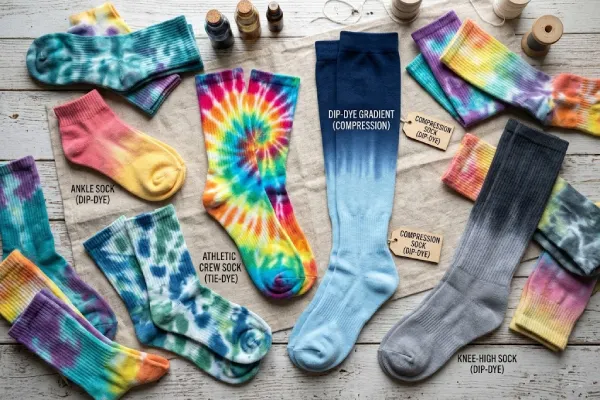
We regularly produce tie-dye and dip-dye versions across:
Compression socks: A growing number of brands in the sports recovery and lifestyle compression space want gradient aesthetics alongside functional compression. Tie-dye and dip-dye compression socks are entirely viable — the dyeing process doesn’t affect the compression properties of the yarn, since it’s applied after the sock is fully finished and the compression structure is already set.
Athletic and running socks: Brands targeting younger athletic consumers often want a design-forward product that still performs. Gradient effects pair well with performance fabrics when the base material is a cotton-spandex or cotton-nylon blend.
Casual and fashion socks: The most common application. Lifestyle brands, independent labels, and fashion retailers use tie-dye and dip-dye socks as seasonal or limited-edition products.
Yoga and pilates socks: Grip socks with tie-dye bases have been a consistent seller in the yoga and wellness space. The silicone grip is applied after dyeing, so the two processes don’t interfere.
Custom Order Specifications
Minimum order quantity: 1,500 pairs per colorway.
Lead time: Approximately 35 days from approved sample. Tie-dye and dip-dye are manual processes — each batch requires hands-on time in the dyeing stage that standard knitting production doesn’t. Plan accordingly if your timeline is tight.
Color matching: We work from your reference images or Pantone codes to develop the dye formula before sampling. The sample establishes the color standard, and bulk production is matched to the approved sample. Tie-dye patterns are inherently organic — minor variation between pairs is a characteristic of the process, not a defect. Dip-dye gradients are more consistent across pairs, though the exact transition point will have natural variation.
Design brief: When submitting your inquiry, share your color references and any design inspiration images you have — mood boards, reference photos, or examples of effects you like all work. If you already know whether you want a tie-dye pattern or a dip-dye gradient, great. If not, our team will review your references and recommend the approach that best matches what you’re going for.
FAQ
What is the difference between tie-dye and dip-dye socks?
Tie-dye involves binding or folding the sock before dyeing, creating irregular organic patterns where the bound areas resist the dye. Dip-dye (also called ombre) involves progressively immersing the sock into a dye bath to create a smooth color gradient. Tie-dye produces an unpredictable, handcrafted look; dip-dye produces a more controlled, graphic gradient effect.
Can tie-dye and dip-dye be done on compression socks?
Yes. The dyeing process is applied to the finished sock and doesn’t affect the compression yarn structure or pressure properties. We produce both tie-dye and dip-dye versions of compression socks for brands that want functional performance alongside a fashion-forward aesthetic.
Why use tie-dye or dip-dye instead of sublimation printing for gradient effects?
Two main reasons. First, most gradient sock designs use cotton-dominant fabrics, which aren’t compatible with sublimation printing — sublimation requires ≥50% polyester to bond correctly. Second, sublimation printing uses high-temperature pressing that damages spandex fibers and reduces elasticity. Tie-dye and dip-dye are low-temperature processes that preserve the sock’s stretch fully. There’s also a visual difference: dyed gradients have an organic quality that printed gradients don’t replicate.
Will the colors fade after washing?
Fiber-reactive dyes used in tie-dye and dip-dye bond directly into the cotton fiber at a molecular level — they don’t sit on the surface the way screen printing or heat transfer does. With normal care (cold or warm water wash, avoid bleach), the colors maintain good vibrancy over repeated washing. As with any dyed garment, some minor fading over time is normal.
What is the minimum order quantity, and how long does production take?
Our minimum order quantity for custom tie-dye and dip-dye socks is 1,500 pairs per colorway. Lead time is approximately 35 days from the approved sample, which is slightly longer than standard knitting production due to the manual dyeing process.
Conclusion
Tie-dye and dip-dye aren’t just a trend — they’re a production method with specific strengths for specific products. If your brief calls for gradient color, cotton-dominant fabric, and a handcrafted aesthetic, this is the right process. If you’re working with polyester fabric and want a digitally precise full-color pattern, sublimation printing is the better fit.
Not sure which direction makes more sense for your product? Send us your design reference and fabric spec. We’ll tell you which process fits and what the finished product will look like before you commit to a sample.
👉 Contact us or request a quote below.