

Most native English speakers can’t precisely explain the difference between socks and stockings — and that’s not because they don’t pay attention. It’s because the two words shift meaning depending on context. A retail buyer, a medical clinician, a fashion stylist, and a British school uniform supplier will each draw the line in a different place.
The short answer: socks are typically shorter (ankle to mid-calf), made for daily and athletic wear; stockings are typically longer (knee-high to thigh-high), with a more formal, feminine, or historical association. But in the world of compression hosiery, the two terms are routinely used to mean the same product.
This article covers four practical differences — length, material, use, and cultural context — plus the one industry where the distinction collapses entirely: medical and compression hosiery.
Socks vs Stockings at a Glance
| Aspect | Socks | Stockings |
| Typical length | Ankle to crew (some knee-high) | Knee-high to thigh-high |
| Common materials | Cotton, wool, polyester, blends | Nylon, silk, sheer synthetics |
| Primary association | Daily wear, athletic, unisex | Formal wear, women’s hosiery, historical/period |
| Compression context | Used interchangeably with stockings | Used int |
Length — The Most Common Distinction
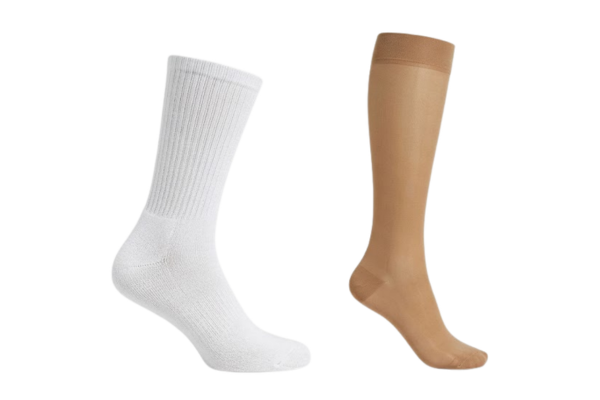
When most people use the words socks and stockings, they’re really making a length statement.
Socks span the lower end of the leg-covering spectrum: no-show (invisible), ankle, quarter, crew, mid-calf, and sometimes knee-high. The defining feature is that they end at or below the knee.
Stockings start where socks usually stop. Knee-high is the lower bound; thigh-high is the most common; full-length stockings extend to the upper thigh or attach to a garter belt or pantyhose top. Pantyhose and tights — which fully enclose the legs and connect at the waist — are sometimes grouped into the stockings category, sometimes treated separately.
The dividing line, when there is one, sits at the knee. Below the knee → socks. Above the knee → stockings.
The exception is the knee-high length itself, which lives directly on the boundary. The same physical product can be marketed as knee-high socks in athletic and casual contexts (think school uniforms in the US, soccer socks, hiking socks) and knee-high stockings in women’s hosiery and medical product lines. Neither is wrong — the word follows the audience and the channel, not the garment.
Material & Construction — Why They Feel Different

Length is the visible difference. Material is the structural one.
Socks are typically made from cotton, wool, bamboo, polyester, acrylic, or blends of these. The construction is built for durability and impact: thicker walls, terry-loop cushioning at the heel and ball of the foot, reinforced toes. A sock has to survive being walked on for hundreds of hours, so the knit is dense and the yarn is robust.
Stockings are built for a different goal: a smooth, often near-invisible appearance against the skin. Historically that meant silk — the early 20th-century stocking material that gave the category its luxury association. Modern stockings use nylon, Lycra, and sheer synthetic blends. The construction is fine, light, and often sheer enough that the wearer’s skin shows through.
The two product categories also use different machines. Socks are produced on standard circular knitting machines with needle counts of 144, 168, 200— coarse enough to handle thick yarns and high-stress wear. Sheer stockings are produced on fine-gauge machines with much higher needle counts (some exceeding 400), which is what allows the fabric to be light and translucent.
This is where the terminology starts to get messy. Modern athletic compression socks use nylon plus 20–50% Lycra — materials that sit closer to traditional stockings than to traditional cotton socks. Which is one of the reasons the compression industry uses both words almost interchangeably.
Use Case & Cultural Context

The two words also carry different cultural associations, which is part of why they’re not freely interchangeable in everyday speech.
Socks show up in athletic, casual, business (dress socks), medical (diabetic socks, plantar fasciitis socks), and outdoor (hiking, ski) contexts. The word is gender-neutral. Men, women, and children all wear socks, and no one assumes a particular style or formality from the word alone.
Stockings carry stronger contextual baggage. The default mental image for most English speakers is women’s hosiery — sheer, knee-high or thigh-high, often paired with a dress or skirt. The word also has a vintage and historical weight: 1940s nylons, mid-century pin-up imagery, period-piece costuming. And in December, “stocking” means something else entirely — the Christmas stocking hung over a fireplace for gifts is unrelated to the hosiery category.
There’s also a meaningful British vs American difference. British English uses stockings more freely in everyday contexts — knee-high knit stockings as part of a school uniform, for instance. American English would typically just call those socks. If you’re writing product copy for a global market, this is worth checking against the regional norms of your target customer.
Industries also have their own conventions: fashion and apparel retail draw a sharp line; outdoor and athletic markets use almost exclusively socks; medical and clinical contexts mix the two without much consistency. Which leads directly to the most useful exception to all of this.
The Compression Exception — When Socks and Stockings Mean the Same Thing
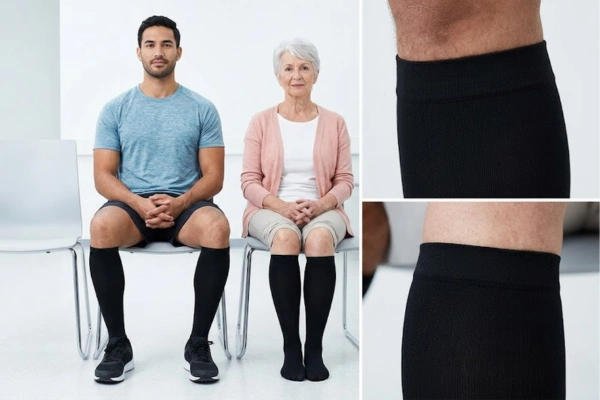
In compression and medical hosiery, “compression socks” and “compression stockings” usually refer to the same product. This isn’t sloppy terminology — it’s an industry convention that’s hardened over decades.
The pattern roughly tracks geography and channel:
- “Compression socks” is the dominant term in the US market, in DTC e-commerce, in athletic and travel-oriented brands, and in retail-floor products at pharmacies.
- “Compression stockings” is more common in clinical settings, medical prescriptions, and European markets — particularly in literature about chronic venous insufficiency, post-surgical recovery, and DVT prevention.
A single brand will often use socks in product names and stockings in physician-facing materials, with no change in the underlying product.
When are they actually different products? Sometimes a brand or supplier lists “compression socks” and “compression stockings” as separate SKUs — and in that case, the distinction usually maps onto product grade:
- Compression socks = daily-grade (15–20 mmHg), knee-high, with full design freedom on patterns and colors
- Compression stockings = medical-grade (20–30 mmHg or higher), often thigh-high, typically plain colors, produced on specialized medical knitting machines, may require ISO 13485:2016 and FDA establishment registration
If you’re working out which to source for your brand, the surface-level word matters less than the underlying spec — mmHg level, material, machine, and certification. We’ve broken down the buyer-side decision in our Compression Socks vs Compression Stockings: Buyer’s Guide.
For the more fundamental question of how compression products differ from regular socks at all, see our breakdown of the 5 differences between regular and compression socks.
Quick Reference — Which Word Should You Use?
A practical cheat sheet for anyone writing product descriptions, naming a product line, or just trying to sound right:
- Length below the knee → socks
- Length above the knee → stockings
- Athletic, outdoor, or unisex product → socks (regardless of length)
- Medical compression, US market → compression socks
- Medical compression, European or prescription context → compression stockings
- Sheer hosiery, women’s fashion → stockings (or hosiery / pantyhose / tights, depending on style)
- A red felt bag for Christmas presents → Christmas stocking (a separate use of the word)
- When in doubt → match the word your target market uses most often. The product is the same; the language follows the audience.
FAQ
Are socks and stockings the same thing?
No, but the line between them is more about length and context than physical construction. Socks generally end at or below the knee; stockings extend above the knee. In compression hosiery specifically, the two terms are often used interchangeably for the same product.
Are knee-high socks the same as stockings?
They can be. Knee-high is the boundary length where both terms apply. The same product is typically called “knee-high socks” in athletic, casual, or unisex contexts and “knee-high stockings” in women’s hosiery, medical, or fashion contexts.
What’s the difference between compression socks and compression stockings?
In most cases, none — the two terms refer to the same product, with socks more common in US retail and stockings more common in clinical and European usage. When a brand lists them as separate products, socks usually means daily-grade (15–20 mmHg, knee-high, full design freedom) and stockings means medical-grade (20–30 mmHg or higher, often thigh-high, plain colors). See our Buyer’s Guide for the detailed comparison.
Why are women’s hosiery items called stockings?
The word predates the modern sock category. In English usage going back to the 16th century, stockings covered any close-fitting leg garment. As shorter sock styles became dominant for men and athletic wear in the 20th century, the word socks took over the lower-leg category, and stockings came to refer mostly to longer, sheer, women’s hosiery.
What length officially counts as stockings vs socks?
There’s no formal industry standard that defines the cutoff. The practical convention is that anything ending at or below the knee is a sock, and anything extending above the knee is a stocking — but knee-high products fall on the line and are named based on the channel and audience.