

Selling compression socks on Amazon is profitable, but strict FBA prep rules cause headaches. One wrong label causes delays and fees. This checklist shows how to prep orders correctly before shipping.
Amazon-ready compression socks need more than good-looking packaging. You need a unit pack that stays closed, one clear scannable barcode on the outer unit, set labeling that matches the selling unit, and a packing plan that still works when the goods reach FBA.
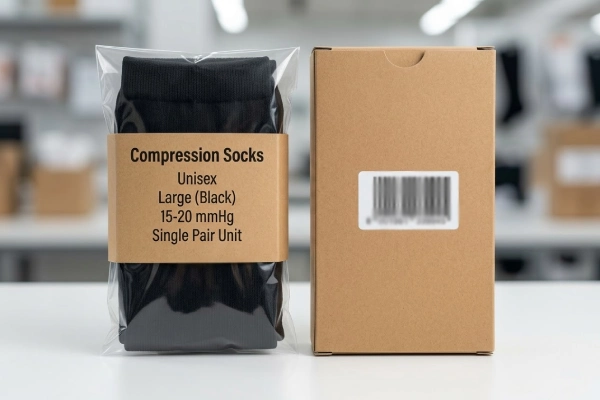
Let’s look at how to pack single units, set up barcodes, handle multi-packs, and why factory-direct prep saves time and money.
Amazon-Ready Physical Packaging Rules for Compression Socks
Soft textile products easily get dirty in giant warehouses. Poor packing leads to damaged stock. Correct physical packaging protects the socks from the factory line to the buyer’s door.
Amazon requires textile items like compression socks to be packed in secure, sealed units to prevent damage. Clear poly bags are the most common choice, but the packaging must stay closed and protect the item during normal warehouse handling.
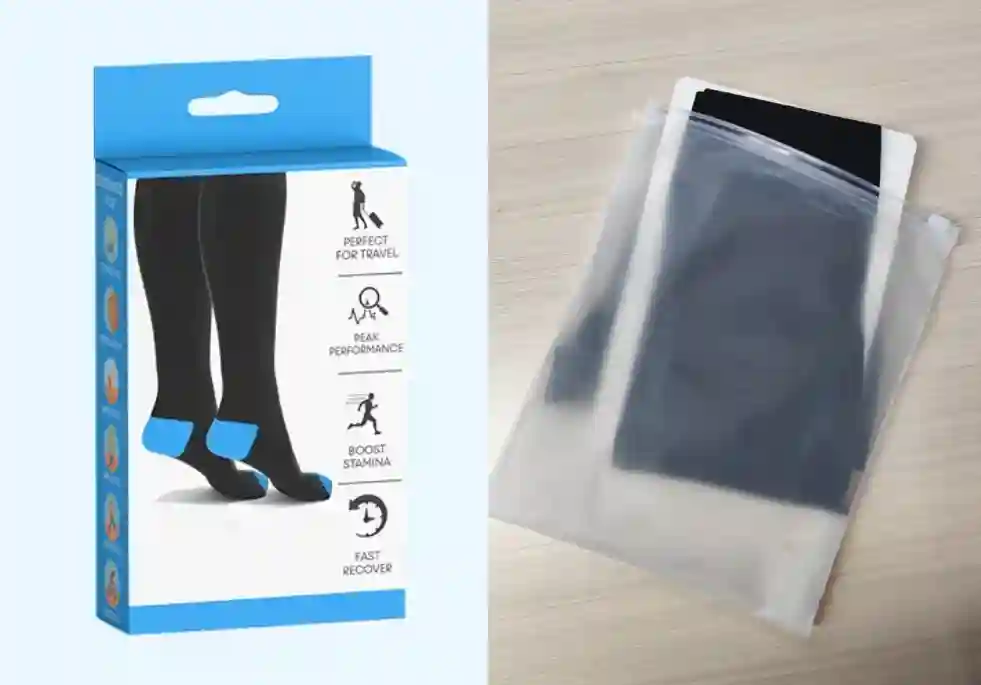
Why compression socks usually need secure unit packaging for FBA
Compression socks are soft, flexible textile items. When they enter an Amazon fulfillment center, the single unit packaging must keep the socks clean. The packaging stops the socks from falling out or unrolling during transport. This environment is very different from a local retail store shelf. Amazon workers and machines handle thousands of items quickly. They need unit handling consistency. A loose pair of socks will quickly get ruined in a large bin. A good Amazon packaging setup does not just look nice. It must survive rough handling from the moment it leaves the shipping container.
Poly bag requirements buyers should check first
For Amazon-bound compression socks, clear sealed poly bags are often the most practical option to meet common FBA prep expectations. Poly bags are cheap, light, and easy to seal. Amazon expects these bags to be completely transparent so workers can see the product inside. The bag material should be at least 1.5 mil thick. You need to seal the bag completely so the socks stay safely inside. If the flat opening of the poly bag is 5 inches or larger, you usually need a suffocation warning printed on the plastic or attached as a label. This keeps the product compliant with basic safety rules and prevents account warnings.
When custom boxes or sleeves make sense for compression socks
Custom boxes or paper sleeves work well for specific compression sock projects. You might use a box for medical-looking products, premium sports lines, or giftable multi-packs. But here’s the kicker… Amazon does not care how pretty the box is. The outer package must stay securely closed. It must protect the unit through normal warehouse handling without taping it heavily. A drop-test-ready structure is usually the safer choice for Amazon-bound stock. If a paper sleeve easily slides off, Amazon might reject the unit. The surface must also be flat enough to hold a barcode sticker securely. To avoid issues, read about common compression sock packaging mistakes that cause FBA delays.
Barcode & Labeling Setup for Amazon Compression Socks
A wrong barcode setup can create confusion even when the socks and packaging look correct. Too many visible barcodes, unclear unit matching, or weak placement can all slow the order. The outer retail unit needs one clean barcode plan.
The outer retail unit for compression socks should keep one clear scannable barcode. Extra barcodes that can still be scanned should be covered or made unreadable. Barcode logic should also match the real selling unit, especially when size variants, support levels, or multi-pack formats are involved.
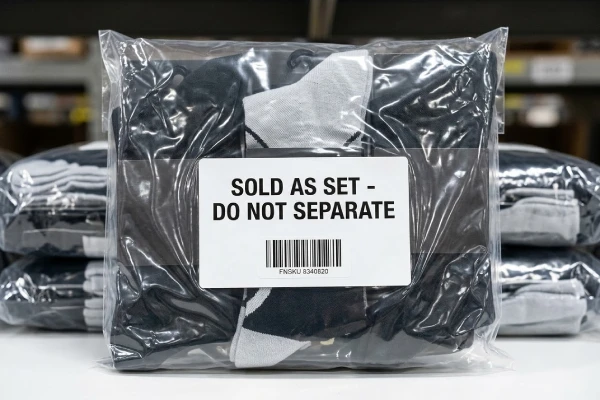
The one-scannable-barcode rule on the outer unit
Your socks need a barcode so Amazon knows what the item is and who owns it. The strict rule is simple. The outer retail unit should keep only one scannable barcode. If the factory prints a barcode on the insert card, and you stick another barcode on the outside bag, the scanner gets confused. Any extra barcode that can still be scanned should be covered with a blank sticker. You can also make it unreadable with a thick black marker. This single step prevents massive inbound handling delays and prevents unexpected prep fees on your seller account.
Why many private label compression socks sellers prefer FNSKU
Many private label sellers still prefer FNSKU because it gives tighter unit-level control inside Amazon’s system. That said, Amazon has announced commingling changes effective March 31, 2026, including more flexibility for some Brand Registry sellers using manufacturer barcodes. That means sellers should not rely on old barcode assumptions. You should always check the latest barcode policy for your account and shipment plan before final label printing.
Compression socks variant logic: size, support level, and pair count
Compression socks are not a one-size-fits-all product. They have many variations. You usually sell different shoe sizes or calf sizes. Many product lines also feature different compression levels, like 15–20 mmHg or 20–30 mmHg. You might sell single pairs, 2-packs, or 3-packs. Each combination is a different selling unit. Your barcode planning must match the size, the compression level, and the pair count perfectly. If you put a size large FNSKU on a size small package, you will get buyer returns and bad reviews.
Label placement basics for Amazon handling
You need to put the barcode in a place where a scanner can read it quickly. Apply the sticker to a flat, smooth area on the package. Do not put the barcode over an edge, near a seam, or on a curved surface. Avoid areas where the poly bag gets wrinkled. Think about the package shape before you print the stickers. If you need help choosing between a manufacturer barcode and an Amazon barcode, check our guide on UPC vs FNSKU for compression socks on Amazon. You can also review exactly where to place barcodes and labels on compression sock packaging.
Multi-Packs and Carton Setup for Amazon Shipments
Without clear labels, a 3-pack may be split into single pairs in the warehouse. That increases the risk of shipping errors, refunds, and extra handling costs.
Multi-pack compression socks act as a single retail unit. The outer package needs one barcode matching the bundle, and you should apply clear set wording like “Sold as Set” so warehouse workers do not separate the socks.

Multi-pack compression socks work well for travel, work, recovery, and repeat-use buyers. But a 3-pack is not just three separate pairs thrown into a box. The outer package holding the three pairs is the actual Amazon retail unit. The pair count, the barcode, and the set identification must match that outer unit. The inner individual pairs should not show any visible barcodes at all. If the inner pairs have barcodes, the scanner might read the wrong price and inventory code.
Amazon guidance commonly recommends clear wording for sets sold as one unit. Phrases such as “Sold as Set” or “Do Not Separate” are often used to reduce handling confusion. The exact wording can vary, but the goal stays the same. The pack should tell warehouse teams and prep teams that the outer unit is one sellable item.
Carton planning should also stay realistic. Check carton weight, carton size, inner unit count, and how the cartons match the inbound shipment plan. Amazon carton rules can change by program and shipment type, so it is safer to verify current inbound carton limits before dispatch than to rely on old numbers from memory. Good planning here saves you from paying repacking fees at the port.
Why Factory-Direct FBA Prep Makes More Sense
Many sellers fix packaging and barcode problems after arrival. That sounds flexible, but it often becomes expensive. Every extra handoff adds labor, delay, and another chance for mismatch. Running out of stock hurts your ranking. Factory prep eliminates these middle steps completely.
Factory-direct FBA prep usually reduces extra handling, relabeling, and repacking after arrival. For compression socks, that matters even more because size variants, pair counts, and support-level distinctions can make late corrections slower and more expensive.
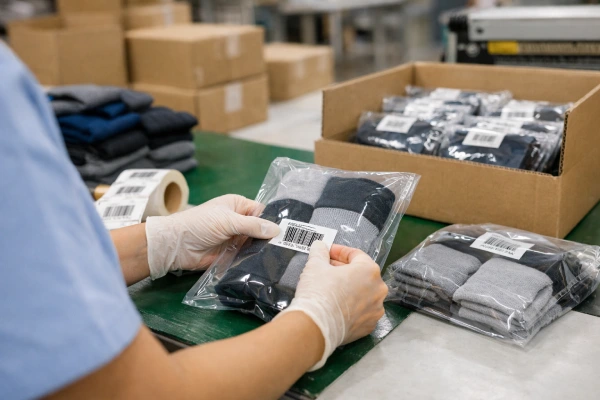
The hidden cost of relabeling after arrival
Many sellers ship stock to the US or Europe and pay a local third-party logistics company to relabel and repack the goods. The problem is more than just paying for local labor. You face double shipping costs to move the goods twice. You wait in a long queue for the warehouse to start your job. The risk of label mismatches goes up when strangers handle your different size variants. All of this causes a big delay in getting your socks online. It pushes your launch date back and leaves your listing inactive.
What factory-direct FBA prep solves for compression socks sellers
When the factory does the prep work, the barcode gets applied before shipment. The Amazon-ready packaging is completely finished before the goods even leave the country. You get better control over single pair versus multi-pack setups. There are fewer handoffs between production, packing, and final shipment. The socks go straight from the factory floor, into the shipping container, and directly into the Amazon fulfillment center. You skip the middleman and save a lot of money on processing fees.
Why this works especially well for custom compression socks
Compression socks often involve many size variants. Support-level distinctions matter a lot to the end buyer. Single pair and multi-pack programs often run at the same time. The truth is… packaging and labeling errors cost much more in this category than with basic daily socks. A wrong size label leads to a medical complaint, which hurts your seller account fast. Handling all sorting and labeling right next to the sewing machines keeps the accuracy very high. The workers packing the socks know exactly which size goes into which bag.
Why buyers use our factory for this workflow
Buyers use our factory for this workflow because production, packaging, barcode labeling, and export packing can be handled in one connected process. That helps reduce extra relabeling, repacking, and coordination after arrival.
We operate as an integrated manufacturing and trading company and support both factory-supplied packaging and client-supplied packaging for Amazon compression socks programs. We can complete FBA-ready barcode labeling and final packing before shipment, which helps keep the approved selling unit aligned from production to export.
For buyers testing new Amazon programs, we also offer a low MOQ of 500 pairs per color and size, with normal lead times of 25 to 30 days for repeatable order planning.
Conclusion
Getting your packaging and barcodes right stops extra fees and saves you time. Good prep before shipping keeps your Amazon compression socks business running smoothly and protects your profit.
Stop paying for avoidable relabeling and repacking after arrival. Work with an integrated manufacturing and trading company that can support FBA-ready packaging, barcode application, and bulk shipment planning before export. Get a Free FBA Packaging Evaluation today, or Request a Custom Compression Socks Quote.
FAQs
Do compression socks need to be packed in poly bags for Amazon FBA?
In many FBA cases, textile items need secure unit packaging. Clear sealed poly bags are often the simplest way to meet common prep expectations for compression socks.
Can I send compression socks to Amazon with both UPC and FNSKU visible?
That is risky. The outer retail unit should keep only one scannable barcode. Any extra barcode that can still be scanned should be covered or made unreadable.
Does a 3-pack of compression socks need its own barcode?
Yes, the outer 3-pack is the retail unit. Barcode planning should match that unit, not one inner pair.
Do I need “Sold as Set” wording on multi-pack compression socks?
For sets sold as one unit, clear set wording is commonly recommended in Amazon guidance to reduce handling confusion.
Can my factory apply FNSKU labels before shipment?
Yes. Many private label sellers ask factories to complete barcode labeling and final retail packing before export.
Can I use my own branded packaging for Amazon-bound compression socks?
Yes, but the packaging should match the approved sock size, pair count, and barcode plan before bulk packing starts.