

Introduction
There are many steps between a yarn cone and a finished sock — and each one affects the quality, price, and lead time of your order. Most buyers only see the finished product. Understanding what happens before it arrives helps you ask better questions, write tighter specs, and avoid the surprises that come from misaligned expectations.
This guide walks through the full production process we use at Max Hosiery, covering both conventional socks and compression socks, with notes on where the two diverge and what each step means for your order.
Step 0: Design & Tech Pack
Production doesn’t start at the machine. Before a single stitch is knitted, our engineers need to translate your artwork into a format the machine can read.
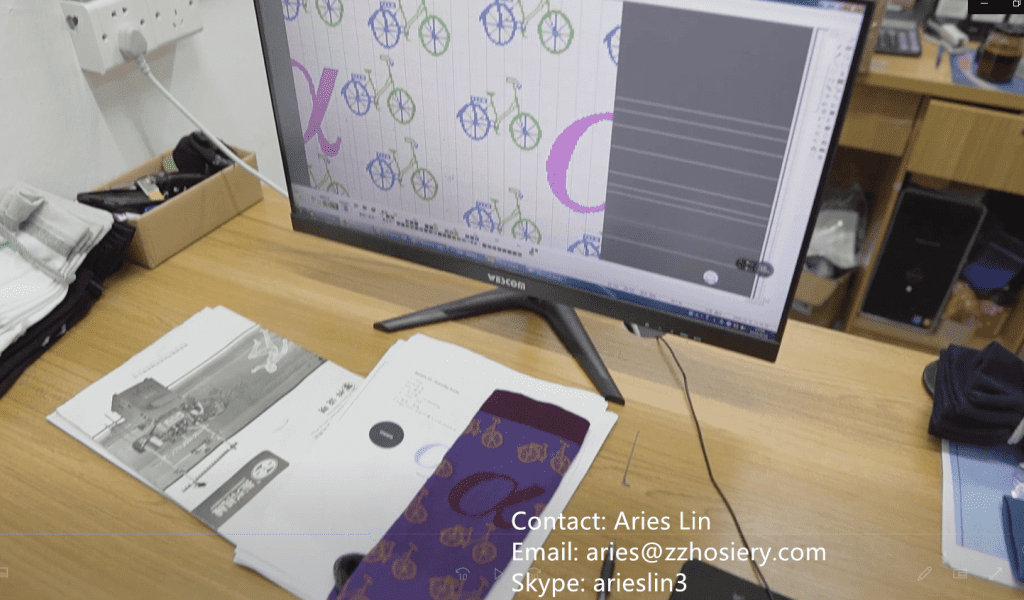
For jacquard socks, this means converting your logo or pattern into a grid-based pixel map — each square representing one stitch on the needle bed. This is similar to working with a bitmap image: curves become stepped edges, gradients aren’t possible, and the maximum color count is typically limited to 6 per design. If your artwork wasn’t originally designed for this constraint, our team will flag adjustments needed before sampling begins.
This conversion step is also where we determine which needle count is appropriate for your design. A logo with fine text or detailed geometry needs 168N or 200N to reproduce cleanly; a bold block pattern works fine at 144N. If you’re not familiar with how needle count affects pattern quality, this guide explains it in detail.
For printed socks, the design process is different — the artwork is prepared digitally and applied post-knitting rather than woven in. If you’re not sure whether your design should be knitted or printed, this article on jacquard vs. sublimation printing covers the decision in detail.
Step 1: Material Preparation
Once the tech pack is confirmed, we purchase raw materials according to the order specification.
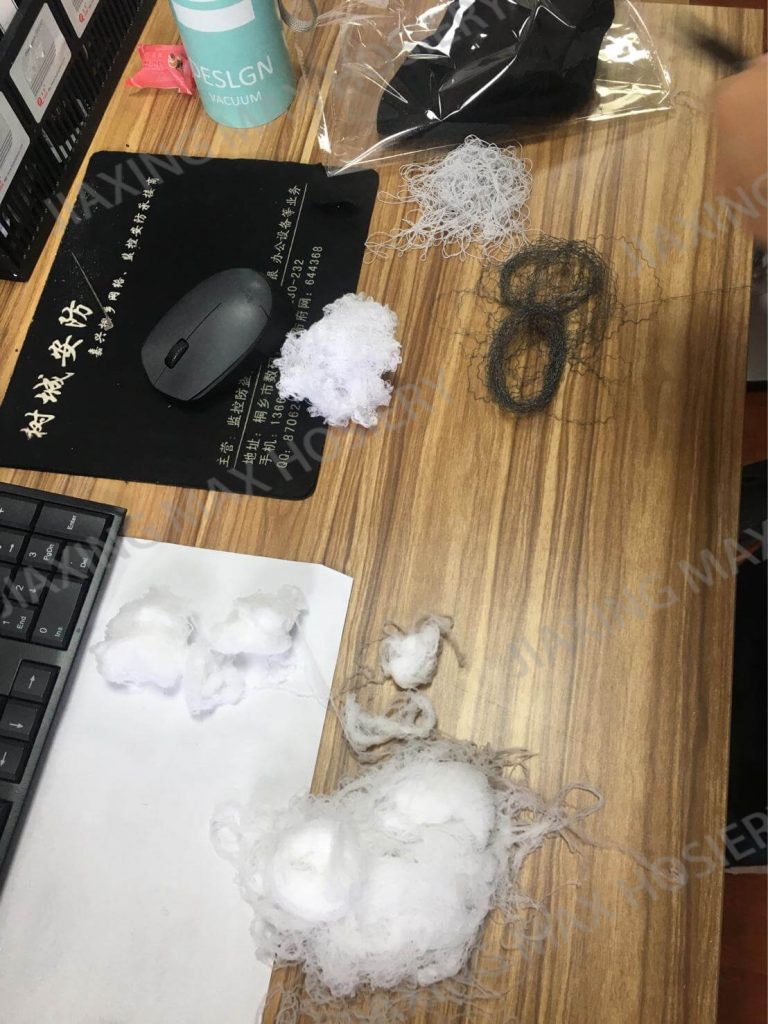
The basic yarn categories we work with include combed cotton, bamboo viscose, polyester, nylon (polyamide), merino wool, and spandex/elastane. Most of these are available as stock yarns in standard colors. If your specification requires a custom color that doesn’t exist in stock, we need to commission a yarn dye run — this typically adds 15–20 days to the lead time and is one of the most common causes of unexpected delays. If your color is critical, confirm yarn availability before finalizing your timeline.
The number of machines allocated to your order is determined at this stage based on order quantity and product complexity. Two key output benchmarks as reference:
- Standard crew-length cotton sock: ~200 pairs per machine per day
- Compression sock: ~120–150 pairs per machine per day
Step 2: Knitting
This is the core production step. Sock knitting machines work on a circular needle bed — the yarn feeds onto a cylinder of needles arranged in a ring, and the sock is knitted in a continuous tube from cuff to toe. Each rotation of the cylinder produces one course (row) of stitches.
Our factory runs both standard knitting machines and two categories of medical-grade machines: LONATI and Merz. These medical-grade machines are used exclusively for compression socks and medical hosiery. They operate with tighter tolerances than standard machines, allowing more precise control over yarn tension and stitch density — both of which directly affect compression performance.
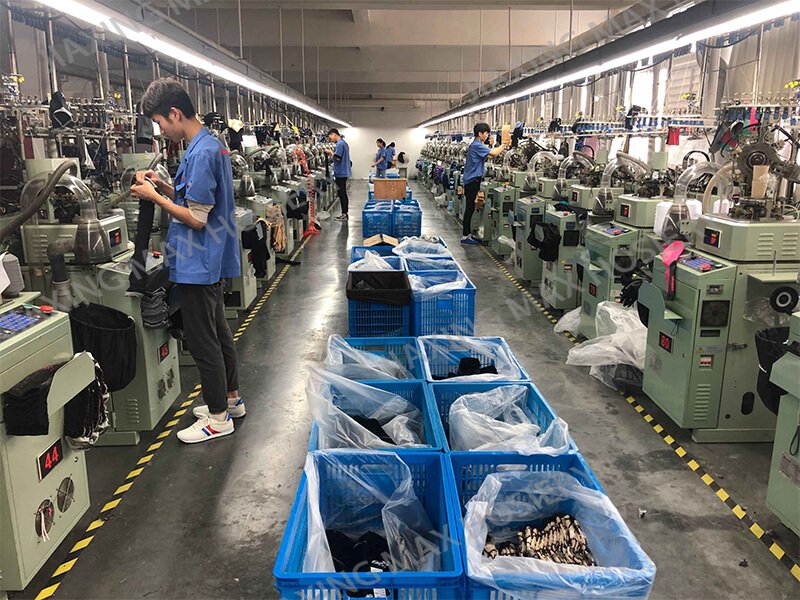
The knitting stage is also where needle count matters practically. A 200N machine has more needles arranged on the same cylinder diameter than a 144N machine, which means finer yarn, higher stitch density, and more precise pattern reproduction — but lower output per machine per day. For large orders on a tight timeline, needle count is one of the specs worth discussing early.
Several factors affect output and therefore lead time at this stage:
Pattern complexity: A full-coverage jacquard pattern with multiple colors has significantly more machine stops and yarn changes than a plain sock. Complex patterns or all-over designs typically reduce daily output and increase defect rate, which means more buffer stock needs to be knitted to meet the final quantity.
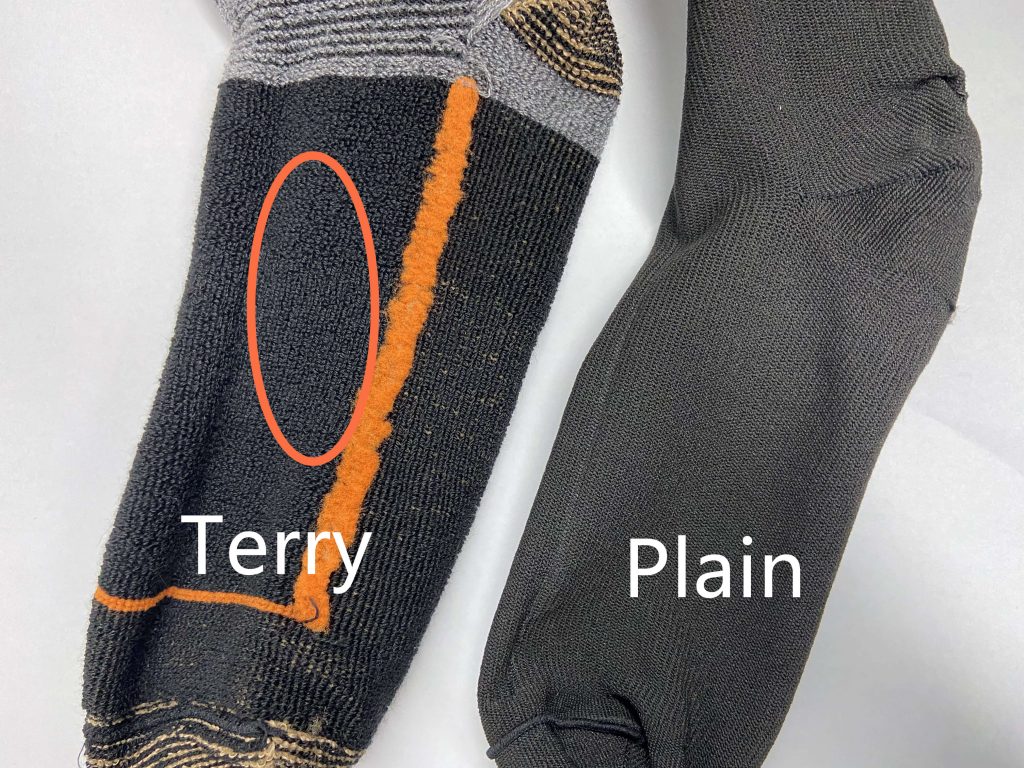
Sole structure: Terry/cushion soles require additional yarn feeds and slower knitting speed compared to flat soles. The terry loops are formed on every course of the sole area, which increases both material consumption and machine time. On higher needle count machines (200N), terry loops come out finer and thinner than on lower needle count machines — if thick cushioning is a priority, discuss needle count and structure together when specifying.
Color: Light-colored and white socks require a machine warm-up period at the start of production. Because knitting machines use oil for lubrication, the first socks produced may have slight oil contamination. This stabilization period means light colors — especially white — have a slightly longer effective production time than dark colors.
Size range: Each size change requires machine adjustment, typically around half a day per size changeover. Orders with many sizes across the same style will have proportionally longer production time.
Step 3: Socks Flipping
After knitting, the socks come off the machine as inside-out tubes with an open toe end. Workers flip each sock to the correct orientation and mount it on a sock inspection plate.
This step serves two purposes: it prepares the sock for toe linking, and it creates the second quality inspection point in the production process. With the sock mounted flat on the plate, workers can clearly identify holes, broken yarns, pattern misalignments, and any knitting defects that weren’t caught during the first in-line inspection.
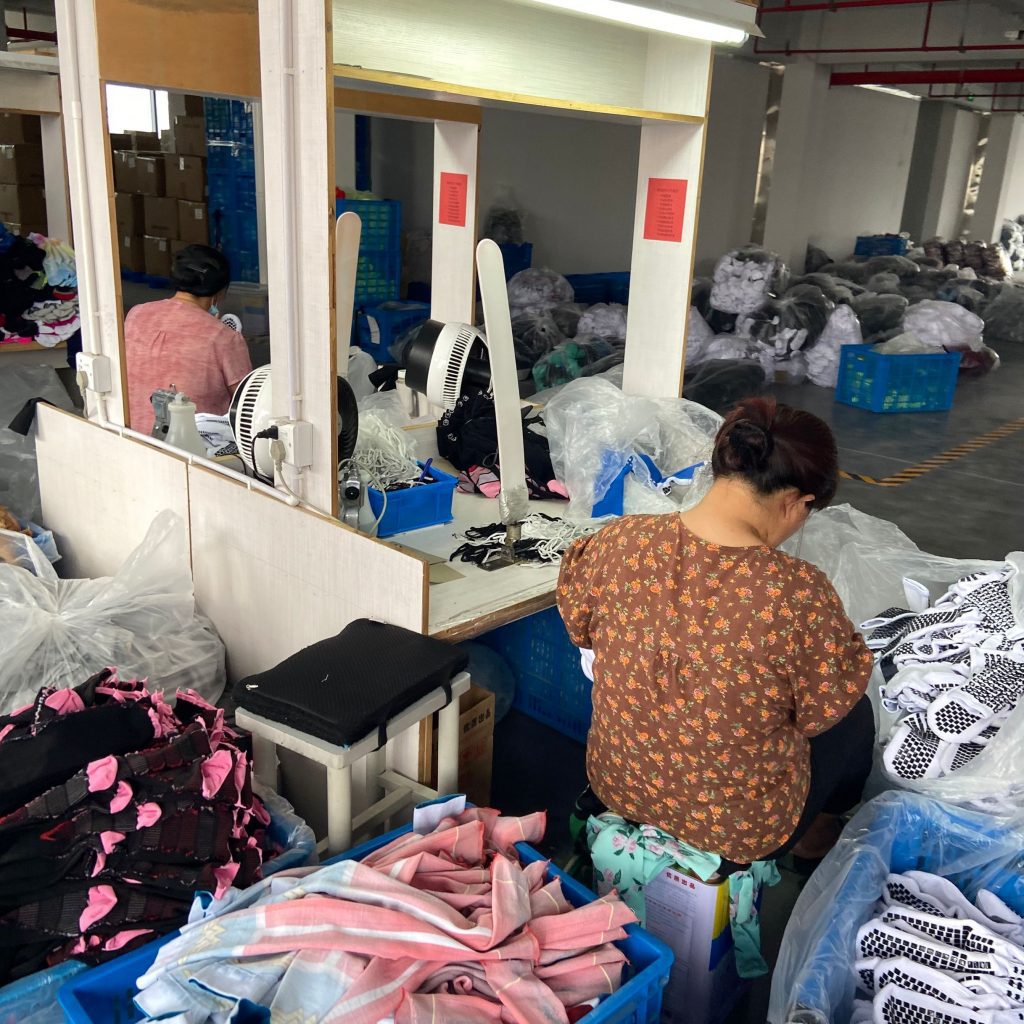
Problems identified at this stage can still be addressed before toe linking — catching them here is significantly cheaper than catching them after boarding and packaging.
Step 4: Toe Linking
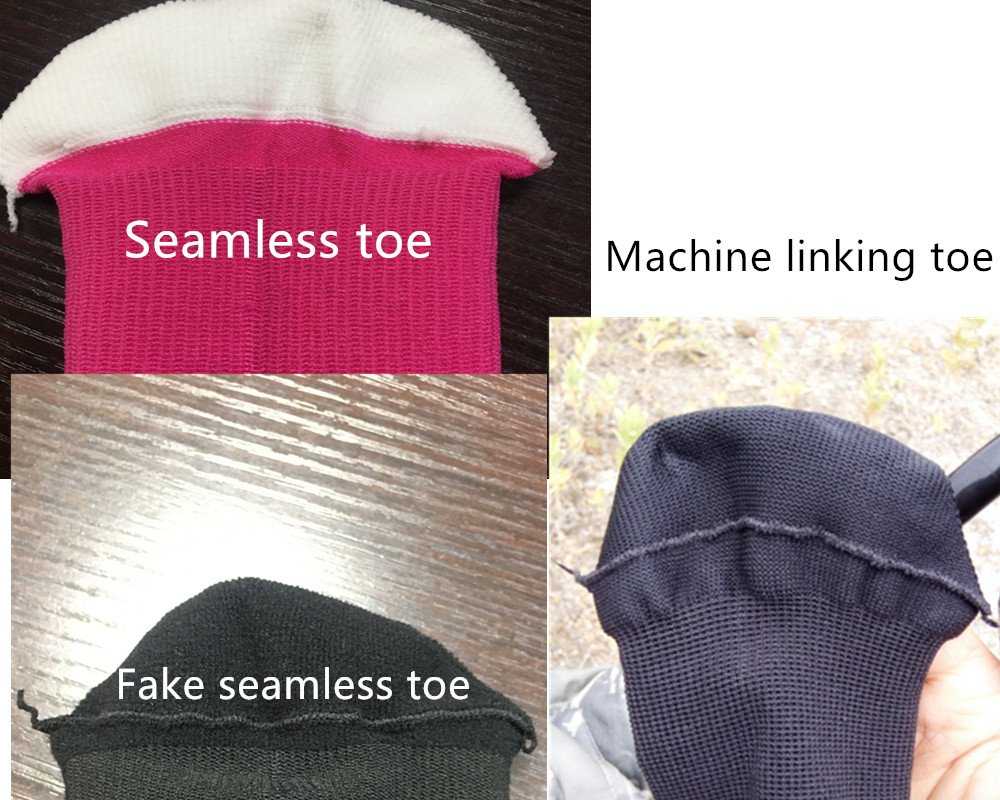
The knitted sock tube has an open toe that needs to be closed. There are two main methods, and the choice affects comfort, price, and lead time.
Seamless hand-linking :
Each stitch on the toe opening is individually aligned to its corresponding stitch on the opposite side and linked together on a specialized machine. When done correctly, no seam ridge is visible or felt inside the sock. This is the preferred method for premium socks, compression socks, and any product where toe comfort is a priority — a prominent toe seam creates friction and pressure points, which matters more in compression products where the sock is worn for extended periods.
Traditionally, seamless hand-linking was a separate manual operation after knitting, which added significant time to the production cycle. We’ve recently introduced integrated knitting machines that complete the hand-linking process as part of the knitting cycle itself — the sock comes off the machine with the toe already seamlessly closed. This reduces the overall production lead time for seamless products considerably. The machines carry a higher equipment cost, but we’ve maintained the same pricing for our customers. We’re progressively replacing our older machines with this integrated setup across the factory.
Rosso linking : The toe is closed by machine, leaving a visible seam ridge on the inside. This is the standard method for most basic athletic and casual socks. It’s faster and cheaper, and for many applications the seam is not a meaningful comfort issue.
For a detailed comparison of these two methods and guidance on which is appropriate for different product categories, this article goes into full detail.
Step 5: Boarding
Fresh off the machine, a sock looks shapeless and baggy — nothing like the finished product. Boarding is the process that changes this.
Each sock is pulled over an aluminum form (boarding plate) shaped like a foot, then passed through a setting machine that applies high-temperature steam under pressure. The heat and steam relax and reset the yarn structure, locking the sock into its final shape and dimensions.
Boarding plate specifications determine the finished sock size — different plates for different sizes, and different shapes for bent-board vs. straight-board products. (Straight boarding is used for sublimation-printed socks, as it allows even heat and pressure contact across the flat sock surface during printing. For more on this, see the size measurement guide.)
For compression socks, boarding precision is a functional requirement, not just an aesthetic one. Because the compression zones are designed to sit at specific anatomical positions on the leg and ankle, a boarding dimension that’s off by more than the tolerance range will shift those zones — the sock will still look correct but may not deliver the intended graduated pressure profile. Our compression sock boarding uses size-specific plates with tighter tolerances than standard sock production.
Output at the boarding stage is inversely related to sock thickness and length: longer, thicker socks take more time per cycle, which reduces daily throughput.
Step 6: Accessories
For many custom sock orders, the sock itself is only part of the finished product. Accessories include grip dots (silicone rubber), embroidery patches, woven or printed labels, hang tags, lace trims, and specialty cuffs.
Each accessory type is a separate production workstream with its own lead time:
- Silicone grip printing requires a screen setup and curing process done after boarding
- Embroidery patches are made separately and attached in a secondary operation
- Custom woven labels typically require 7–10 days of production from a label supplier before they arrive at the factory
This means accessories can become the lead time bottleneck even when sock production runs on schedule. If your product includes custom accessories, confirm their production timeline separately and ensure they’ll arrive at the factory before the socks are ready for final pairing and packing.
Step 7: Quality Control
Quality inspection runs throughout the production process, not just at the end. There are three main checkpoints:
First inspection (knitting stage): In-line monitoring during knitting checks for pattern errors, size deviations, holes, and machine-related defects. If a machine fault is identified, it’s corrected immediately to prevent a batch of defective product.
Second inspection (flipping stage): As described above, each sock is visually inspected on the plate for holes, loose threads, and surface defects before toe linking.
Final inspection (before re-pairing): Completed socks are checked for overall appearance, size conformance, and correct accessory attachment before being paired and packed.
For compression socks, pressure testing is an additional requirement at every stage. We use the Swisslastic MST MK V compression tester to verify that finished socks meet their specified pressure values. Testing is conducted at the sampling stage to validate the design, and again during pre-production and mid-production to confirm consistency. The MST MK V measures pressure at multiple points along the leg (ankle, calf) to verify the graduated pressure profile — not just a single point reading.
Step 8: Re-pairing
Before packing, workers pair each two socks by size and visual match. This step also serves as a final size tolerance check — because different color yarns can have slightly different shrinkage behavior, two socks of nominally the same size in different colors may measure fractionally differently. The standard tolerance is ±1cm on foot length, which does not affect fit given the stretch of the fabric.
Socks that don’t pass the final visual or size check at this stage are pulled and handled separately.
Step 9: Packaging
Packaging options include OPP poly bags, color boxes, color bags, header cards, and combinations of the above. The choice of packaging affects both cost and lead time:
- OPP poly bag: Standard for wholesale/B2B bulk shipment. Fastest and lowest cost.
- Header card: Common for retail hook display. Requires card printing lead time if custom-designed.
- Color box: Used for gift retail or premium presentation. Requires box manufacturing lead time, typically 7–10 days if custom.
- Color bag: Often used for sports or outdoor retail. Similar lead time to color boxes.
If your packaging requires custom printing, build the packaging production timeline into your overall order timeline separately from sock production — packaging components arriving late is a common and avoidable cause of shipment delays.
What Affects Lead Time: A Complete Reference
| Factor | Impact | Notes |
| Custom yarn color | +15–20 days | Dyeing lead time before knitting can begin |
| Pattern complexity | Significant | Full-coverage jacquard reduces output; more buffer stock needed |
| Sole structure | Moderate | Terry sole is slower to knit than flat sole |
| Light/white colors | Variable | Machine stabilization period required; actual impact depends on order quantity and scheduling |
| Multiple sizes | Variable | Machine adjustment required per size changeover; impact depends on how many sizes and total order volume |
| Seamless toe linking | Reduced vs. before | New integrated machines have shortened this significantly compared to traditional separate hand-linking |
| Custom accessories | Variable | Labels, grips, patches have independent lead times |
| Custom packaging | +7–10 days | Color boxes and header cards require separate production |
| Compression socks | Longer overall | Lower knitting output, more QC checkpoints, pressure testing |
Compression Socks: Production Differences
Compression socks share the same basic production flow as conventional socks, but with several additional requirements:
Specialized machines: We use LONATI and Merz medical-grade knitting machines for compression and medical hosiery. These machines provide the tension control precision that compression specifications require — standard machines cannot reliably maintain the consistency needed for medical-grade products.
Boarding precision: As noted above, compression sock boarding uses tighter dimensional tolerances because size directly affects pressure zone positioning.
Pressure testing (Swisslastic MST MK V): Compression performance is verified at sampling, pre-production, and mid-production. Each batch is tested against the specified pressure values (mmHg) at ankle and calf measurement points before the order is released for packing.
If you’re developing a compression sock line and want to understand the full specification requirements, our custom compression socks page covers the options available.
Every step in this process is a decision point that affects what ends up in the box — and what your customer feels when they put the sock on. Understanding the production flow helps you brief factories more precisely, set realistic timelines, and catch specification conflicts before they become sampling rounds.
If you have a project in development and want to walk through the production requirements for your specific product, send us your design and target spec. We’ll review it and tell you exactly what the production process looks like for your order.
👉 Contact us or request a quote below.
FAQ
How long does it take to produce custom socks from start to finish?
For a standard custom jacquard sock with stock yarn colors, typical production lead time is 25–30 days from approved sample. Add 15–20 days if custom yarn dyeing is required. Complex accessories, custom packaging, or seamless toe linking will extend this further. Compression socks generally run at the longer end of the range due to lower machine output and additional QC requirements.
What is the difference between seamless toe linking and rosso linking?
Seamless hand-linking aligns each stitch individually and closes the toe with no visible or tactile seam. Rosso linking closes the toe by machine and leaves a seam ridge inside the sock. Seamless is slower and more expensive but produces better wearing comfort, especially for compression and performance socks worn for extended periods.
Do compression socks go through a different production process?
Yes, in several ways: they require covered yarn preparation before knitting, are produced on specialized LONATI or Merz medical-grade machines, have tighter boarding tolerances, and go through pressure testing at multiple production stages using a Swisslastic MST MK V tester. Standard sock machines cannot produce compression socks to medical-grade specifications.
What causes the most common production delays?
The three most frequent causes are: custom yarn color (adds 15–20 days that buyers often don’t budget for), custom accessories arriving late from suppliers, and late approval of pre-production samples. Confirming yarn availability and accessory timelines at the order stage prevents most of these.
How does boarding affect the final size and shape of a sock?
Boarding sets the sock’s permanent shape and dimensions using high-temperature steam. The boarding plate size determines the finished measurements. For compression socks, boarding precision is particularly important because slight dimensional variation shifts the graduated pressure zones away from their intended anatomical positions.