

People who don’t know about sock design often confuse jacquard with print — and it’s an easy mistake to make. From a distance, both can look like a patterned sock. But the two processes are fundamentally different, and choosing the wrong one will cost you time, money, and rounds of unnecessary sampling.
If you understand the difference upfront, you’ll be able to make a rough judgment on pricing before you even contact a supplier, avoid design mistakes that make your artwork impossible to produce, and know which process actually fits your product and end market.
This guide covers all four main decoration methods used in sock manufacturing: jacquard knitting, sublimation printing, screen printing, and tie-dye / dip-dye — including when to use each one, and the common mistakes buyers make when specifying the wrong process.
What Is Jacquard Knitting?
Jacquard is a pattern knitted directly into the sock during production. Before the socks are manufactured, an engineer designs the pattern on computer software — the draft looks similar to a vector or pixel-based grid, where each square represents one stitch on the machine.
Once the pattern is programmed, the sock machine knits it automatically. Every color in the design is a different yarn feed; the machine selects the right yarn at each stitch position to build the pattern row by row.
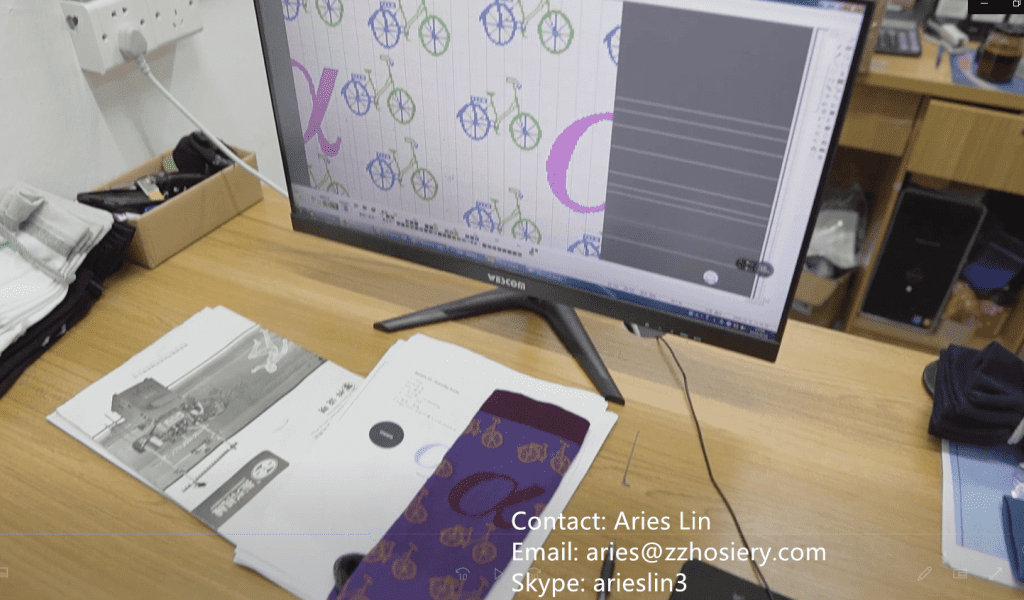
Because the color is literally built into the yarn structure, jacquard patterns don’t crack, peel, or fade with washing. The design is as durable as the sock itself.
Key characteristics of jacquard:
- Colors woven directly into the fabric — no surface layer
- Maximum color count: typically up to 6 colors per design
- No gradients or photorealistic images
- Compatible with most yarn types: cotton, polyester, nylon, wool blends
- Elasticity fully preserved
- Most durable decoration method available for socks
What Is Sublimation Printing?
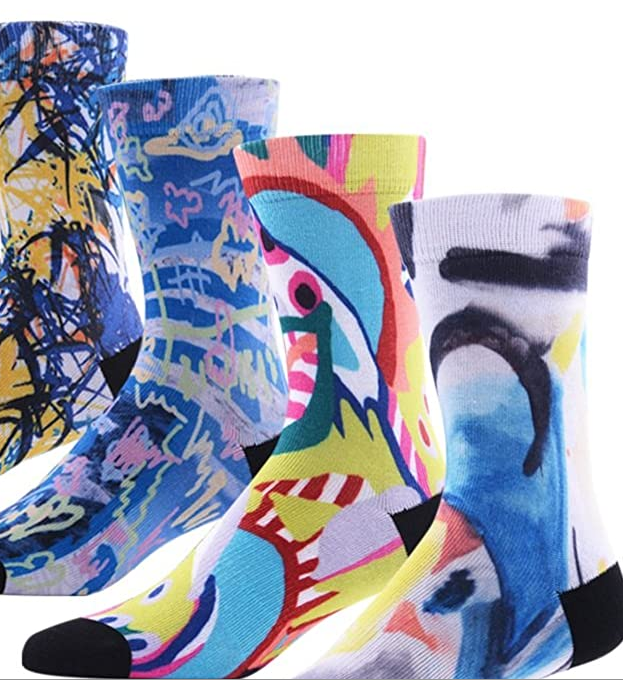
Sublimation printing transfers patterns onto finished socks using heat and pressure. A design is printed onto special transfer paper using sublimation ink, which is then pressed against the sock surface at around 200°C. At that temperature, the solid ink converts directly to gas and bonds into the polyester fibers — becoming part of the fabric rather than sitting on top of it.
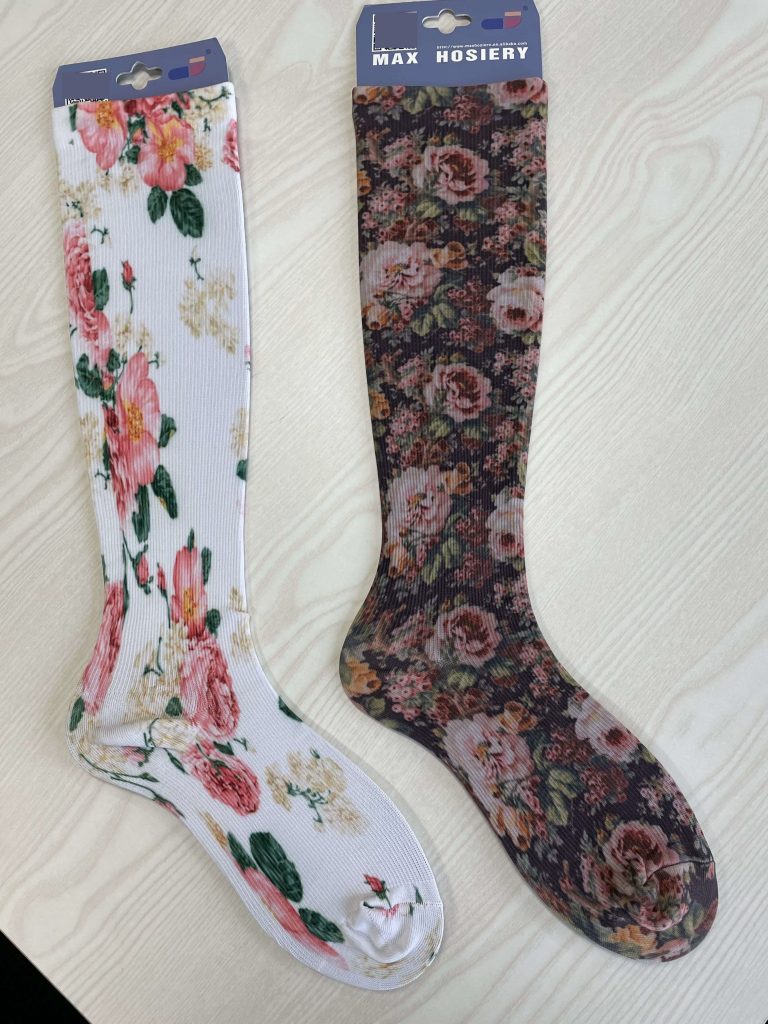
Because the dye penetrates the fiber, sublimation prints don’t crack or peel. However, the high temperature required has two important consequences: it partially damages the elastic fibers (spandex/lycra) in the sock, reducing stretch; and it only works on synthetic fibers — polyester primarily, because polyester is heat-resistant and bonds well with sublimation dye.
Key characteristics of sublimation printing:
- Unlimited colors, including gradients and photorealistic images
- Requires ≥50% polyester content for acceptable results
- Nylon is technically compatible, but the cost is 2–3× higher than polyester
- Cannot print on dark or black base fabric — sublimation has no white ink, so dark backgrounds will overpower the design
- Elasticity partially reduced after high-temperature pressing
- Less breathable than a knitted sock of equivalent weight
What Is Screen Printing on Socks?
Screen printing on socks works differently from how most people picture it. On garments like T-shirts, screen printing can cover a large area. On socks, it’s almost exclusively used for small-area prints — typically within a 5×5cm area — such as a single brand logo, a flag, or a small graphic on the ankle or leg panel.
Each color requires a separate screen and a separate press run, which makes screen printing cost-effective for simple designs but impractical for anything with more than 4–5 colors or any gradient.
Key characteristics of screen printing on socks:
- Best for: small logos or single motifs, ≤5×5cm
- Compatible with most fabrics including cotton
- Color limit: typically 4–5 colors maximum
- No gradients
- Can be applied to dark base fabrics
- Low setup cost for simple single-color applications
What About Gradient and Ombre Effects? Tie-Dye and Dip-Dye
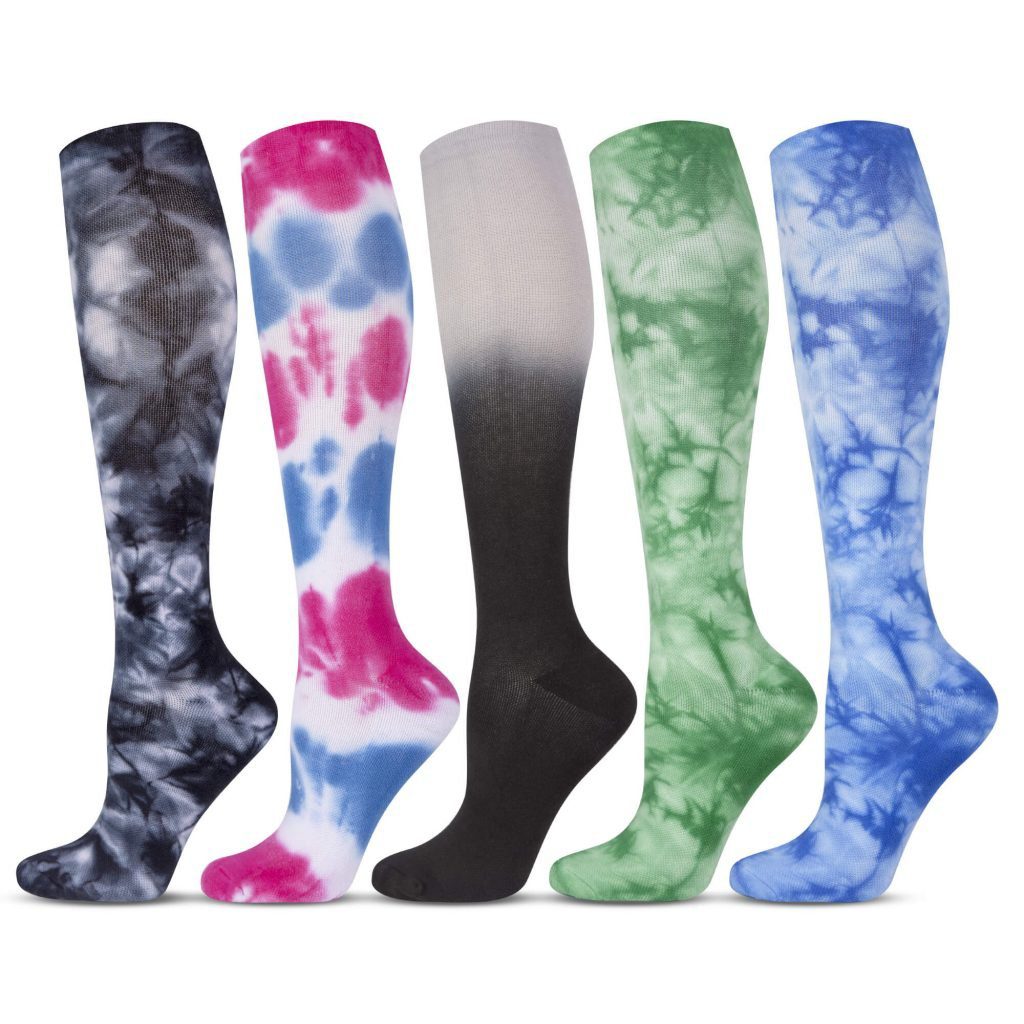
Customers often assume that gradient or ombre effects on socks are done with sublimation printing. In practice, we use tie-dye or dip-dye for most gradient work — and there are specific reasons for this.
Tie-dye involves binding, twisting, or folding the sock before applying fiber-reactive dye, which creates irregular, organic color patterns. Dip-dye (ombre) involves gradually immersing the sock into a dye bath at timed intervals, producing a smooth gradient from one color to another.
Both methods use fiber-reactive dyes that work best on natural fibers — primarily cotton or cotton-polyester blends. Here’s why this matters for gradient designs specifically:
Why not sublimation for gradients?
First, many fashion socks with gradient designs are cotton-based. Sublimation printing requires ≥50% polyester — on high-cotton fabric, the gasified dye spreads and diffuses excessively, producing a blurry rather than defined result.
Second, sublimation requires ~200°C heat pressing, which damages spandex and elastic fibers. Tie-dye and dip-dye are low-temperature processes that leave the sock’s elasticity fully intact.
Third, the visual result is different. Sublimation produces a digitally precise gradient. Tie-dye and dip-dye produce a natural, organic color bleed that has a handcrafted aesthetic — which is often exactly what the end market wants for fashion or lifestyle socks. That look cannot be replicated digitally.
Key characteristics of tie-dye / dip-dye:
- Best for: gradient, ombre, and abstract color-bleed effects
- Requires high cotton content (≥70% cotton for best dye absorption)
- Works on natural and natural-blend fibers — not suitable for high polyester
- Elasticity fully preserved (low-temperature process)
- Results have an organic, handcrafted character
- Higher labor cost than other methods due to manual process
Full Comparison: All Four Methods at a Glance
| / | Jacquard Knitting | Sublimation Printing | Screen Printing | Tie-Dye / Dip-Dye |
|---|---|---|---|---|
| Color limit | ≤6 colors | Unlimited | ≤4–5 colors | Natural bleed, organic |
| Gradients | Not possible | Yes | Not possible | Yes (natural effect) |
| Fabric requirement | Cotton, polyester, nylon, wool | ≥50% polyester (nylon possible, 2–3× cost) | Most fabrics | ≥70% cotton |
| Dark base fabric | Yes | No | Yes | Yes |
| Effect on elasticity | None | Partial reduction | Minimal | None |
| Pattern area | Full sock | Full sock | Small area only (≤5×5cm) | Full sock |
| Wash durability | Excellent | Good (may fade over time) | Good (may crack over time) | Good (cold wash recommended) |
| Unit cost | Lower at volume | Medium | Low for simple designs | Higher (manual process) |
| Best for | Athletic, compression, dress socks | Full-color branded, promotional | Small logo placement | Fashion, lifestyle, ombre socks |
How to Tell the Difference If You Already Have a Sock
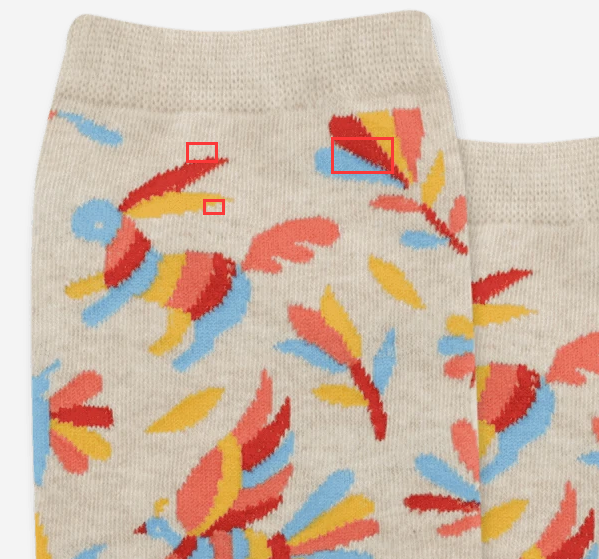
If you have a physical sample in hand, the quickest method is to turn the sock inside out. Jacquard socks will have loose yarn floats on the inside — the threads of colors not in use on each row are carried across the back of the fabric. Printed socks have a clean inner surface with no floating threads.
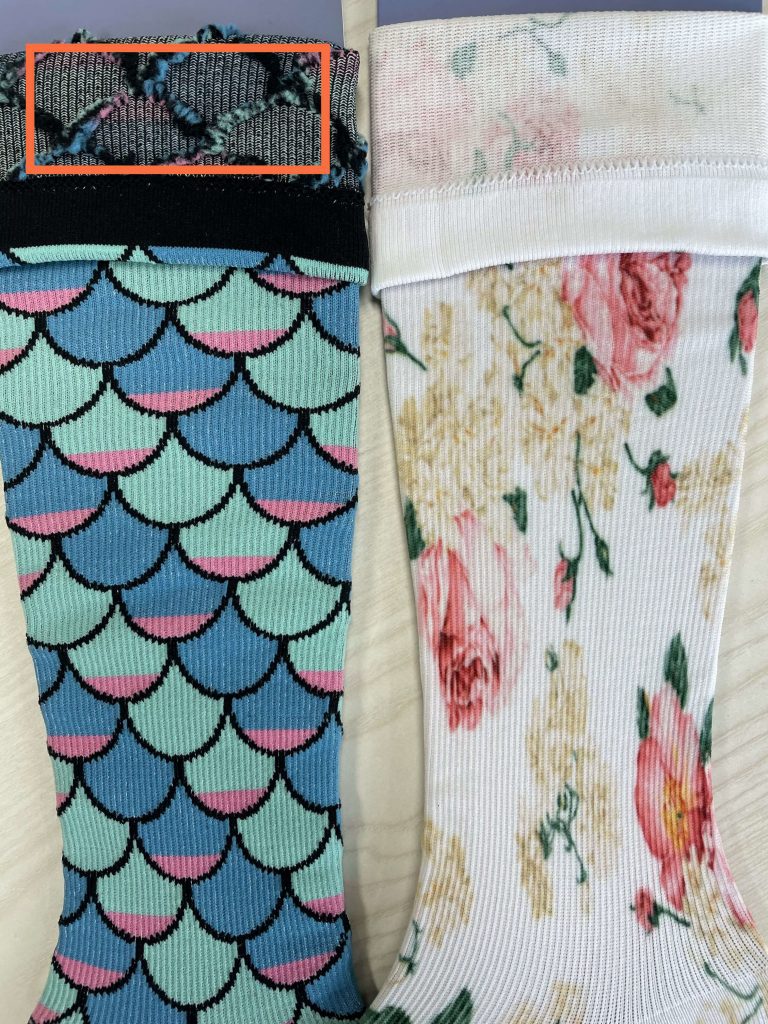
If you’re judging from a photo only, zoom in on the pattern edges. Jacquard patterns are built stitch by stitch, so edges will have a slightly stepped, pixelated appearance — similar to a zoomed-in bitmap image. Sublimation and screen-printed patterns have smooth, clean edges because the ink is applied continuously, not in discrete stitches.
Which Method Is Right for Your Order?
Use this as a starting point:
Choose jacquard if:
- Your product requires elasticity (athletic socks, compression socks, performance wear)
- Your design has ≤6 colors and no gradients
- You’re producing at volume and want to control unit cost
- Long-term wash durability is a priority
Choose sublimation if:
- Your design has more than 6 colors, gradients, or photorealistic artwork
- Your fabric is polyester-based
- You’re doing smaller runs of fully custom branded or promotional socks
Choose screen printing if:
- You need a small logo or brand mark on an otherwise plain or jacquard sock
- Your base fabric is cotton or a blend that can’t be sublimated
- The design is simple — bold colors, no gradients
Choose tie-dye / dip-dye if:
- You want a gradient or ombre color effect
- Your fabric is cotton or cotton-dominant
- You want a handcrafted, fashion-forward aesthetic that printed gradients can’t replicate
Common Mistakes to Avoid
These are the requests we see regularly that cause sampling delays and cost issues — worth knowing before you brief your supplier.
“I want this gradient logo done in jacquard.” Jacquard cannot produce gradients. Each color transition requires a separate yarn feed; smooth color blending between two tones is not achievable with this process. If your artwork relies on gradients, you need sublimation or dip-dye depending on your fabric.
“I want sublimation printing on cotton socks.” High-cotton fabric absorbs the gasified dye too aggressively, causing the image to spread and blur. The result will be significantly softer and less defined than what your artwork shows. If your fabric is cotton, jacquard or tie-dye are the appropriate options.
“I want a dark-colored sock with sublimation printing.” Sublimation ink has no white component. On a dark base, the design colors will be invisible or barely visible. Sublimation printing requires a white or very light base fabric.
“I want sublimation on nylon socks — same price as polyester.” Nylon can be sublimated, but the process is more demanding and the cost is typically 2–3× that of polyester sublimation. It’s a valid option for premium products, but needs to be budgeted accordingly.
Conclusion
The four methods — jacquard, sublimation, screen printing, and tie-dye / dip-dye — each exist because they solve different problems. None of them is universally “better.” The right choice depends on your design, your fabric, your end market, and your budget.
If you’re not sure which process fits your project, send us your artwork and product brief. We’ll assess it and give you a straight recommendation — including whether your design will work as-is or needs to be adjusted for the process you want.
Related reading:
- What Is Needle Count in Socks? 96N vs 144N vs 200N Explained
- What’s the Best Material for Compression Socks?
- Guide to Logo Techniques for Custom Socks
FAQ
1. Can I do sublimation printing on cotton socks? Not effectively. Sublimation dye is designed to bond with polyester fibers. On cotton, the dye spreads uncontrollably during heat pressing, producing a blurred, washed-out result. For cotton socks with color design, jacquard knitting or tie-dye are the correct processes.
2. What method is best for a gradient or ombre effect? It depends on your fabric. For polyester socks, sublimation printing can produce a clean digital gradient. For cotton socks, tie-dye or dip-dye is the right approach — the result is a natural, organic gradient that also happens to suit the aesthetic of most fashion and lifestyle brands requesting this effect.
3. How many colors can a jacquard sock have? Typically up to 6 colors per design for standard production. This includes the background color. If your design requires more colors or any gradient transitions, jacquard is not the right process.
4. What is screen printing actually used for on socks? On socks, screen printing is used almost exclusively for small-area applications — typically a brand logo or single graphic within a 5×5cm area. It’s not suitable for all-over patterns or anything with gradients. It’s a common choice for adding a brand mark to an otherwise plain or jacquard sock.
5. Which process is better for compression socks? Jacquard is strongly recommended for compression socks. The high-temperature pressing in sublimation printing damages spandex and lycra content, which directly reduces the compression performance of the sock. For compression products, preserving elasticity is a functional requirement — not just an aesthetic one.