

You want to launch your own line of compression socks. Maybe you’re a brand owner looking to expand into wellness products, a retailer who’s spotted the demand, or an Amazon seller searching for your next winning product. Either way, you’re facing the same set of questions: What materials should you pick? Which compression level actually sells? How does the whole OEM process work from first sample to finished product?
You’re not alone in seeing this opportunity. The global compression therapy market was valued at around USD 2.45 billion in 2024 and is projected to reach USD 3.42 billion by 2030, growing at a steady CAGR of about 5.07% (Research and Markets, 2024). That growth isn’t just coming from hospitals and clinics anymore. Athletes want them for recovery. Nurses need them to survive 12-hour shifts. Pregnant women rely on them for swelling relief. And everyday consumers are buying them on Amazon simply because they feel better after a long day of sitting at a desk.
The point is: the end consumers are already there. What’s missing for many of them is a brand they trust and a product that actually delivers.
That’s exactly where custom compression socks come in. Instead of reselling someone else’s generic product, you get to build something of your own — your materials, your compression specs, your branding, your packaging. This guide walks you through everything you need to make that happen: the key market opportunities worth targeting, how to pick the right compression level and materials, the step-by-step OEM process from concept to delivery, what certifications you’ll need, what drives the cost, and how to turn all of this into a brand that stands out.
Let’s get into it.
Key Applications and Market Opportunities
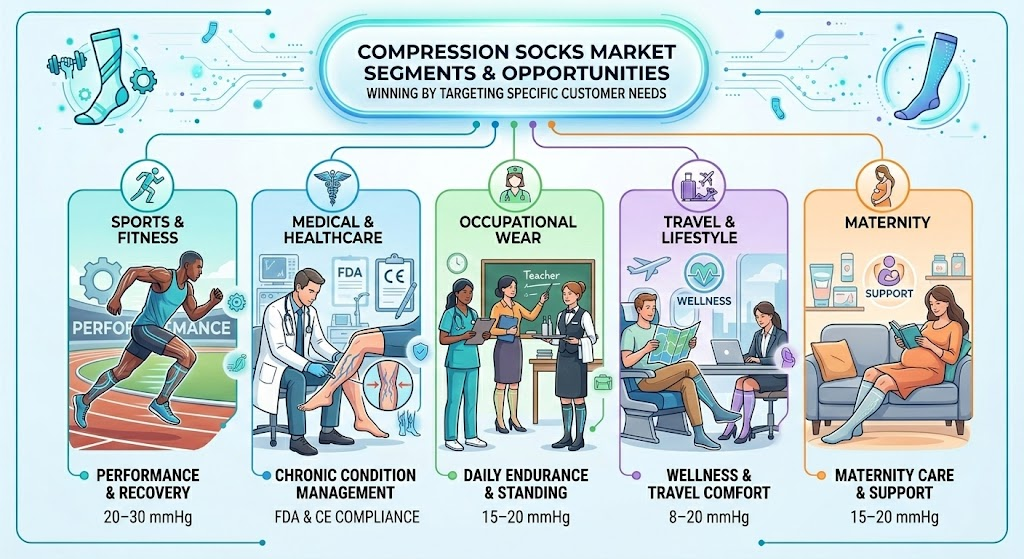
Compression socks are not a one-size-fits-all market. The brands that win are the ones that pick a specific customer segment and build a product around their exact needs. Here are the five segments worth your attention.
Sports and fitness is one of the fastest-growing segments. Research from McMaster University and the British Journal of Sports Medicine confirms that compression socks reduce muscle soreness, speed up recovery, and improve endurance during prolonged exercise. Runners, cyclists, and CrossFit athletes are driving this demand. To compete here, you need real graduated compression (20–30 mmHg), moisture-wicking materials like nylon-Coolmax blends, and marketing that speaks the language of performance.
Medical and healthcare is the market’s backbone. Chronic venous diseases affect about 30% of adults globally — roughly 2.2 billion people (Journal of Vascular Surgery, 2021). Varicose veins alone account for nearly 49% of total compression socks demand in 2025 (Persistence Market Research). This segment means higher margins but also higher standards: you’ll need accurate compression testing, FDA registration for the U.S., CE marking for Europe, and batch-to-batch consistency that hospitals and pharmacies can rely on.
Occupational wear is a massive but often overlooked opportunity. Nurses walk 4–5 miles per shift. Teachers, servers, retail staff, and factory workers all spend 8–12 hours on their feet daily. Brands like FIGS and Comrad have built serious revenue targeting healthcare workers specifically. The sweet spot here is 15–20 mmHg — no strict medical certifications needed, but customers perceive real functional value and buy in multiples. Corporate wellness programs add a B2B angle with recurring bulk orders.
Travel and everyday lifestyle is where compression socks cross over from medical product to wellness essential. Long flights, desk jobs, and daily commutes are driving demand for 8–20 mmHg socks that look good and feel good. Entry barriers are low, design matters more than clinical data, and DTC e-commerce is the primary channel. If your brand can make compression socks that don’t look like medical devices, this segment is wide open.
Maternity is a high-growth niche with strong brand loyalty. Blood volume increases up to 50% during pregnancy, making leg swelling nearly universal. Brands like Kindred Bravely and Motif Medical have proven this can be a core revenue driver, not just a side product. You’ll need softer materials, wider calf options, and gentler compression (15–20 mmHg) — but the payoff is a customer who researches deeply, pays premium prices, and recommends fiercely. See our OEM maternity compression socks success case in US market.
Custom compression socks solutions
Customization isn’t just about adding your logo—it’s about locking in the right technical specs so your compression socks feel great, perform consistently, and meet your market’s compliance needs. In this section, we’ll break down how to choose materials, compression level (mmHg), sizing strategy, and required certifications, so you can build a clear spec sheet and avoid costly revisions later.
Material Science and Optimal Composition Ratios
Every compression sock is built from a blend of yarns, and each one plays a specific role. Here’s a quick rundown of what you’re working with:
Nylon is the foundation of most compression socks. It’s durable, lightweight, holds its shape well, and provides the structural backbone that everything else is built on. It also accounts for the largest share of material used across the industry globally.
Spandex (Lycra) is what actually creates the compression. The more spandex in the blend, the higher the pressure. Getting this ratio right is critical — too little and the sock won’t deliver its promised mmHg; too much and it becomes uncomfortable. This is one area where working with an experienced manufacturer really matters.
Polyester adds quick-dry performance and helps the sock hold its shape after repeated washing. It’s common in athletic and everyday compression socks where moisture management is a selling point.
Cotton and bamboo bring softness and breathability. They’re popular in lifestyle and maternity compression socks where comfort is the top priority. Bamboo in particular has natural antibacterial properties, which makes it a great story for brands positioning around wellness and sustainability.
Performance fibers like Coolmax and merino wool serve more specialized needs. Coolmax excels at moisture-wicking for athletic use, while merino wool provides temperature regulation for outdoor and cold-weather applications.
On the sustainability side, recycled nylon, recycled polyester, and organic cotton are increasingly available from manufacturers. If your brand story involves eco-responsibility, these materials let you back that up with real substance — not just marketing.
➡ For a full breakdown of how these materials work together in a finished sock, read our guide on the composition of compression socks.
How Material Choice Shapes Your Brand
Here’s the thing most first-time buyers don’t realize: your material choice isn’t just a technical decision. It’s a brand decision. The yarn blend you pick determines how your product feels, performs, and gets talked about by customers.
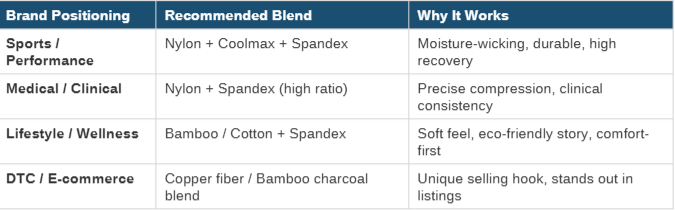
If you’re building a sports or performance brand, a nylon-Coolmax blend gives you the moisture-wicking and durability story that athletes expect. For medical-grade products, nylon-spandex as the primary combination ensures the compression accuracy and consistency that healthcare buyers demand. Lifestyle and wellness brands tend to lean toward bamboo or cotton blends for their natural softness and eco-friendly appeal — these materials feel premium and give you a clear differentiation from clinical-looking competitors.
And if you’re a DTC e-commerce brand looking for a unique angle, specialty fibers like copper-infused yarn or bamboo charcoal fiber can become your headline feature — something that catches attention in a crowded Amazon listing or Instagram ad.
Determining the right compression level
How to Choose the Right Compression Level
Compression level is one of the first decisions you’ll make — and it’s one of the most important, because it directly determines who your product is for, which markets you can sell in, and whether you’ll need medical certifications.
Here’s a quick breakdown of the four standard levels and where each one fits:
8–15 mmHg (mild) is your entry point for lifestyle and travel products. It’s gentle enough for all-day wear, doesn’t require a prescription in any market, and appeals to consumers who are new to compression. Think desk workers, casual travelers, and people who just want their legs to feel lighter at the end of the day.
15–20 mmHg (moderate) is the bestseller across the board. It covers the widest range of use cases — nurses and teachers who stand all day, pregnant women dealing with swelling, runners who want recovery support, and everyday consumers looking for noticeable relief. If you’re launching a brand and not sure where to start, this is the sweet spot. It’s strong enough to deliver real results but low enough to avoid medical device regulations in most markets.
20–30 mmHg (firm) is where things get more serious. This level is standard for treating varicose veins, managing post-surgical recovery, and supporting athletic performance at a competitive level. In some markets — particularly the U.S. and EU — socks at this level may be classified as medical devices, which means you’ll need FDA registration or CE marking depending on where you’re selling. Higher barrier to entry, but also higher margins and stronger customer loyalty.
30–40 mmHg (extra firm) is clinical territory. DVT prevention, severe edema, lymphedema management — these socks are typically prescribed by doctors and sold through medical supply channels. If you’re targeting this level, you’ll need proper certifications and a manufacturer who can guarantee precise, consistent pressure across every single pair.
That consistency part is worth emphasizing. The difference between a good compression sock and a bad one often comes down to whether the pressure is actually what the label says it is. A sock labeled “20–30 mmHg” that only delivers 15 mmHg isn’t just a quality issue — it’s a liability risk for your brand.
That’s why we test every production run with dedicated compression testing equipment. Our in-house pressure testing machines measure the exact mmHg at multiple points along the sock to make sure the graduated compression profile matches your specifications. This isn’t a spot check — it’s built into our production process so you can share verified test data with your retail partners, your regulatory filings, or directly with your customers as a trust signal.
Not sure which compression level is the right fit for your target market? We’ve put together a more detailed breakdown with specific selling strategies for each level — read our 5 tips to choose the right compression level for selling.
Sizing: Get It Right for Your Market
Sizing can make or break your customer reviews. Compression socks that are too tight get returned; ones that are too loose don’t deliver the promised pressure. And here’s what most first-time buyers don’t realize — sizing standards vary significantly between markets.
A “Large” in the U.S. is not the same as a “Large” in Europe or Asia. Calf circumference, foot length, and ankle measurements all differ across regions, and your size chart needs to reflect the actual body dimensions of your target customers — not just a generic S/M/L/XL label.
This is something we help with from the start. Based on your target market and customer demographic, we’ll recommend a size grading system that fits properly — whether that’s a U.S.-standard 4-size range, European metric sizing, or a custom breakdown based on your own data.
We also support wide-calf and plus-size production, which is a segment many manufacturers simply can’t handle. Wide-calf compression socks require adjusted knitting patterns to maintain accurate graduated pressure across a larger circumference — it’s not as simple as making the sock bigger.
Custom Packaging: Match Your Sales Channel
A sock selling on Amazon has completely different packaging requirements than one sitting on a pharmacy shelf or hanging in a retail store — and getting this wrong can cost you sales.
For e-commerce and Amazon, you want compact poly bags or flat packaging that minimizes shipping dimensions and costs. For retail and pharmacy shelves, a printed card insert or custom box with a hang hole gives you visibility and lets customers see your branding at a glance. For premium or gift positioning, rigid boxes create an unboxing experience that justifies a higher price point.
We offer a full range of packaging options: custom poly bags, printed card sleeves, belly bands, hang tags, individual boxes, and multi-pack bundling. Everything is customizable — your logo, colors, product info, size, compression level, material composition, care instructions, and barcodes. We’ll also advise on regulatory labeling requirements for your target market, because what needs to be printed on packaging in the U.S. versus the EU is not the same.

Factors affecting the price of custom compression socks
One of the first questions every buyer asks is: “How much per pair?” The honest answer is — it depends. Custom compression socks aren’t a commodity product with a fixed price. Your final cost per pair is shaped by a handful of key decisions, and understanding them upfront helps you avoid surprises and build realistic margins.
Materials are the biggest cost driver. A basic nylon-spandex blend is your most affordable option. Move to Coolmax or bamboo fiber and the cost goes up. Choose merino wool and you’re at the premium end. The difference between the cheapest and most expensive yarn blend can easily be 2–3x per pair — so your material choice needs to align with your retail price positioning, not just your product vision.
Compression level also plays a role. Higher mmHg ratings require a higher spandex ratio in the blend, which increases raw material cost. A 30–40 mmHg medical-grade sock simply costs more to produce than an 8–15 mmHg lifestyle sock — there’s no way around it.
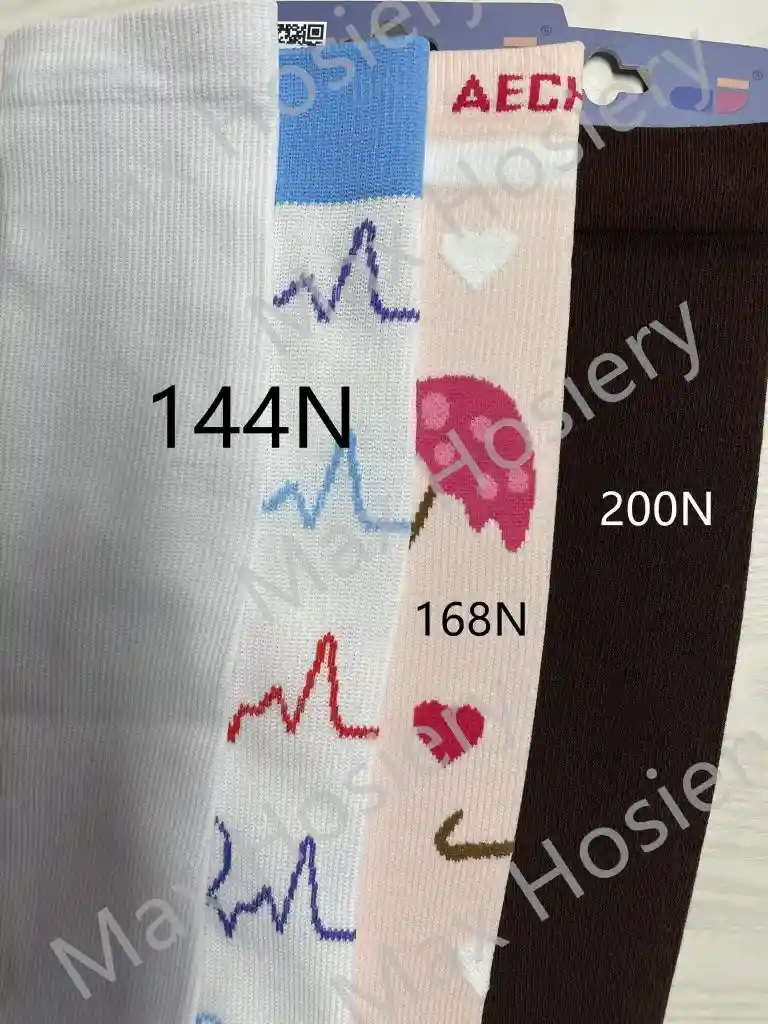
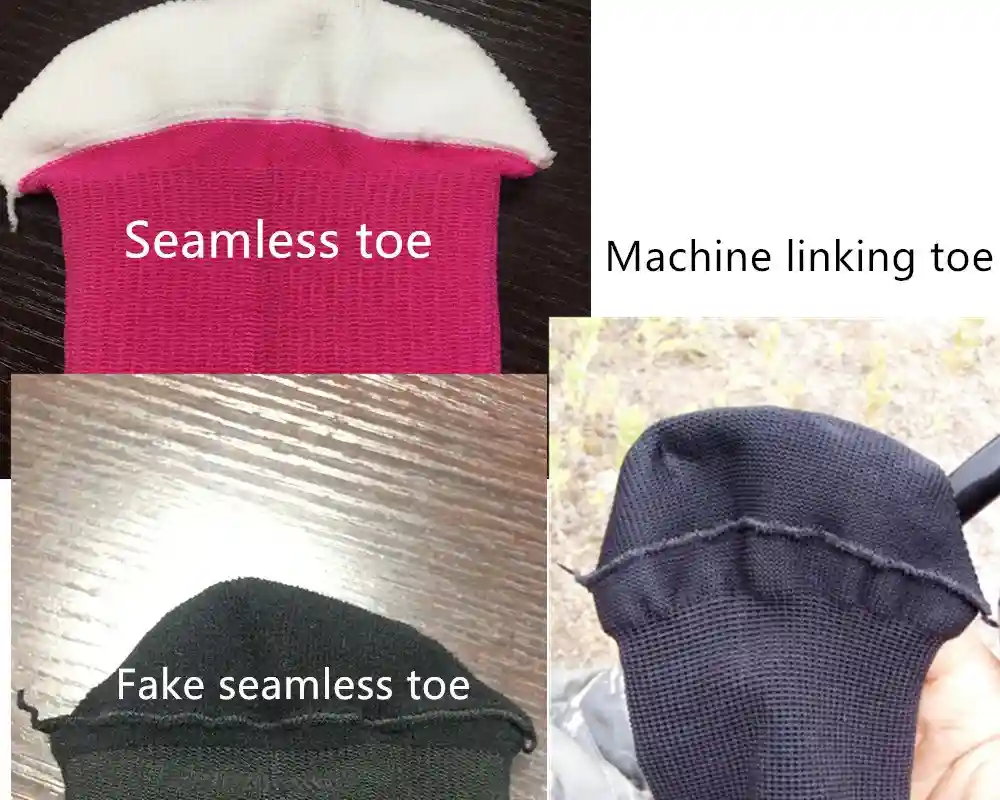
Manufacturing complexity is where smaller details add up. Needle count matters: a 200-needle machine produces a finer, denser knit than a 144-needle machine, which means better quality but higher cost. Features like seamless toe construction add roughly $0.10 per pair — a small number that becomes significant at scale. Specialized knitting structures like targeted cushioning zones or multi-density compression panels also add to the production cost.
Logo and branding method affects pricing more than most buyers expect. Jacquard knitting (woven into the fabric) is the most cost-effective for simple designs. Embroidery adds texture and a premium feel but costs more. Full sublimation or 360° printing gives you unlimited design freedom but is the most expensive option per pair.
Order quantity follows basic economics — bigger orders mean lower unit prices. Our standard MOQ starts at 500 pairs per style/color/size, and pricing improves meaningfully as volume increases. If you’re testing a new product, starting at MOQ makes sense; once you’ve validated demand, scaling up is where your margins really open up.
Packaging adds its own layer. A simple poly bag costs a fraction of a custom rigid box with printed inserts. And certifications like FDA or CE require upfront investment in testing and registration — costs that don’t repeat per pair but need to be factored into your launch budget.
Want to understand exactly how each of these factors impacts your bottom line? We break it all down with specific numbers in our guide on 6 key factors that affect compression socks pricing.
Certifications and Compliance: What You Need Before You Sell
Certifications and Compliance: What You Need Before You Sell
This is the section most new buyers skip — and the one that can cause the most expensive problems down the road. Depending on where you’re selling and what compression level your product offers, you may need specific certifications before your socks can legally hit the market.
Here’s the reality: certification requirements vary by country and by product category. A 15 mmHg lifestyle sock sold on Amazon in the U.S. has very different regulatory requirements than a 25 mmHg medical-grade sock sold through pharmacies in Germany. Getting this wrong doesn’t just mean delays — it can mean seized shipments, pulled listings, or legal liability.
Let’s break down what each certification covers and when you need it:
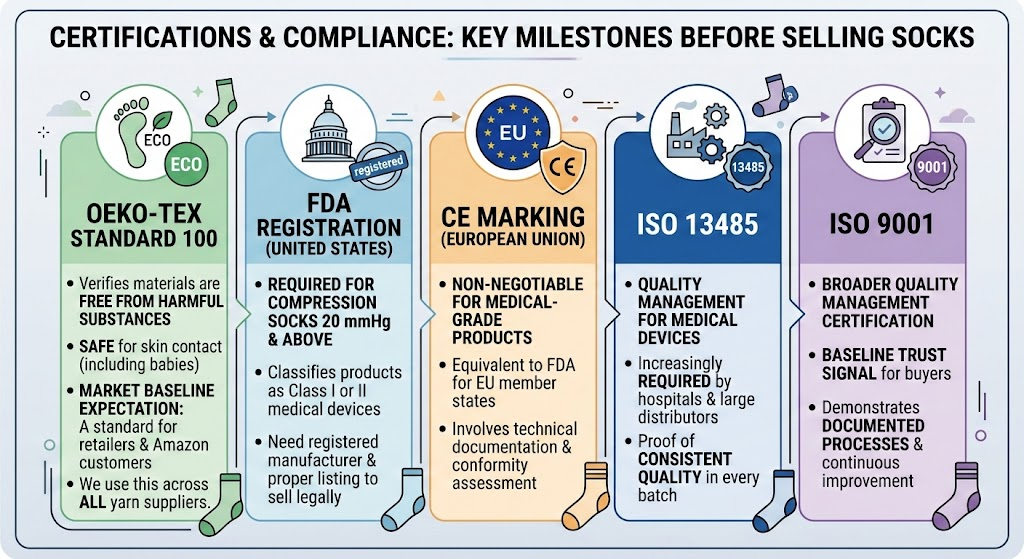
OEKO-TEX Standard 100 verifies that all raw materials used in your socks are free from harmful substances — tested safe enough for direct skin contact, including baby skin. This isn’t legally required in most markets, but it’s become a baseline expectation. Retailers, distributors, and increasingly Amazon customers look for this label. We hold this certification across all our yarn suppliers.
FDA registration is required in the United States for compression socks rated 20 mmHg and above. The FDA classifies these as Class I or Class II medical devices, and you’ll need a registered manufacturer and proper product listing before you can legally sell them. If you’re staying below 20 mmHg, FDA registration typically isn’t required — but having it still adds credibility.
CE marking is the equivalent for the European Union. Medical-grade compression socks must carry CE marking to be sold in EU member states. The process involves conformity assessment, technical documentation, and in some cases third-party testing. If Europe is part of your sales plan, this is non-negotiable for medical-level products.
ISO 13485 is a quality management system standard specifically for medical device manufacturers. It’s not always legally mandatory, but hospitals, medical distributors, and large retail chains increasingly require it as a condition of doing business. Think of it as proof that your manufacturer has the systems in place to deliver consistent quality — not just once, but every single batch.
ISO 9001 is the broader quality management certification. It’s the baseline trust signal that tells buyers your manufacturer operates with documented processes and continuous improvement standards.
We hold ISO 13485, ISO 9001, CE, and FDA registrations, and we can provide certificate copies and third-party test reports before you place an order. If you’re not sure which certifications your target market requires, ask us — we’ll tell you exactly what you need based on where you’re selling and at what compression level. It’s a conversation worth having early, not after production is done.
The Custom Compression Socks Process: From Concept to Delivery
If you’ve never ordered custom socks before, the process can feel like a black box. It doesn’t have to be. Here’s exactly how it works, step by step.
🎥 Before we break down each stage, you can watch this short video to see how our custom compression socks are made—from material selection and pressure testing to final packaging.
Step 1 — Consultation and Product Planning
Everything starts with a conversation. You tell us who you’re selling to, what market you’re targeting, and what kind of product you have in mind. We’ll ask about your preferred compression level, materials, price range, and any specific features you need — like wide-calf sizing, open-toe design, or a particular knitting structure.
From there, we don’t just take orders — we give recommendations. If you’re targeting nurses in the U.S., we’ll suggest different specs than if you’re building a maternity line for the European market. Our job at this stage is to help you avoid costly mistakes before a single sample gets made.
Step 2 — Design and Sampling
Once the product specs are locked in, we move to design. You’ll choose your logo method — jacquard weaving for a clean, integrated look; embroidery for raised, textured branding; or sublimation printing for full-color, all-over designs. Each has different cost and visual impact, and we’ll advise based on your brand positioning and budget.
Colors are matched to your exact Pantone codes to keep your brand identity consistent across products. We then produce physical samples, typically within 3–7 days. You’ll receive photos from multiple angles.
Step 3 — Production and Quality Control
After sample approval, production begins. Our standard MOQ is 500 pairs per style, per color, per size — though this can vary depending on the product. Lead time is typically 25–35 days from deposit.
Quality control runs throughout the entire production process, not just at the end. We apply a 3-stage in-line inspection during production, followed by a final check after packaging. Every batch is tested on our compression testing equipment to verify that the graduated pressure profile matches your approved specs.
Step 4 — Packaging and Delivery
Your finished socks are packed according to your specifications — whether that’s poly bags for e-commerce, card sleeves for retail, or custom boxes for premium positioning. We handle barcoding, regulatory labeling, and any market-specific packaging requirements.
For shipping, we support both FOB (you arrange freight) and DDP (we deliver to your door, duties included). Most clients start with DDP for simplicity, especially on first orders. From production completion to delivery, you’re typically looking at 20–30 days depending on destination and shipping method.
The entire process — from first conversation to socks in your warehouse — usually takes 8–12 weeks. Not months. Not a year. If you’ve got a product launch window to hit, talk to us early and we’ll build a timeline that works.
Customer Success Story – Custom Compression Socks for Sports Brand
Company P, a leader in the sports and fitness industry, wanted to expand its product line and introduce athletic compression socks to meet the needs of the US market. However, many similar products are in the market, and consumers demand high quality and functionality. After in-depth research and analysis, we found that Company P had obvious unique product design and brand influence advantages.
In response to Company P’s needs, we customized a sports compression sock for them. The socks are designed with a gradient pressure of 20-30mmHg and high-performance fabrics that are breathable, moisture-absorbent, and perspiration-absorbent, considering the needs of different sports and sports people. Combined with P’s unique brand elements, we jointly created a sports compression sock that is both functional and fashionable.
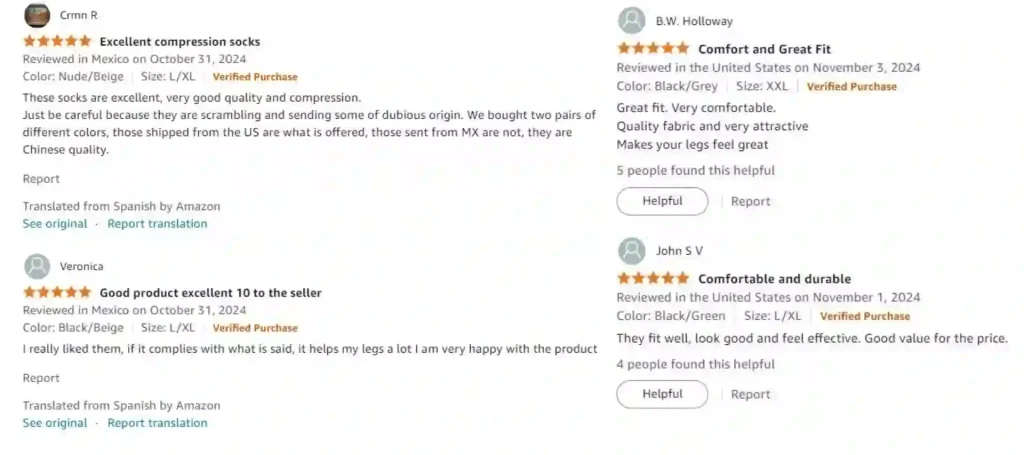
After its launch, the compression socks quickly gained consumer popularity and ranked No.1 in Amazon’s sports compression socks category. Numerous professional athletes and fitness enthusiasts have shared their experiences via social media, giving positive reviews. They said that wearing the compression socks effectively relieved post-workout muscle soreness, significantly improved athletic performance, and helped them recover faster.
By working closely with P, we successfully helped them open up the US sports compression sock market and brought in $3 million in sales within a year. View more sucessful story.
Conclusion
You’ve seen the market opportunity, you understand the product decisions involved, and you know how the process works. The compression socks market isn’t waiting — it’s growing every year, and the brands getting in now are the ones building real customer bases while competitors are still “thinking about it.”
Whether you’re launching your first product line or expanding an existing brand into compression wear, we’re here to make it simple. You’ll get a dedicated team that handles everything from material sourcing and sample development to certified production and delivered packaging — with full transparency at every step.
Here’s how to get started: fill out the contact form below with your project details, and we’ll get back to you within 24 hours with a free product recommendation and pricing estimate. If you already have a sample or reference product, send it over — we can reverse-engineer it and improve on it.
Want to see what’s possible before reaching out? Browse our custom compression socks product page for a closer look at our capabilities, certifications, and real client examples.
FAQ
How do custom compression socks differ from regular socks?
They differ in several key ways:
- -Custom compression socks are designed with graduated compression to promote blood flow. Click to know how to choose the right compression level for custom socks?
- -Custom compression socks are usually made of high-performance materials that are more breathable, antimicrobial, and stretchy to ensure comfort and support over long periods, as opposed to regular socks, which are made of more conventional materials.
-Custom compression socks are designed for specific needs such as sports recovery, medical rehabilitation, etc. They can help relieve fatigue and prevent edema, whereas ordinary socks cannot provide specialized support and are more suitable for daily wear. - Click to learn more about the difference between compression socks and regular socks.
How many hours a day should I wear compression socks?
The length of time you should wear compression socks depends on what you are using them for. Suppose it is due to a medical need (e.g., postoperative rehabilitation or vascular problems). In that case, medical professionals usually recommend wearing them up to 24 hours a day until you can move around normally. For general purposes, such as relieving swelling or improving circulation when standing or sitting for long periods, it is recommended that you wear them during the day and take them off at night to allow your skin to rest and maintain the elasticity of the sock. Overall, wearing time should be adjusted according to individual needs and circumstances, but wearing them during the day and removing them at night is usually recommended.
Click for more comprehensive guide to compression socks.
We are interested in the graduate compression socks market but don’t know how to start developing them, do you have any suggestions?
We suggest that you start by researching related products from major brands on e-commerce platforms such as Amazon, and by analyzing their functional features and price ranges, you can find a development direction that suits your brand’s positioning. At the same time, it is essential to identify which elements of the product design reflect the uniqueness of your brand. If you encounter any problems during the development process, please get in touch with us by email; we will be happy to provide you with professional advice and guidance.
We are interested in some brands of graduated compression socks, can MaxHosiery produce similar products?
MaxHosiery always respects intellectual property rights and patents and takes the rights of its brand customers very seriously. If you have a unique design or need for certain graduated compression products, we are more than happy to work with you and combine our professional experience to customise innovative products that match your brand’s characteristics and help your products stand out and be competitive in the market.