

Pick up a hiking sock and a regular sock and the difference feels like one thing: the hiking sock is thicker. That’s the part you can feel in a shop, and it’s the part almost every buying guide leads with. It’s also the least useful way to understand what you’re holding.
Three things actually change. Everything else follows from them.
The Short Answer
A hiking sock differs from a regular sock in the fibre it’s made from, where the cushioning sits, and how it’s seamed and shaped to stay still on your foot. Height, weight, colour and price are all downstream of those three.
That matters because a regular cotton sock doesn’t fail on one of them — it fails on all three at once. Which is why the problem shows up at hour four as a blister, rather than as anything you’d have noticed at hour one.
Fibre: Cotton Is the Actual Problem
What cotton does once it’s wet
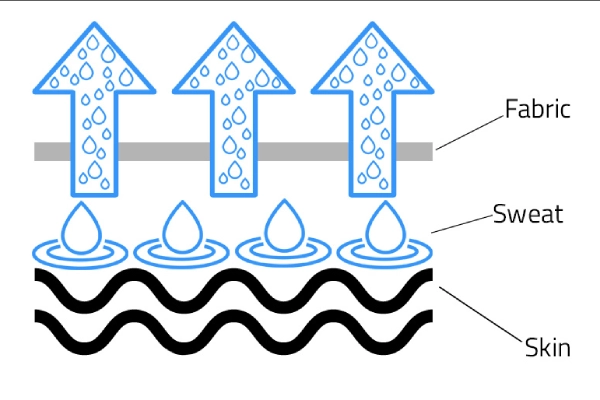
Cotton takes sweat into the fibre and holds it there. A saturated cotton sock is heavier, colder, and much slower to dry — but the real issue is that it gets soft. Wet, soft fabric slides against skin instead of moving with it. That sliding is what lifts the top layer of skin and starts a blister. The cotton sock isn’t failing because it’s thin. It’s failing because it changed state.
Why merino behaves differently
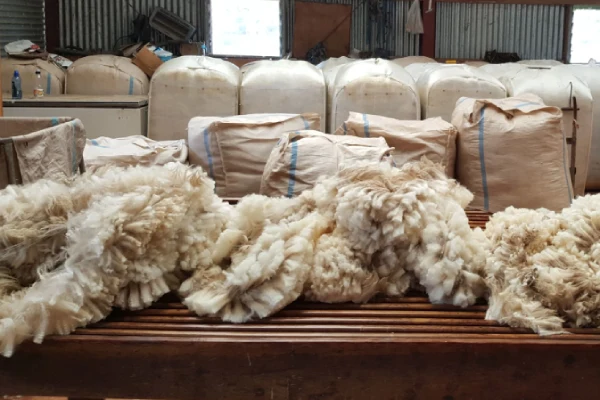
Merino absorbs moisture as vapour, into the core of the fibre, and can take on roughly a third of its own weight before the surface feels wet to the touch. The outside of the fibre stays comparatively dry, so the contact between sock and skin stays stable while you’re still sweating.
Wool also carries lanolin, which is naturally antimicrobial. That’s why a merino sock on day three of a trip doesn’t smell the way a synthetic one does — it isn’t a chemical antimicrobial finish doing the work, it’s the fibre. Finishes wash out over the life of the sock. The fibre doesn’t. More on that here: why wool outperforms other sock fabrics.
The itch question, answered with a number
The reason people think they’re “allergic to wool” is usually a measurement, not an allergy. Skin registers a fibre as prickle at around 25 microns — that’s the threshold where the fibre end is stiff enough to push into the skin rather than bend against it.
Standard wool measures roughly 25–40µm. It sits above the threshold, and it feels exactly like the jumper you remember. Merino measures 16–24µm, and the finest grades come in under 19µm. Same animal family, different diameter, completely different experience next to skin. If you tried wool once and hated it, you almost certainly tried the wrong micron.
Synthetics aren’t the enemy
Polypropylene and bamboo both dry faster than wool. On a hot day over a short distance, a synthetic-rich sock can genuinely be the better choice — drying speed matters more than moisture buffering when you’re not out long enough for the buffer to fill.
Most hiking socks end up as blends anyway, and the blend is doing three separate jobs: wool for moisture buffering and odour, nylon for abrasion resistance where the boot rubs, elastane for recovery so the sock still grips after twenty washes. A pure anything is usually a compromise somewhere.
Cushioning Is a Map, Not a Thickness
This is the part almost every guide gets half-right.
What every other guide tells you
“Hiking socks have extra cushioning at the heel and forefoot.” True — those are the two most common cushioned zones. But that sentence describes a habit, not a mechanism, and it leaves you thinking thickness is a single slider from thin to thick.
How terry is actually made
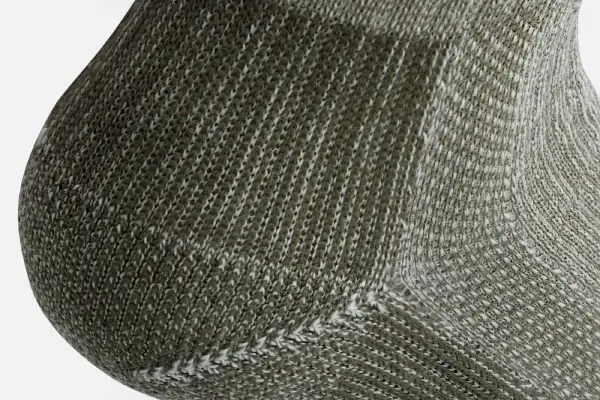
The cushioning in a sock is terry: loops pulled out on the inside face of the fabric during knitting, by a terry opening device on the machine, stitch by stitch. Because it happens stitch by stitch, loop placement is programmable. A machine can knit terry across the whole footbed, or only under the heel, or in a band two centimetres wide along the Achilles, and knit plain fabric everywhere else.
Needle count sets how fine that map can be — our terry-capable machines run at 144, 168 and 200 needles, and a higher needle count means a denser, finer loop field in the same area.
So “thick sock or thin sock” is a false choice. The real question is where, how wide, and how deep.
The zones that matter, and what each one is for
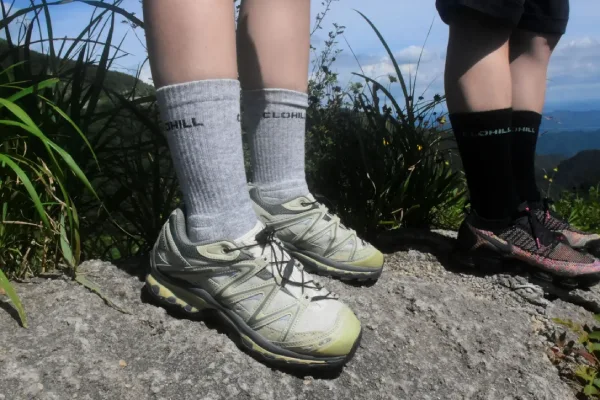
- Heel — descent impact. Going downhill loads the heel far harder than going up, which is why heel cushioning matters most on the return leg.
- Forefoot — push-off pressure, every step, all day.
- Toe — contact with the front of the boot on steep descents. This is where people lose toenails, not where they get blisters.
- Achilles — rub from the boot collar. A narrow band here does more for comfort than a thicker sock everywhere.
- Ankle contact band — where a mid or high boot presses against the ankle bone.
- Full footbed — warmth. Worth it in cold conditions, and a real cost the rest of the time: it dries slower and takes up volume inside the boot.
Why your boot height changes the map
A low-cut trail shoe, a mid boot and a high boot touch your leg in different places. The same sock will rub in a different spot in each. This is the single most common reason a sock that worked for one person doesn’t work for another — not the sock, the pairing.
The Toe Seam Nobody Looks At
Why a ridge across your toes matters over six hours
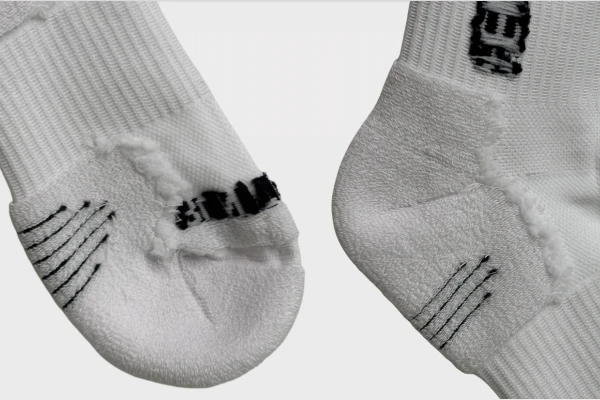
The toe closure is a seam running straight across the tops of your toes. In a shop, for thirty seconds, you won’t feel it. Inside a boot, under load, at hour four, it’s a raised line pressing into the same spot several thousand times. Almost nobody checks it before buying. It’s one of the more reliable ways to end a day early.
How a flat toe is actually produced
The seam itself is closed by machine, on an automatic toe-closing unit. But before the machine closes anything, a worker aligns the toe opening by hand on every single sock — matching the front and back edges stitch to stitch so the closure runs straight.
That hand-alignment step is what decides whether the finished toe is flat or skewed. It isn’t the machine, and it isn’t the yarn. If you’ve ever bought two socks from the same pack where one felt fine and the other felt slightly off across the toes, that’s what varied.
When five-toe makes sense
Five-toe construction is worth it when your problem is toe rubbing on toe — common with wide feet, long descents, or feet that swell.
It carries a cost worth knowing about. Knitting separate toe channels leaves float threads running between them on the inside. Those floats have to be trimmed internally. If they aren’t, the float itself becomes a new friction source, sitting exactly between the toes you were trying to protect. If you’re considering five-toe socks, that internal finish is the thing to ask about.
Fit: The Blister Cause Nobody Blames
A sock that moves takes skin with it
Blisters get blamed on boots, distance and heat, and friction gets the rest of the blame. But the actual mechanic is shear. Under a loaded foot, the outer layers of skin are dragged sideways against the layers beneath while the whole area is being pressed down. Repeat that a few thousand times and the layers separate, fluid fills the gap, and you have a blister.
Which is why a sock’s job isn’t to be slippery, and isn’t to be padded. It’s to not move. A sock loose enough to shift will bunch, and a bunch is a fold of fabric pressed into skin under load — a shear point you’ve built yourself. Cushioning spreads the pressure; fit removes the sideways drag. You need both, and fit is the one nobody buys for.
What actually holds a sock still
Three things. A heel pocket shaped to the anatomy of the heel — a Y-shaped construction rather than a flat tube — so the sock rotates with the foot instead of around it. An arch band that keeps the footbed from creeping forward. And elastic placed where the sock needs to grip, which is not evenly along the whole leg.
Why the same size can feel different
Socks are boarded — shaped on a form with heat — after knitting, and boarding carries a real tolerance. On a straight board it’s about ±2.5cm; on a curved board it tightens to roughly ±1cm. Length also shifts slightly with how long the sock rests on the board and with ambient temperature, which changes by season.
So two pairs of the same size, from the same factory, can measure a little differently. That’s not a defect and no brand will mention it, but it explains a difference you’ve probably noticed.
Height, Weight, and Season
Heights and what each is for
No-show and ankle sit below the boot collar — fine in trail shoes, a problem in anything higher, because the boot collar then contacts bare skin. Quarter clears a low collar. Crew is the default for mid and high boots: it puts fabric between the collar and the Achilles. Over-the-calf is for tall boots and cold weather.
Pick height from your boot collar, not from preference.
Why one weight can’t cover four seasons
Summer and winter want opposite things from the same construction. A summer sock reduces terry and opens ventilation zones in the upper foot to move heat out. A winter sock adds terry across the footbed and shifts to a wool-rich blend for insulation when damp. A single mid-weight sock is a compromise in both directions — workable, but it’s a compromise, not a solution.
So Are Hiking Socks Actually Worth It?
Honestly: if you’re walking thirty minutes on a flat path in trainers, regular socks are fine. Nothing above will save you money on that walk.
Three conditions decide it, and they compound:
- Duration — how long your feet stay under load and stay damp.
- Moisture — heat, humidity, rain, stream crossings, or just feet that sweat a lot.
- Footwear — a stiff boot with a defined collar creates specific contact points that a regular sock has no structure to handle.
All three, and the difference is obvious within one day. None of the three, and you’re paying for engineering you won’t use.
If You’re Building a Hiking Sock Line
Some readers here aren’t choosing socks — they’re developing them. If that’s you, the decisions above are the ones that separate a line that sells once from one that sells on repeat: terry zoning matched to boot height, toe closure quality, and a blend that survives washing. We build those specs with outdoor brands from the yarn up, on OEKO-TEX® Standard 100 certified materials, and can start from custom hiking sock development rather than from a catalogue. The merino wool socks range is where most outdoor programmes begin.
FAQ
Can you wear regular socks for hiking? Yes, for short, dry, low-effort walks in flexible shoes. The failure conditions are duration, moisture and stiff boots — once two of the three apply, a cotton sock gets wet, soft and mobile, and mobility against skin is what causes blisters.
Are merino wool hiking socks worth the extra cost? For multi-day trips and variable weather, yes — merino buffers moisture as vapour and resists odour through lanolin rather than a wash-out finish. For hot, short outings, a fast-drying synthetic or bamboo blend can outperform it. Check the micron: under 19µm won’t itch.
Why do my hiking socks still cause blisters? Usually fit rather than cushioning. A sock that shifts inside the boot bunches, and the fold becomes a pressure point. Check the heel pocket shape, the arch band, and whether your sock height clears your boot collar — a crew sock in a high boot solves rub that no amount of extra padding will.
How many pairs do you need for a multi-day hike? Two worn in rotation plus one dry spare is the common approach — one on, one drying on the pack. Merino stretches the rotation further than cotton or synthetics because it resists odour, but drying time, not smell, is what sets the number.