

Key takeaways
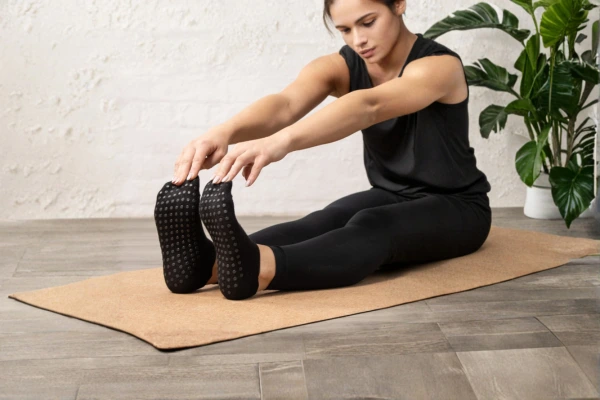
- Alo has turned studio grip socks into fashion accessories, priced roughly $38–$48 — and designs the silicone on the sole as part of the look, not just the traction.
- The premium buys design, not measurably better performance: available customer reviews raise two recurring concerns: inconsistent fit and limited wash durability.
- Those complaints are manufacturing-controllable. A well-specced line can keep the look and fix the fit, the wash durability, and turn the grip pattern into a brand signature.
Alo’s studio socks are not one aesthetic. They run from clean minimalist to full balletcore to newer, edgier drops — and the design goes all the way down to the silicone on the sole. This is a manufacturer’s teardown of how that is built: what the design does well, what the reviews quietly reveal it gets wrong, and how a brand would spec a sock that keeps the look and fixes the flaws. Not a dupe guide.
What Alo Actually Sells
| Style | Look / use | Price | Signature detail |
| Pivot Barre | Low-cut ballet / barre | $38 | No-slip grips, elastic straps |
| Pulse Grip | Above-ankle, function-meets-fashion | $38 | Terry cushioning, arch compression, mesh stripes |
| Strappy Siren | Crew, strongest balletcore | $48 | Cushioned sole, cross-straps, ribbed cuff |
| Throwback Barre | Slouch / retro stripe | $48 | Soft cushioning, classic stripe |
| Lettuce Edge Grip | Above-ankle, decorative | $38 | Ruffled trim, embroidered logo |
“Product names, features and listed prices were checked against Alo’s official product pages on July 15, 2026. Pricing, colors and availability may change.”
The design language shifts across the line — Pivot and Pulse read clean and minimal, Strappy Siren and Throwback lean balletcore and retro — but every one is styled to be seen, sole included. Alo even splits the range into a grip (training) and a non-grip (styling) version of the same look, treating socks as a fashion category rather than a training add-on.
What the Fashion-Forward Choices Trade Off
Alo’s socks are designed to be seen. That is the point — and it is where the compromises live.
Cross-straps are the balletcore signature buyers recognize instantly. They also sit across the instep, where some higher-instep wearers report the straps digging in — and a strap over the foot is a styling detail, not something that stops the foot sliding inside the sock.
Multi-color drops drive repeat purchases; reviewers openly ask for every shade, and for a Pilates line the color story is a genuine selling point. The trade-off is consistency — deep, saturated, and candy shades are the hardest to reproduce identically from one dye batch to the next, so a fashion-led palette lives or dies on tight dye-house control. It is a real production discipline, not a given.
Mesh panels are photogenic and genuinely breathable in heated sessions. The cost shows over time: in a third-party review summary, Garage Gym Reviews noted that the available customer reviews were limited but consistently raised durability concerns, including mesh tearing, holes, and grippers coming loose.
How Alo Designs the Silicone Itself
This is where a brand like Alo pulls ahead of the market — and it is exactly the kind of work a manufacturer makes possible for the brands, wholesalers, and studios building their own lines.
Clear vs Colored Grip
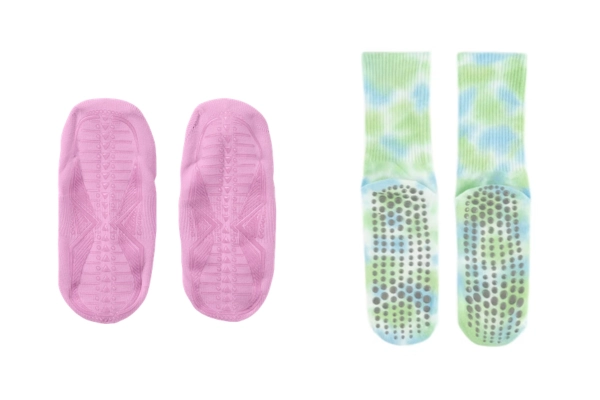
Look at Alo’s product photos and the grip almost disappears. Many styles use clear silicone, so the sole reads clean instead of dotted; most of the market still uses colored grip that announces itself. From production, this is a free choice — transparent or tinted, the silicone costs the same; it is only pigment. Two things are worth knowing before you commit to clear:
- Silicone is naturally soft and tacky, so it picks up lint and floor dust. On clear grip, that debris shows more than it would on black.
- Clear only stays clear if it is real, properly cured silicone. Quality silicone with an anti-yellowing curing agent stays transparent for years. The yellowing people fear comes mostly from cheap PVC or rubber “grip,” which breaks down under heat and UV — not from silicone done right.
So a clean, near-invisible sole is a look you can own. It is a material-quality decision, not a design compromise.
Design Patterns vs Round Dots
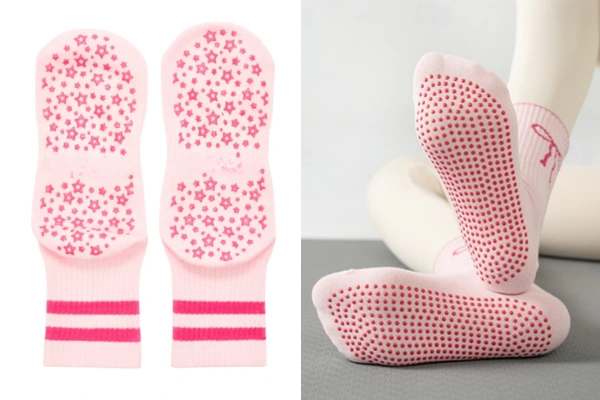
Alo’s grips are not just clear — many are shaped into refined, brand-specific patterns. The market default is evenly spaced round dots, sometimes stamped with a logo. The shape is not a cost barrier: a custom pattern does not raise tooling cost over standard dots. Two production realities do apply:
- An intricate custom design has to come from a customer-supplied editable vector file — that is what makes it producible, not a screenshot.
- Pattern geometry is not only cosmetic. Round dots grip in every direction; bars grip strongly one way and weakly across it; hexagon and chevron shapes balance the two. A good custom pattern is drawn for the load direction of the activity, not just the logo.
Done right, the grip is a brand signature and a performance feature at once. Carry the same mark into a finer-gauge cuff — 120N–200N for crisp logo and rib detail — and the branding reads across the whole sock, not just the hangtag.
What the Reviews Are Really Telling You to Fix
Strip away the styling and Alo’s own reviews name the two flaws a private-label line should design out from day one.
“Cute, but too loose”
Fashion socks routinely ship with loose or inconsistent fit — the sock looks right and will not stay put. That is a grading and recovery problem, not a grip problem, and it is controllable: real size breaks instead of one-size-stretches-all, the right elastane ratio for recovery, a compression arch band with tuned cuff tension, and a shaped heel so the sock does not sag mid-session. (If the foot still slides inside a correctly sized sock, that is a separate fix — internal grip placement — covered in our Lululemon teardown.)
“Worn out after a few washes”
The other recurring complaint is durability — grippers peeling and mesh holes after a handful of washes. Material and process decide this. Properly bonded, cured silicone survives dozens of wash cycles where cheap PVC cracks and lets go; reinforcing the knit around any mesh panel keeps the look from being the first thing to fail. Quality here is invisible on the shelf and obvious by week three, which is exactly why it is worth speccing rather than assuming.
| What reviewers say | What actually causes it | What a factory controls |
| “Cute but too loose / won’t stay up” | Fit grading + weak recovery | Size breaks, elastane ratio, arch band, cuff tension, heel shaping |
| “Foot slides inside the sock” | No internal grip | Targeted heel / forefoot silicone (see Lululemon teardown) |
| “Grippers peel / mesh holes after a few washes” | Cheap grip material, unreinforced knit | Bonded, cured silicone; reinforced knit zones |
| “Clear grip looks dirty or yellowed” | Tacky silicone + poor-grade material | Grip color choice; quality silicone + anti-yellow cure |
Building Your Own Line
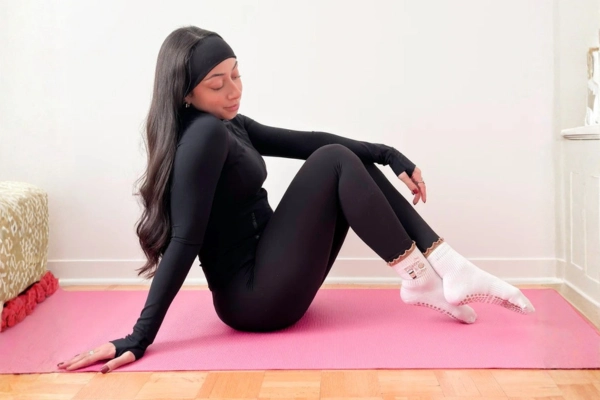
If you are a brand, wholesaler, or studio building your own line, the goal is not to copy Alo — it is to get that same accessory-grade look with a sock that actually fits and lasts. Keep the design language — a clean or refined-pattern sole, a tight color story — and build it on the right production. The full grip-function spec (coverage, foot-lock, arch mechanics) is in our Lululemon teardown; explore our custom Pilates grip sock solutions or Pilates grip sock styles to plan a collection. Sourcing looks like this:
| Item | Details |
| MOQ | 800 pairs per design for customization; stock options from 500 pairs mixed |
| Sample lead time | 3–7 days |
| Bulk lead time | 3–4 weeks |
| Grip options | Clear or color-matched silicone, custom pattern or standard dots, logo integration, coverage and placement |
| Customization | Fit grading, arch band, cuff and heel shaping, toe design, knit gauge, yarn and silicone color, packaging |
| Materials | Cotton blend, bamboo blend, performance synthetic, organic cotton |
| Compliance | OEKO-TEX Standard 100, BSCI, ISO 9001 support available |
For brands developing a new line with a custom grip sock manufacturer, the safest path is never to approve a sock from photos alone. Test samples on the surfaces your customers actually use — dry, lightly damp, and through real transitions — and confirm that the sole grips properly, the foot stays securely in place, and the grip performance remains effective after washing.
FAQs
Are Alo Yoga grip socks worth the price?
The higher price appears to reflect Alo’s branding and fashion-led design as much as functional construction. Available reviews suggest that value perception varies, particularly when buyers experience fit or durability issues.
Why do Alo grip socks feel loose or wear out?
Both are manufacturing-controllable. Loose fit comes from size grading and weak elastic recovery; early wear comes from grip material and unreinforced knit. Proper grading, cured silicone, and reinforced mesh zones design both out.
Can grip silicone be clear instead of colored?
Yes, and it costs the same — clear versus tinted is only pigment. Clear reads cleaner in photos but shows dust more; use quality, properly cured silicone so it stays clear rather than yellowing.
Does clear silicone grip turn yellow over time?
Real silicone with an anti-yellowing curing agent stays clear for years. Yellowing is mainly a cheap-PVC or rubber problem, not a silicone one — a reason to specify the grip material, not just the color.
Can you make a custom grip pattern instead of round dots?
Yes. A custom pattern does not raise tooling cost over standard dots; it needs a customer-supplied editable vector file to produce, and the shape can be designed for both branding and grip direction.
What is the minimum order to make your own studio grip socks?
Custom designs start at 800 pairs per design, with mixed stock options from 500 pairs — enough to test sizing, fit, and grip on real studio surfaces before scaling a color range.