

Lululemon’s Find Your Balance grip socks are one of the most recognizable studio socks in reformer Pilates, yoga, and barre spaces — which makes them a useful benchmark for understanding how studio grip socks are designed. But under the mesh, silicone, and branding, what is the sock actually built for?
This is an honest teardown of the construction — what it does well, what it prioritizes, and what a brand might adjust when developing its own grip sock line. Not a knock on the brand, and not a “dupe” guide. The useful question is not “How do we copy this?” It is: which design choices are worth keeping, and which would you change for your own customer, studio surface, and price point?
Let’s open it up and look.
What Lululemon’s Find Your Balance Grip Socks Actually Are
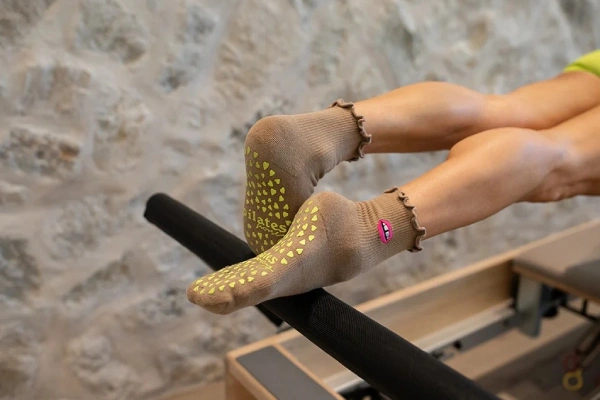
Lululemon’s grip socks sit under its Find Your Balance line — not one product, but a few studio-focused styles. It’s worth being precise about what each one is, because the grip story is not the same across the range.
- Grip Tab — low-cut tab style. Per Lululemon’s own product page, the grippers are on the outside, with mesh construction and light underfoot cushioning.
- Grip Crew — the same outside-grip approach in a higher-cut length for more ankle coverage.
- Grip Socks Strappy — an open-top strappy variant, again with grippers on the outside.
- Studio Tab — the one exception. It adds an inner silicone strip near the heel opening, plus 360° arch support and a foot-specific toe shape. The inner strip is mainly there to help keep the sock from slipping down on the foot.
This distinction matters. The inner silicone strip on the Studio Tab is designed to help the sock stay in place around the heel area. It is different from targeted internal grip under the footbed, which is used when a brand wants to reduce foot movement inside the sock during studio exercises.
The shared DNA across the line is a lightweight, breathable, good-looking studio sock built on a nylon-dominant knit, with mesh ventilation and light cushioning. The fair read on positioning: tuned for the studio regular on clean floors at light-to-moderate intensity, with breathability and aesthetics prioritized over aggressive full-coverage traction.
How Grip Socks Are Made — and What Each Choice Trades Off
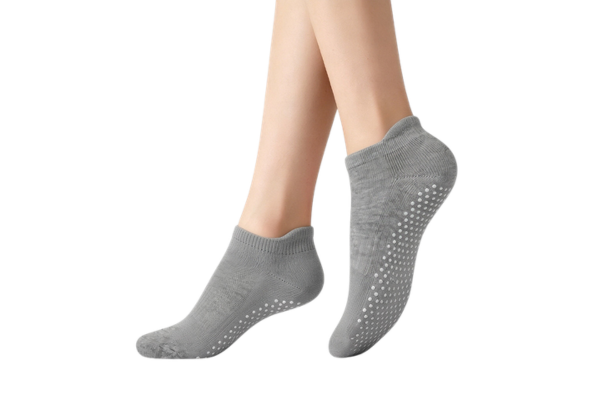
Once you see how a grip sock is built, the design reads as a chain of trade-offs. This is the part a normal review skips — and the part that decides whether the sock actually holds.
If you want the full picture, see our guide on how grip socks are made, from yarn selection to silicone application and packaging.
Low-Profile Sole Grip — Sleeker Feel, Less Lock-In
Grip is silicone, PVC, or rubber bonded onto the knit. Two things matter most: how much of the sole it covers, and how high the grip profile sits.
Lululemon runs a low-profile pattern, which keeps the sock thin and comfortable and avoids the “walking on beads” feel of chunkier grips. The trade-off is traction intensity.
A third-party test by Garage Gym Reviews described the gripper height as very minimal and noted that the socks did not feel as locked-in as some others tested. That points to a useful production trade-off: a lighter grip can feel cleaner and more comfortable, while fuller or higher-relief silicone usually gives a stronger sense of surface security.
For a brand, this is a positioning decision:
- If the product is for lifestyle studio use, low-profile grip can feel premium and comfortable.
- If the product is for high-sweat Pilates, hot yoga, barre, rehabilitation, or studio rental use, stronger coverage may be more important.
- If the sock is for reformer Pilates, the ball of foot, heel, and toe-loading zones need special attention.
The key is not simply “more grip is better.”
The better question is:
Where does the user load pressure, and how much traction do they need at those exact points?
Mesh Upper — More Air, Less Hold
Mesh breathes well, which genuinely helps in heated sessions. The trade-off is structural hold: a more open upper wraps and locks the foot less firmly than a denser knit, so it can shift more easily during side-loaded movement or footbar transitions.
Breathability is valuable, but it has to be balanced against hold somewhere else in the sock.
That support can come from:
- a compression arch band
- a more secure heel shape
- better elastic recovery
- stronger midfoot knit tension
- targeted internal grip placement
A breathable sock can still be stable, but ventilation cannot be treated as a stand-alone feature. It has to work together with the grip and structure.
Where the Grip Lives — and What It Actually Solves
Grippers on the outside anchor the sock to the carriage, mat, or studio floor. That solves the obvious problem: sock-to-surface slip.
But slip resistance has another layer: foot-to-sock movement.
A sock can grip the carriage well and still feel unstable if the foot moves inside the sock. This is most noticeable in planks, lunges, short-spine work, footbar transitions, and diagonal loading.
That is why slip resistance is best judged as a two-part system:
- Sock-to-surface: keeping the sock planted on the mat, floor, or carriage.
- Foot-to-sock: keeping the foot stable inside the sock.
Once you see the difference, the question changes. It is not just “Does the sock have grippers?” It is:
Does the sock grip the surface, and does the foot stay stable inside the sock during movement?
What Makes a Grip Sock Slip-Resistant — The Problem Most Miss
Ask a reformer regular what annoys them and you’ll often hear the same thing: the sole gripped the carriage fine, but the foot still moved inside the sock.
That is why a performance grip sock usually depends on three design levers working together.
1. External Sole Grip
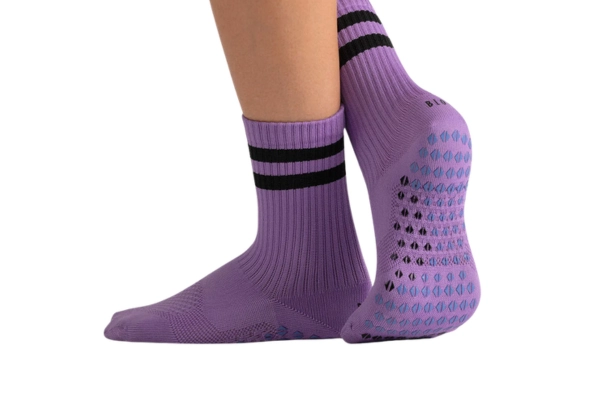
External sole grip is what keeps the sock connected to the mat, floor, or reformer carriage.
The main variables are:
- coverage area
- gripper height
- silicone hardness
- pattern shape
- heel and forefoot placement
- bonding strength
- wash durability
Heel-to-toe coverage gives stronger surface security. Targeted heel-and-ball grip feels lighter and more flexible. The right choice depends on the training surface and the user’s movement intensity, not just the look of the pattern.
2. Internal Grip Placement
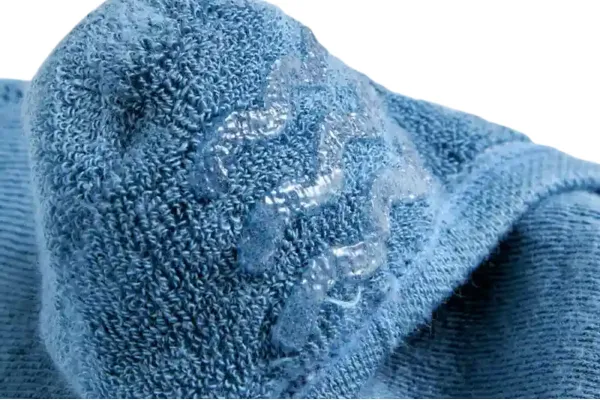
For brands that want stronger stability during Pilates, barre, or reformer movement, targeted internal silicone can be added under the heel, forefoot, or midfoot.
Combined with external sole grip, this dual-sided grip design helps improve contact with both the surface and the foot, reducing slipping on mats, floors, or equipment.
This is different from a heel-opening silicone strip. A heel-opening strip helps keep the sock from sliding down on the foot. Targeted internal footbed grip is designed for movement stability inside the sock.
For private-label development, the important questions are:
- Where should the internal grip sit — heel, forefoot, midfoot, or multiple zones?
- How much coverage is needed?
- Will it stay comfortable against the skin?
- Will it keep working after repeated washing?
- Does it work together with the arch band and sole grip?
This is why “dual-sided grip” should always be specified clearly. It is not enough to say “inside and outside grip.” A brand should define placement, coverage, thickness, and purpose.
3. Compression Arch Band
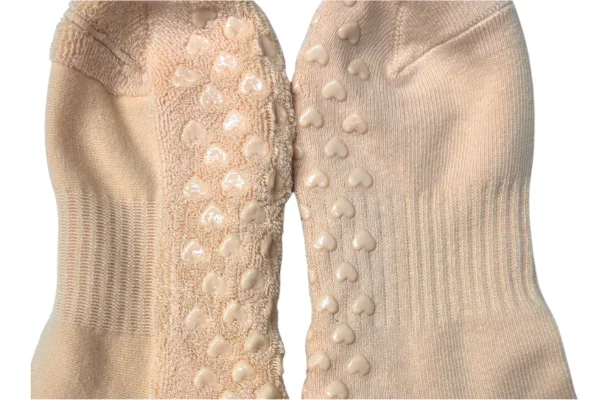
A compression arch band is one of the most important fixes for midfoot slide.
The midfoot is where many users feel the sock shift, twist, or loosen during Pilates and barre movement. A good arch band keeps the grippers aligned with the pressure points without making the whole sock thick.
For private-label development, the arch band can be adjusted by:
- compression strength
- width
- elastic recovery
- knit density
- placement across the arch
- comfort level for different foot shapes
For performance-focused socks, this is often where the product starts to feel more secure.
So when you judge any grip sock — Lululemon’s or anyone else’s — the question is not just “Does it have grippers?” It is:
Does it grip the surface, support the arch, and reduce movement inside the sock where the foot actually loads and slides?
For how the main studio brands line up side by side, see our comparison of Pilates grip socks across brands.
For Brands and Studio Operators: Specing Your Own Grip Sock
If you read the teardown above as a buyer, you now know what to look for. If you’re building a line, every design choice becomes a spec decision.
You can keep a breathable, clean studio feel while improving traction and foot-lock for your own customer base. It starts with the use case, not the silicone:
- Reformer, mat, barre, yoga, or mixed studio use?
- Clean floors or high-sweat conditions?
- Lifestyle studio sock or performance grip sock?
- Soft comfort or stronger lock-in?
- Retail, studio resale, DTC, Amazon, or club supply?
Once that is clear, the spec becomes much easier.
Grip
Grip spec can include:
- heel-to-toe vs targeted coverage
- external-only or dual-sided grip
- internal grip placement: heel, forefoot, or midfoot
- silicone height and softness
- pattern and logo integration
- heat-cured application for wash durability
- color-matched or contrast silicone
For high-performance Pilates socks, we usually recommend focusing on the heel, ball of foot, toe-loading area, and midfoot stability zone.
Structure
Structure spec can include:
- toe design: closed-toe, toeless, or five-toe
- cut: tab, ankle, quarter, or crew
- arch band strength
- heel shape
- cuff tension
- knit gauge
- logo and pattern clarity
Closed-toe socks feel warmer and more traditional. Toeless socks give a stronger barefoot connection. Five-toe socks support toe splay but require more careful sizing and production control.
Materials
Material choice affects comfort, durability, breathability, and brand positioning.
Common options include:
- cotton blend for soft everyday studio comfort
- bamboo blend for a softer hand feel and sweat-focused positioning
- nylon-dominant performance synthetic for durability and faster drying
- organic cotton for eco-positioned lines
- spandex or elastane for stretch and recovery
The best yarn is not always the softest one. It also has to bond well with silicone, hold shape after washing, and support the target grip performance.
Branding
For private-label grip socks, the product also has to fit the brand line.
A complete spec can include:
- custom yarn colors
- silicone color
- woven or silicone logo
- grip pattern with logo integration
- size range
- hangtag
- belly band
- individual polybag
- studio retail packaging
- barcode or FBA label support
- multi-color assortment planning
For studio operators, packaging may be simple. For DTC and Amazon brands, packaging and size/color planning are often just as important as the sock itself.
A Practical Spec Example
A line that likes Lululemon’s clean, breathable direction but wants stronger performance might spec:
| Spec Item | Recommendation |
| Product Type | Pilates / reformer grip sock |
| Cut | Low tab or ankle |
| Upper | Breathable mesh or ventilated knit |
| Arch | Medium-to-strong compression arch band |
| External Grip | Heel-to-toe silicone coverage |
| Internal Grip | Targeted heel + forefoot anti-slip zones |
| Cushioning | Light underfoot |
| Material | Cotton blend or nylon-dominant performance blend |
| Best For | Pilates studios, DTC activewear brands, boutique fitness, Amazon private label |
This keeps the light studio feel but improves two areas many grip socks under-engineer: traction coverage and foot-to-sock stability.
What Sourcing With Us Can Include
| Item | Details |
| MOQ | 800 pairs per design for customization; stock options from 500 pairs mixed |
| Sample Lead Time | 3–7 days |
| Bulk Lead Time | 3–4 weeks |
| Customization | Grip coverage and profile, inside/outside application, arch band, toe design, knit gauge, yarn and silicone color, logo, packaging |
| Materials | Cotton blend, bamboo blend, performance synthetic, organic cotton |
| Compliance | OEKO-TEX Standard 100, BSCI, ISO 9001 support available |
As a custom grip socks manufacturer, we turn these decisions into a production-ready spec. The safest path for a new line is not approving a sock from a photo. It is testing samples on the actual surfaces your customers use.
Test them dry. Test them lightly damp. Test them through real reformer transitions. Check both that the sock grips the surface and that the foot stays stable inside it.
Explore our custom Pilates grip socks, compare different Pilates grip sock styles, or view our full grip socks range to plan your next collection.
FAQs
Are Lululemon grip socks good for reformer Pilates?
They can work well on clean studio floors at light-to-moderate intensity, where breathability matters most. For high-sweat reformer, hot yoga, or more demanding studio use, some buyers may prefer fuller silicone coverage, a stronger arch band, or targeted internal grip.
Why do my feet slide inside grip socks even when the sole grips?
Sole grip mainly solves sock-to-surface slip. If your foot moves inside the sock, that is foot-to-sock movement. A better fit, stronger arch band, and targeted internal grip placement can help reduce it.
What is the difference between external grip and internal grip?
External grip is on the outside sole and helps the sock grip the mat, floor, or carriage. Internal grip is placed inside the sock, usually under specific footbed zones, to help reduce foot movement inside the sock during exercise.
Is a heel-opening silicone strip the same as internal footbed grip?
No. A heel-opening silicone strip helps keep the sock from slipping down on the foot. Internal footbed grip is placed under the foot to improve stability during movement. They solve different problems.
Should a brand choose full-coverage or targeted grip?
Full heel-to-toe coverage gives more surface security for performance Pilates, barre, and studio rental use. Targeted heel-and-ball grip feels lighter and is often enough for casual yoga or lifestyle socks. The training surface and intensity should decide the spec.
Can you make a breathable grip sock with stronger traction?
Yes. It is a spec question, not a fixed trade-off. A breathable upper can be paired with fuller sole coverage, targeted internal grip, and a compression arch band. The goal is not to make the sock thick everywhere, but to reinforce the zones where the foot actually loads and slides.