

The Short Answer
The daytime question — when to put them on and how long to keep them on — is covered in when to wear compression socks and how long each day.
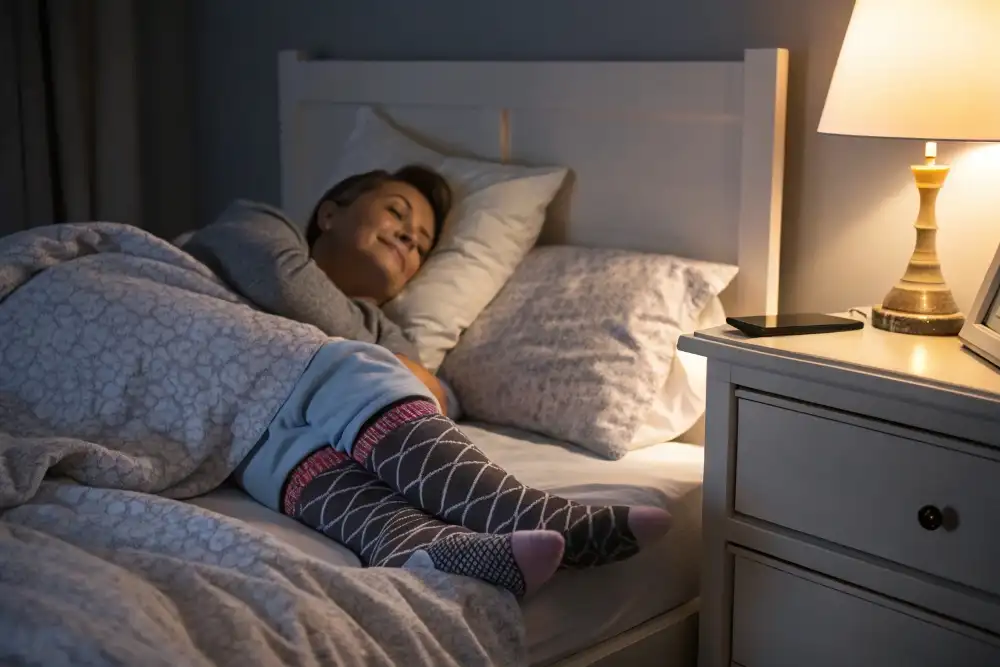
Generally, you should not wear compression socks overnight. They are designed to counteract gravity while you are upright. When you lie flat, that pressure is unnecessary and can, in the wrong circumstances, restrict circulation rather than support it. Wear them at night only if a clinician has told you to for a specific condition.
This is not a fringe position — Cleveland Clinic advises putting them on in the morning and taking them off before bed, for the same reason: the benefit exists when you are up and moving and gravity is working on your veins.
That is the verdict, and whether it is safe in your particular case depends on things a general article cannot know about your legs.
What this page covers is the part most advice skips: what physically happens over those eight hours — to your circulation, to your skin, and to the sock itself, which does not stay the same garment it was at bedtime.
What Compression Actually Does While You Are Upright
To see what changes at night, you have to be clear about what compression is doing during the day.
Standing, the blood in your leg veins has to travel roughly a metre upward against a continuous column of pressure. Your veins have one-way valves to stop it falling back, but valves do not push. What pushes is your calf: every step compresses the deep veins between muscle and bone and squeezes blood toward the heart. This is the calf muscle pump, and it does the overwhelming majority of the work.
A graduated compression sock supports that system in one specific way. It is tightest at the ankle and progressively looser up the calf, so it narrows vein diameter most where the gravitational load is highest. Narrower veins mean the valves close more completely and blood moves upward instead of pooling.
Every part of that description depends on you being vertical.
What Changes the Moment You Lie Down
The gravitational column disappears. Your legs come to roughly heart level, and the pressure differential the sock was engineered against is gone. A gradient calibrated for a standing leg is now applying its firmest pressure at the ankle of a leg that no longer needs it there.
The calf pump stops. You stop moving, and the mechanism that moves most of the blood shuts down for the night. No garment replaces it — a sock is a passive constraint, not a pump.
Your peripheral vessels widen. Blood pressure and heart rate fall during deep sleep and peripheral vessels dilate. The leg inside the sock is not the same leg that put it on.
Fluid redistributes. Some of what accumulated in your lower legs during the day moves back into circulation once you are horizontal. This happens whether or not you are wearing anything, and it is the main reason ankles are slimmest in the morning. That point comes back below.
What Happens to the Sock Over Eight Hours
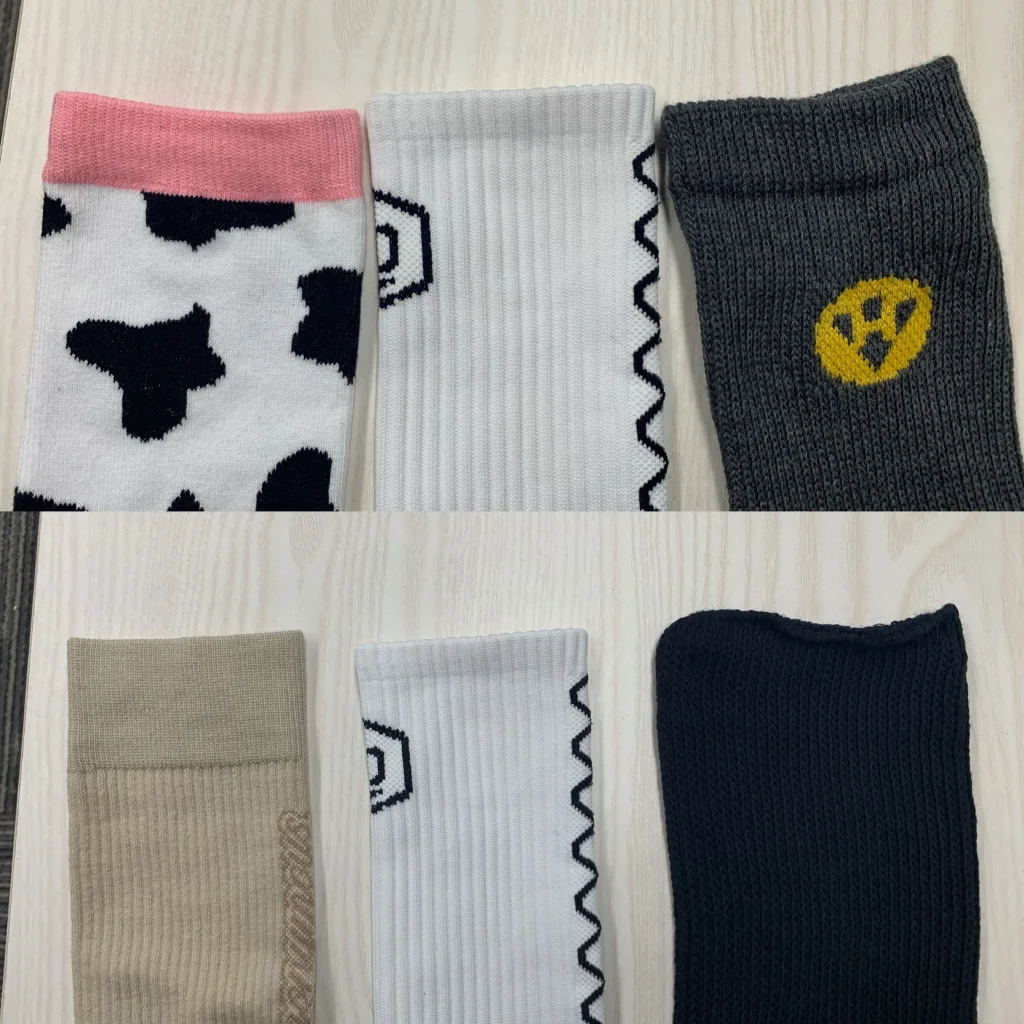
This is the part a factory sees and a wearer does not: the welt, the fold behind the knee and the toe seam are specified for a working day, not for a night. Brands asking for extended-wear styles change exactly these three — see custom compression socks for how they are specified.
This is the part almost nobody writes about, and the part we can speak to directly.
The compression value printed on a package is measured on a new garment, stretched over a standard leg former, at room temperature. It is a specification, not a promise about hour seven.
Elastane under sustained strain does not hold a constant force. Held at a fixed extension, the tension it exerts decays — a normal property of the polymer, not a defect. During the day this barely matters, because you move constantly: every step loads and unloads the yarn and it recovers between cycles. Overnight there is no unloading cycle. The sock sits at one extension, at body temperature, in a humid microclimate, for eight uninterrupted hours. Heat and moisture both accelerate the decay.
So the sock softens overall, while getting worse in the three places that matter.
The welt migrates and concentrates
As overall tension drops, the top band loses grip and begins to slide. A sock that slips a few centimetres and folds concentrates all its remaining pressure into a narrow ring, in the one place you cannot see or feel it happening. Overnight complaints start at the top band, not the ankle.
A fold behind the knee lands on a nerve
The fibular nerve runs close to the surface on the outside of the knee. A folded band sitting over it applies sustained point pressure to a structure with no padding, which is the usual explanation for waking with a numb outer calf.
The toe seam has nowhere to go
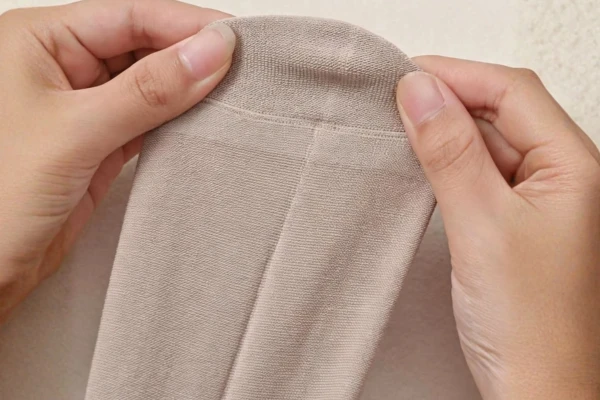
During the day, a raised toe seam is relieved dozens of times an hour by movement. Motionless, it presses on the same few square millimetres all night. This is why hand-linked or seamless toe construction matters more for extended reclining wear than for daytime use, and it is one of the things separating a garment actually built for overnight wear from a daytime sock with a smaller number on the label. The fit and construction details that matter for overnight wear are a different specification, not a different size.
The other two parts of that specification are the welt and the yarn. A welt meant for long wear is wider and has the elastane knitted through it rather than relying on a separate elastic band, so it holds by spreading the load instead of gripping at one narrow ring — which is what stops it sliding into the fold described above. And the body yarn moves away from heavy nylon toward cotton, bamboo viscose or merino blended with elastane, so skin that is not being aired stays drier through the night. On our side, extended-wear styles are closed with either a hand-linked or a seamless toe, and the welt and body yarn are specified per style.
What Happens to Your Skin
Eight hours of sustained pressure, in a warm and humid layer, without position changes, is a specific set of conditions.
Skin under continuous compression cannot shed moisture normally. Trapped moisture softens the outer layer — maceration — and macerated skin tears and abrades at pressures that would not mark healthy skin. That is why the risk is disproportionately higher for anyone whose skin is already fragile.
The pressure points that develop are predictable: the top band, the heel where the sock is under most tension, and the toe seam. Those three places are where you look in the morning.
The complicating factor is that the normal feedback loop is switched off. During the day, a sock that is too tight becomes uncomfortable and you adjust it. Asleep, you do not. For anyone with reduced sensation — advanced peripheral neuropathy in particular — that feedback loop is absent even while awake, which is why it is one of the situations where overnight compression is off the table entirely.
Who Overnight Compression Is Actually Prescribed For
The limits — which pressures are tolerable overnight and who should never wear compression to bed — are set out in is it safe to wear compression socks to bed. The situations below are the supervised exceptions, and they use the medical compression tier rather than an everyday sock.
There is a real list, and it is short.
Post-surgical immobility. A patient who cannot walk has no calf pump at all, day or night. That is the situation anti-embolism stockings exist for. NHS guidance is to wear them as much of the time as possible, day and night, until you are back to your usual level of activity — and note that these are a different product, at lower pressure, with a profile calibrated for a reclining leg rather than a standing one.
Lymphedema during intensive therapy. Management often calls for round-the-clock compression to hold fluid balance, again with night-specific garments rather than standard socks.
Severe venous insufficiency, post-thrombotic syndrome, and healing venous ulcers. Some protocols extend compression stockings at night where daytime compression alone has not controlled symptoms or the wound is not closing.
What these share is a diagnosis, a specified pressure, and someone examining the leg regularly. None of them describes a healthy person putting on a 20–30 mmHg sport sock before bed.
“But My Ankles Look Better in the Morning”
This is the most common reason people conclude overnight compression is working, and it deserves a straight answer rather than a dismissal.
Your ankles do look better in the morning. They would have anyway. Lying down redistributes accumulated fluid regardless of what you are wearing, which is why swelling is at its daily minimum when you wake and builds through the day. Attributing that to the sock is an easy mistake because the timing lines up perfectly.
The useful comparison is not “socks versus nothing.” It is socks overnight versus compression worn for a while with your legs raised in the evening and taken off to sleep. Most people find the second produces the same morning without the welt marks — that and the other alternatives to sleeping in compression socks are where we would start for anyone asking this question without a diagnosis.
Telling Adaptation Apart From a Problem
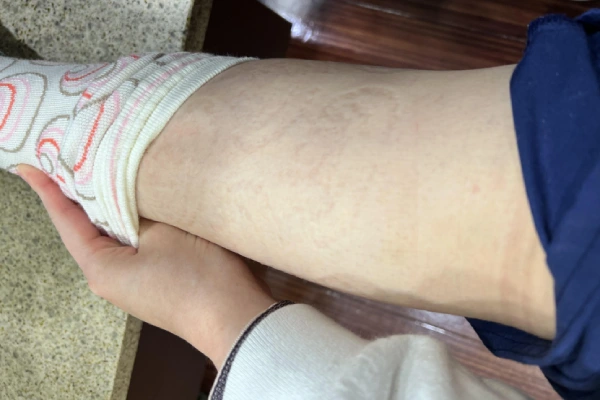
New compression feels tight. That is normal and it settles. These do not settle, and none should be waited out until morning:
- Pain during the night, as opposed to awareness of pressure
- New numbness or tingling, especially on the outer calf below the knee
- Toes that look dusky, blue or unusually pale
- Indentations still visible twenty minutes after removal
- Any broken skin at the welt, heel or toe seam
If you wake with any of these, take the socks off and do not wear them overnight again until someone has examined the leg.
FAQs
What happens if you accidentally sleep in compression socks once?
For a healthy person, almost certainly nothing. You may wake with a visible ring at the top band that fades within the hour. A single night is not the concern; a nightly habit at daytime pressure is.
Do compression socks lose their compression if you sleep in them?
They lose tension faster than during equivalent daytime wear, because there is no unloading cycle for the elastane to recover through, and body heat and moisture accelerate the process. Whether that is permanent depends on the yarn and how often it is repeated.
Why do my legs feel worse in the morning after wearing them overnight?
Usually the sock migrated. A garment that slips and folds concentrates pressure into a narrow band instead of distributing it, producing the opposite of the intended effect.
Is it different for anti-embolism stockings?
Yes. Those are a separate product at 8–18 mmHg, with a profile calibrated for a reclining leg. Continuous overnight wear is their design intent, not an exception to it.
Can I sleep in them if I take them off partway through the night?
If you are considering that, wearing compression in the evening with your legs elevated and removing it before sleep achieves the same thing more reliably, and without setting an alarm.